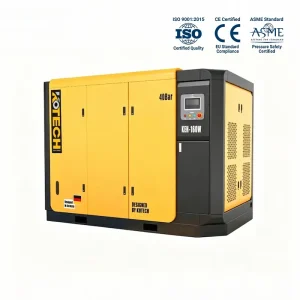
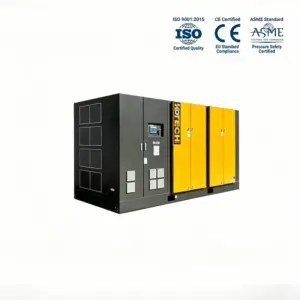
A modern spinning mill rarely stops. Ring frames, spinning preparation, winding, and automatic doffing and cleaning systems draw compressed air across three shifts, and in many textile plants the air compressor station is one of the largest single consumers of electricity. A two-stage screw compressor with a variable speed drive is well matched to that load: it compresses air more efficiently than a single stage when the mill runs hard, and the VSD trims output automatically when production or shifts reduce demand.
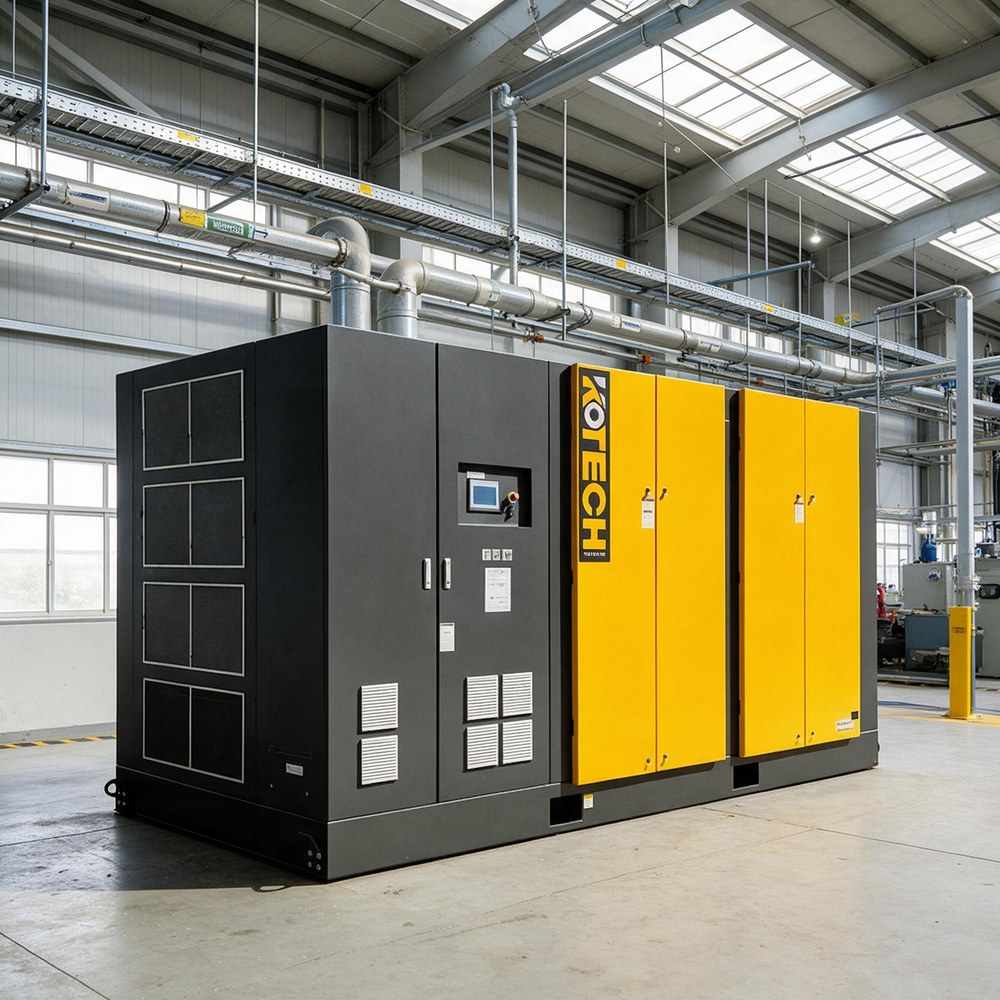
How spinning mills use compressed air
Textile plants use compressed air in almost every department. In spinning, air operates pneumatic controls and actuators, automatic doffing and splicing functions, suction and cleaning systems, and the valves and cylinders that keep material moving through preparation, ring spinning, and winding.
Two features of this load matter for compressor selection. First, it is continuous: the mill runs long shifts, often close to 24 hours a day, so a small efficiency gain per cubic meter is multiplied into a very large annual saving. Second, it is variable: demand changes between departments, shifts, and maintenance windows, and it rarely stays exactly at the nameplate value of a fixed machine.
Why two-stage compression fits a continuous load
In a two-stage screw compressor, air is compressed in a first airend, cooled between stages, and then compressed further in a second airend. Splitting the pressure rise over two stages, with cooling in between, reduces the work needed to reach a given pressure and lowers discharge temperature compared with forcing the full pressure ratio through one stage.
For a mill that runs thousands of hours per year, that lower energy per unit of air is the main benefit. The machine is simply cheaper to run at the high utilisation typical of textile production, and the cooler compression process supports longer lubricant and component life.
- Lower specific energy than single-stage compression at typical mill pressures.
- Lower discharge temperature supports reliability in long shifts.
- Particularly effective in high-utilisation plants that run nearly nonstop.
- Available across a wide power range to match mills of different sizes.
What the variable speed drive adds
A variable speed drive changes motor and airend speed so the compressor output follows actual air demand. Instead of running fully loaded and then unloading, or cycling on and off, a VSD machine raises and lowers the amount of air it produces while keeping system pressure stable within a narrow band.
That matches the real demand pattern of a spinning mill. Production changes between day and night, departments start and stop, and weekend or maintenance loads are lower. A fixed-speed machine wastes energy during those periods and can cause pressure swings; a VSD machine trims back and reduces both energy use and wear from frequent loading and unloading cycles.
- Output follows demand, cutting energy use during lower-load shifts.
- Stable pressure protects sensitive pneumatic controls and splicing.
- Frequent start-stop and blow-off losses are reduced.
- Two-stage efficiency and speed control combine across the full load range.
Real KOTECH two-stage compressor models
Current KOTECH two-stage models with free air delivery, working pressure, and motor power from the product page specifications. VSD variants carry variable speed control on the same frame.
The table lists real KOTECH two-stage models with and without VSD, showing free air delivery, working pressure, and motor power. The VSD versions are distinguished in the model name, allowing a mill to compare fixed and variable speed options for the same frame.
Sizing the compressor station for a mill
Sizing should be based on measured air demand rather than the connected equipment list alone. Logging pressure and load over at least a week shows the true base load, the peaks, and how low demand falls between shifts, which is exactly the information needed to combine machines and decide how much capacity should be variable speed.
- Log demand across shifts and weekends before fixing station capacity.
- Identify the continuous base load and the variable portion separately.
- Use a VSD machine to cover the varying part of the demand.
- Allow a margin for expansion and for air leaks, then fix leaks aggressively.
- Keep pressure at the minimum the equipment genuinely needs.
Air quality and maintenance in textile plants
Textile environments contain fine fibers and dust, which is why the compressor intake and ventilation must be considered carefully. A clean, cool air supply improves both efficiency and reliability, while blocked intake filters or fouled coolers raise discharge temperature and energy use. In areas where air contacts product or sensitive controls, filtration and, where needed, dryers protect against moisture and oil carryover.
Because the mill depends on continuous air, maintenance is best planned rather than reactive. Monitoring discharge temperature, pressure, and filter condition, and servicing airends, belts or couplings, lubricant, and separators on schedule, prevents an unplanned compressor stop from halting spinning lines. In multi-machine stations, scheduled servicing can be rotated without losing redundancy.
What to check when choosing a mill compressor
- Measure air demand over a full week including shift and weekend changes.
- Choose two-stage compression if the mill runs a high number of hours.
- Put the variable part of the load on a VSD machine rather than oversizing.
- Plan a clean, cool intake and protect the station from fiber and dust.
- Specify filtration and drying to match the most sensitive end use.
- Design the station with redundancy so servicing does not stop spinning.
Frequently asked questions
Why does a spinning mill need a two-stage compressor?
Does a VSD compressor save energy if the mill runs nonstop?
What pressure do textile plants typically need?
How do I size a compressor for a spinning mill?
Does the dusty textile environment damage the compressor?
Should the whole station use VSD machines?
If your spinning mill is expanding or replacing an ageing compressor station, KOTECH can help combine two-stage fixed and VSD machines from measured demand.
Related Applied Cases