Key Takeaways
Most plant managers know two-stage compressors save energy. But ask them why, and you’ll often get a blank stare. The simple truth is this: two-stage compression reduces the work required to compress air by keeping the process closer to ideal thermodynamic conditions.
Single-stage compressors do all the work in one go. That generates intense heat, spikes power draw, and increases internal air leakage. Two-stage compression splits the job, cooling the air between stages, which cuts the power needed for the second stage.
Field data backs it up: two-stage units cut specific energy consumption by 15% to 20% compared to single-stage models. For a mid-sized factory running 24/7, that adds up to tens of thousands in annual electricity savings—with payback typically in 10 to 18 months.
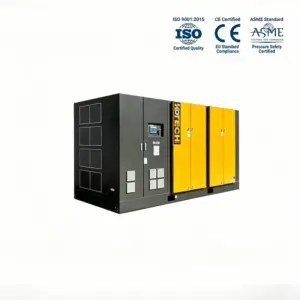
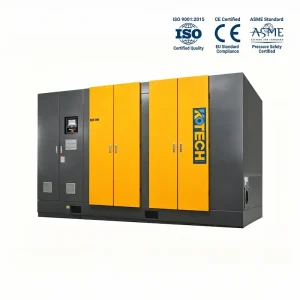
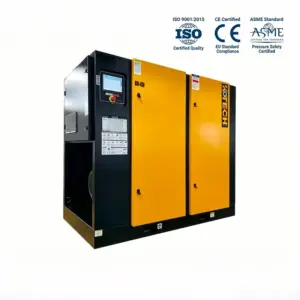
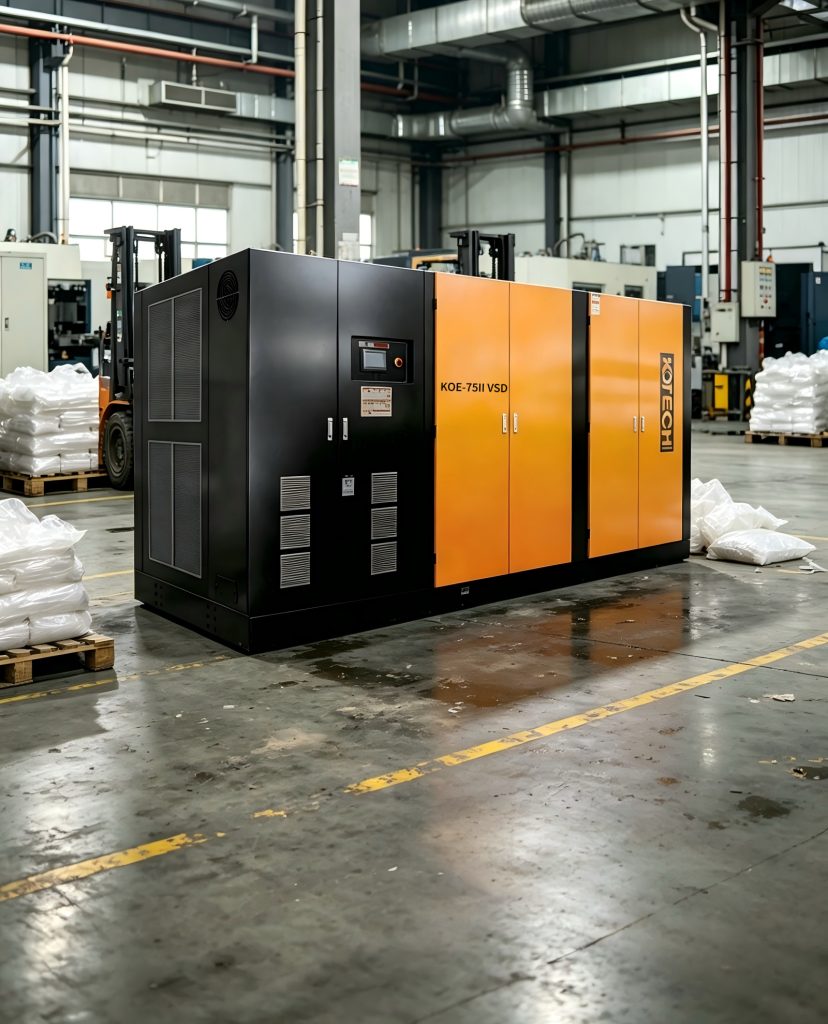
KOTECH’s KOE-II two-stage compressors deliver this efficiency with Siemens components and stable ±0.02MPa pressure output. They’re a proven upgrade for facilities tired of high electricity bills.
The Simple Principle Behind the Savings
Here’s the core idea: compressing air generates heat. Lots of it. And that heat is wasted energy.
In a single-stage compressor, air goes from atmospheric pressure to final discharge pressure in one step. The temperature spike is significant—compression ratios of 8:1 or higher can push discharge temperatures well above 200°C. This heat doesn’t just disappear; it hurts efficiency in three ways:
- More power needed: Hot air is harder to compress, forcing the motor to work harder
- Less air taken in: Heat makes air expand, reducing how much fresh air the compressor can draw
- More internal leakage: Higher temperatures and bigger pressure gaps increase air seepage inside the airend
A two-stage compressor solves these problems by splitting the work. Air is partially compressed in the first stage, cooled through an intercooler, then compressed to final pressure in the second stage. The intercooler removes heat between stages, bringing the air back toward ambient temperature before the second stage.
The result: The compression process stays closer to ideal isothermal (constant temperature) compression, which requires the minimum possible energy.
Why the 15%–20% Energy Saving Is Real
Industry data confirms two-stage compression consistently delivers 15%–20% lower specific energy consumption than single-stage alternatives.
| Metric | Single-Stage | Two-Stage | Saving |
|---|---|---|---|
| Specific energy consumption | Baseline | 15–20% lower | 15–20% |
| Discharge temperature | High (200°C+) | Lower (with intercooling) | Reduced wear |
| Internal leakage | Higher | Lower | Improved efficiency |
| Volumetric efficiency | Lower | Higher | More air per kWh |
The two key technical reasons:
- Lower pressure differential per stage: Each stage has a lower compression ratio (e.g., 3:1 + 3:1 vs. 9:1). This reduces internal air leakage—a major efficiency loss in screw compressors.
- Intercooling gets you closer to isothermal: The air is cooled between stages, reducing thermal expansion and the work required for the second stage. The whole process runs closer to ideal thermodynamic conditions.
A Real Story: When a Factory Finally Did the Math
A plastics factory in southern China had been running two 75kW single-stage compressors for eight years. The plant manager, Mr. Chen, noticed his electricity bill creeping up despite stable production. His maintenance team told him it was normal wear and tear.
He asked us to run a 30-day energy audit. Here’s what we found:
| Metric | His Existing Setup (75kW Single-Stage) | KOTECH KOE-II 75kW Two-Stage |
|---|---|---|
| Average power consumption (kWh/day) | 1,426 | 1,150 |
| Annual electricity cost | ~$23,500 | ~$18,900 |
| Pressure fluctuation | ±0.08MPa | ±0.02MPa |
| Oil change frequency | Every 1,500 hours | Every 2,500 hours |
The savings: $4,500 per year in electricity alone. Combined with reduced maintenance, the payback was under 18 months.
Mr. Chen’s response: “So I’ve been paying an extra $4,500 a year in electricity, and I didn’t even know it.”
Technical Breakdown: What Happens Inside a Two-Stage Compressor
Stage 1: Low-Pressure Compression
Air enters through the inlet filter and passes into the first-stage airend. It’s compressed to an intermediate pressure—typically around 2.5 to 3.5 bar—and heats up. Oil is injected for cooling, sealing, and lubrication.
Intercooling
The hot compressed air-oil mixture passes through an intercooler. This is where the magic happens: heat is removed before the second stage, bringing air temperature back down. This cooling step is what makes two-stage compression more efficient.
Stage 2: High-Pressure Compression
The cooled air enters the second-stage airend, where it’s compressed to final discharge pressure (typically 7–10 bar). Because the air entered cooler, the second stage requires less work.
Key Technical Features That Enable the Savings:
- Efficient rotor profiles: Advanced rotor designs minimize internal leakage
- Balanced pressure ratio distribution: Each stage handles a fair share of the compression load
- Precise oil injection: Proper oil flow controls temperature and seals clearances
- Intelligent control: Modern PLC systems adjust operation to match demand
What This Means for Your Factory
| Your Situation | Recommended Action | Expected Benefit |
|---|---|---|
| Running single-stage compressors >5 years | Conduct an energy audit | Identify actual saving opportunities |
| Electricity costs >$0.10/kWh | Two-stage upgrade likely pays back in <18 months | Return on investment in 12-18 months |
| Running 24/7 production | Two-stage is almost always the right choice | Maximize savings on continuous operations |
| Fluctuating air demand | Consider VSD two-stage (KOE+ series) | Additional 10–40% savings |
KOTECH KOE-II Two-Stage Compressors
KOTECH’s KOE-II series two-stage screw compressors are engineered for maximum efficiency, combining British engineering heritage with Siemens core components:
- Up to 20% energy saving compared to single-stage models
- Stable ±0.02MPa pressure output for consistent production quality
- Siemens motors and airends for reliability and precision control
- Available VSD option for variable-load applications
- 40%+ longer airend life in high-temperature environments
- Full compliance with international energy and air quality standards
Conclusion
Two-stage compression isn’t complicated technology. The principle is simple: compress, cool, compress again. By removing heat between stages, the process stays closer to ideal thermodynamics, reducing the energy required for compression.
The 15%–20% energy saving is real, documented, and achievable in most industrial applications. For facilities running 24/7 production, the upgrade typically pays for itself within 10 to 18 months—just from electricity savings alone.
If your compressed air system hasn’t been evaluated in the last three years, you’re likely paying more than you should. The technology works. The payback is proven. The only question is: why wait?
Frequently Asked Questions
Q1: What’s the principle behind two-stage compression energy savings?
Two-stage compression splits the compression work and cools the air between stages, keeping the process closer to ideal isothermal compression. This reduces the energy required compared to single-stage compression, where all the work is done in one step with significant heat generation.
Q2: How much energy can I save with a two-stage compressor?
Industry data shows 15% to 20% reduction in specific energy consumption compared to single-stage compressors. For facilities running 24/7, this typically translates to a payback period of 10 to 18 months.
Q3: What’s the difference between single-stage and two-stage compressors in practical terms?
Single-stage compressors do all compression in one step, generating high heat and increasing internal leakage. Two-stage compressors use low-pressure compression, intercooling, and high-pressure compression. This approach lowers discharge temperatures by 22°C to 30°C and extends service life by over 40%.
Q4: Does two-stage compression work with VSD?
Yes. Two-stage compressors with VSD can deliver additional 10%–40% savings in variable-load applications, making them ideal for factories with fluctuating air demand.
Q5: How do I know if my facility should upgrade to two-stage?
If your single-stage compressor is more than 5 years old, runs 24/7, or if your electricity costs are high, a two-stage upgrade likely makes financial sense. A professional energy audit can confirm savings potential.
Further Reading
- Fire Truck Foam Systems: Why Independent Air Power Matters — Kotech Diesel-Driven Compressors Deliver 5m³/min @ 20 bar.
- 5 Questions You Must Answer Before Buying an Air Compressor.
- Oil Refineries, Chemical Plants, Ports, and Industrial Sites — Kotech’s Diesel Air Compressor Powers Foam Systems Where It Matters Most.
- Pure Air, Zero Risk: KOTECH Oil-Free Compressors for Airports.
- 2-stage compressors provide a more stable pressure source than single-stage compressors – Single-Stage or Tw
- Could a Drop of Oil Ground Your Entire Fleet? KOTECH Oil-Free Compressors Keep Airport Operations Safe.
- Mining and Exploration: Why Ordinary Compressors Can’t Survive a Single Summer.
- Pure Air, On Demand: KOTECH Oil-Free Compressors Keep Airports Operating Without Interruption.
Related Applied Cases