Key Takeaways
If you’re in the market for an industrial air compressor, you’ve likely faced one critical question: single-stage or two-stage? Many buyers underestimate just how much this choice impacts daily operations. It directly affects your monthly energy bill, production consistency, and long-term maintenance costs.
The difference is straightforward. A single-stage compressor compresses air in one full step. A two-stage compressor breaks the process into two parts: initial low-pressure compression, intermediate cooling, then final high-pressure compression. This staged design brings the compression cycle much closer to the ideal isothermal process, which uses the least energy possible.
Real-field data backs up the efficiency gap. Two-stage compressors lower specific energy consumption by 15% to 20% compared to single-stage models under ISO 1217 standard conditions. For a 160kW compressor running 4,000 hours per year, that means roughly $18,400 in annual electricity savings. Most mid-sized and large industrial plants fully recover their investment within 10 to 18 months.
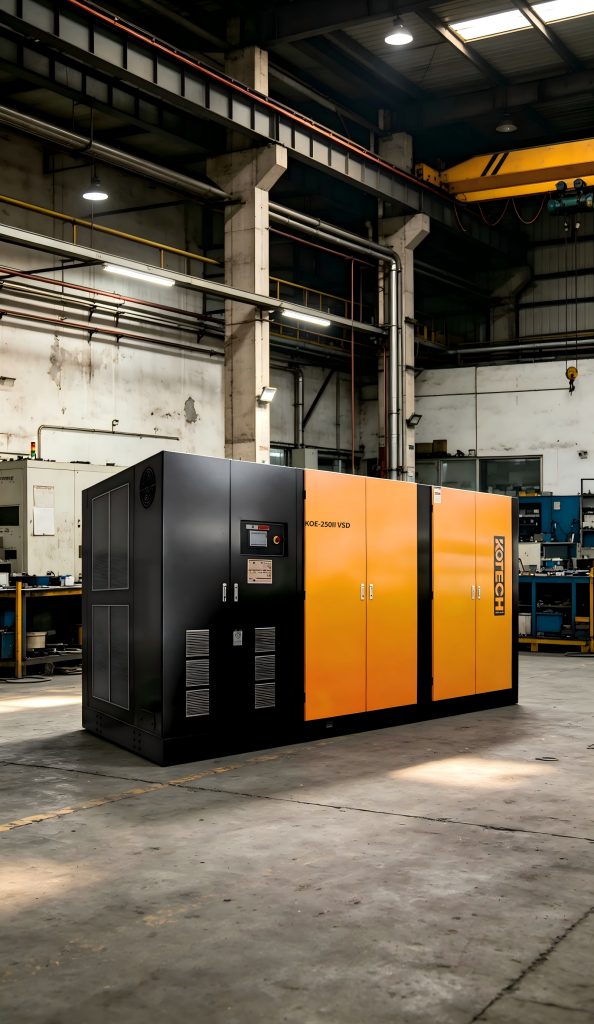
KOTECH’s KOE-II series two-stage compressors deliver reliable efficiency with pressure stability within ±0.02MPa and longer component life. For heavy-duty industrial applications — mining, automotive manufacturing, food processing, pharmaceuticals, and energy — the choice is increasingly clear.
Single-Stage vs. Two-Stage: What’s the Real Difference?
The real difference boils down to how many compression cycles air goes through before reaching your required final pressure. Each compression cycle counts as one “stage.” The more stages, the closer the system runs to ideal isothermal compression, where air is compressed at a consistent temperature with minimal energy waste.
How a Single-Stage Compressor Works
In a single-stage compressor, air is compressed just once. It enters the cylinder, is compressed to the target pressure in one pass, moves through a basic cooling stage, and enters the air supply system.
When compression ratios rise above 8:1, discharge temperatures often exceed 200°C. This extreme heat hurts efficiency in three clear ways. Hot air demands more power to compress, increasing motor load. Thermal expansion reduces the volume of fresh intake air. Higher temperatures and wider pressure gaps also increase internal air leakage inside the airend.
Single-stage compressors are simpler, have fewer parts, cost less upfront, and are easier to maintain. But efficiency drops noticeably under continuous high-pressure operation. Long-term load tests show single-stage machines can lose 5–8% efficiency each year due to heat-related damage and wear.
How a Two-Stage Compressor Works
Two-stage compression divides the workload into two connected steps. First, low-pressure compression: air enters the first-stage rotor and is compressed to an intermediate pressure, typically 2.5–3.5 bar. Next, intercooling: the hot air-oil mixture passes through an intercooler that removes 85–90% of compression heat. Finally, high-pressure compression: cooled air enters the second-stage rotor and is compressed to final pressure, usually 7–13 bar.
The result is a compression cycle much closer to ideal isothermal performance, using significantly less energy overall. Advantages include lower discharge temperatures, reduced internal leakage, better volumetric efficiency, and higher air output per kilowatt-hour.
Why Two-Stage Compression Is 15–20% More Efficient
Industry testing consistently shows that two-stage compressors use 15–20% less specific energy than single-stage alternatives. This improvement comes from two core design advantages.
Lower Pressure Differential Per Stage
In a single-stage compressor, the entire pressure increase occurs in one step. If you need a 9:1 compression ratio, the unit handles the full load at once. In a two-stage system, the load is split — for example, 3:1 in the first stage and 3:1 in the second. Compressing air in smaller increments is thermodynamically more efficient. Energy input relates directly to pressure ratio, so dividing a large ratio into smaller steps reduces total power use. It also cuts internal air leakage, one of the largest efficiency losses in screw compressors.
Intercooling Enables Near-Isothermal Operation
The intercooler is where the largest efficiency gains happen. After the first stage, it removes 85–90% of compression heat before air enters the second stage. As air cools, its volume drops significantly. The second stage then compresses a smaller volume to reach final pressure, requiring much less work. This single step brings the entire system closer to ideal isothermal compression — the most energy-efficient thermodynamic cycle available.
Combined real-world benefits:
- Discharge temperature reduced by 22°C to 30°C
- Internal operating losses lowered by about 11%
- Vibration reduced by 27%
- Maintenance intervals extended by more than half
A Real Story: What 15–20% Energy Savings Looks Like
A packaging manufacturer running multiple production lines struggled with rising operating costs and inconsistent product quality. The plant replaced its single-stage compressors with KOTECH KOE-250VSD II two-stage units.
The results were immediate and measurable. Energy consumption fell by 35% from baseline. Carbon emissions decreased by 30%. Operating noise dropped below 65 dB. Maintenance intervals extended to 8,000 hours. The plant manager reported that energy savings exceeded projections, product quality stabilized thanks to ±0.02MPa pressure control, and longer service intervals greatly reduced downtime and operating costs.
Where Two-Stage Compressors Deliver the Most Value
Two-stage compression is not ideal for every situation, but it provides clear advantages in specific industrial environments.
In 24/7 manufacturing, two-stage compressors maintain peak efficiency year-round, while single-stage units lose 5–8% efficiency annually. For high-pressure operations between 10–12.5 bar, two-stage design delivers stable high-pressure output naturally. In precision industries such as food, pharmaceuticals, and electronics, stable ±0.02MPa pressure reduces scrap and provides ISO 8573-compliant air with ≤2ppm oil content. For operations with fluctuating air demand — such as shift-based production or batch processing — two-stage compressors with VSD cut no-load waste by 32–40%. In high-temperature factory settings, built-in intercooling lowers discharge temperatures by 22–30°C and extends airend life by more than 40%.
What to Look for in a Two-Stage Compressor
If you’re considering an upgrade, focus on these practical specifications:
- 15–20% lower specific energy use than single-stage models
- Pressure range of 7.5–13 bar for most industrial applications
- Air delivery matched to actual demand, not just nameplate capacity
- Pressure stability of ±0.02MPa or better
- IE4 premium efficiency motors with IP54/IP55 protection
- ≤2ppm residual oil and ISO 8573 compliance
- PLC control with intelligent load management
- Available VSD option for variable air demand
KOTECH KOE-II Two-Stage Compressors
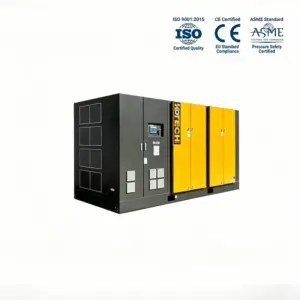
KOTECH’s KOE-II series two-stage screw compressors are engineered for industrial-grade efficiency and reliable performance.
- Up to 20% lower energy use compared to single-stage models under ISO 1217 conditions
- ±0.02MPa ultra-stable pressure output for consistent production quality
- Siemens motors and controls for dependable operation and precision regulation
- Optional VSD for an additional 32–40% reduction in no-load energy consumption
- Airend life extended by more than 40% in high-temperature environments
- ISO 8573 compliance with ≤2ppm residual oil, suitable for food, pharma, and electronics applications
Conclusion
Choosing between single-stage and two-stage compressors is simple once you understand real-world performance. Single-stage machines compress air in one step — simple, low upfront cost, but thermodynamically inefficient. Two-stage compressors split the work, remove heat between stages, and run much closer to the ideal isothermal cycle that uses the least energy.
The 15–20% energy savings are real, field-proven, and achievable in most industrial settings. For facilities running 24/7 operations, the upgrade typically pays for itself within 10 to 18 months. When combined with longer component life, less frequent maintenance, and more stable pressure output, the case for two-stage compression becomes even stronger.
KOTECH’s KOE-II series two-stage compressors deliver these efficiency gains in demanding industrial applications — mining, automotive, food processing, pharmaceuticals, and energy. The technology is proven. The payback is measurable. The only remaining question is: why wait?
Frequently Asked Questions
Q1: What’s the practical difference between single-stage and two-stage compressors?
Single-stage compressors complete compression in one cycle, creating high heat and increased internal leakage. Two-stage compressors use low-pressure compression, intercooling, and high-pressure compression. This design lowers discharge temperatures by 22°C to 30°C and extends service life by more than 40%.
Q2: How much energy can I save with a two-stage compressor?
Industry data shows a 15% to 20% reduction in specific energy consumption compared to single-stage compressors. For a 160kW unit running 4,000 hours per year, that equals roughly $18,400 in annual electricity savings.
Q3: Is two-stage compression always better than single-stage?
Two-stage is clearly superior for heavy industrial applications with high pressure, continuous operation, or fluctuating demand. Single-stage compressors work well for light industrial or commercial use with lower pressure requirements.
Q4: Does two-stage compression work with VSD?
Yes. Two-stage compressors with VSD can save an additional 32–40% in variable-load conditions. KOTECH’s KOE-II series is available in both fixed-speed and VSD models.
Q5: How do I know if my facility should upgrade to two-stage?
If your single-stage compressor is more than 5 years old, runs 24/7, or contributes to high electricity costs, a two-stage upgrade is likely financially practical. Most mid-sized and large facilities recover full investment within 10 to 18 months.
Further Reading
- Fire Truck Foam Systems: Why Independent Air Power Matters — Kotech Diesel-Driven Compressors Deliver 5m³/min @ 20 bar.
- 5 Questions You Must Answer Before Buying an Air Compressor.
- Oil Refineries, Chemical Plants, Ports, and Industrial Sites — Kotech’s Diesel Air Compressor Powers Foam Systems Where It Matters Most.
- Pure Air, Zero Risk: KOTECH Oil-Free Compressors for Airports.
- 2-Stage Screw Air Compressor – Why Does Two-Stage
- Could a Drop of Oil Ground Your Entire Fleet? KOTECH Oil-Free Compressors Keep Airport Operations Safe.
- Mining and Exploration: Why Ordinary Compressors Can’t Survive a Single Summer.
- Pure Air, On Demand: KOTECH Oil-Free Compressors Keep Airports Operating Without Interruption.
Related Applied Cases