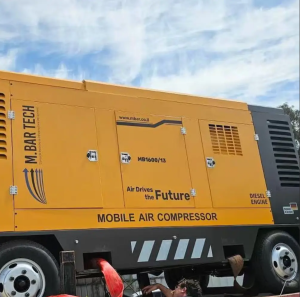
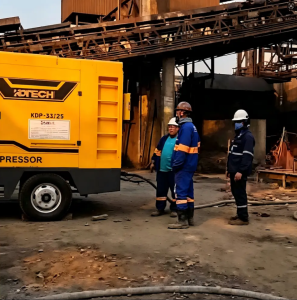
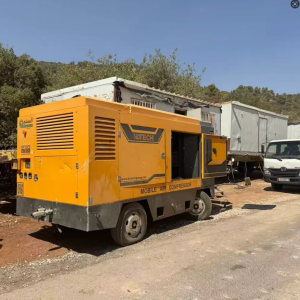
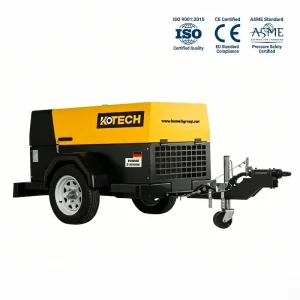
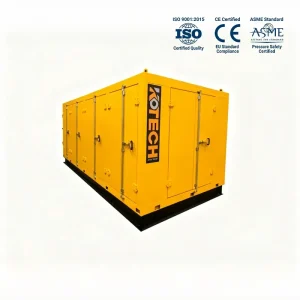
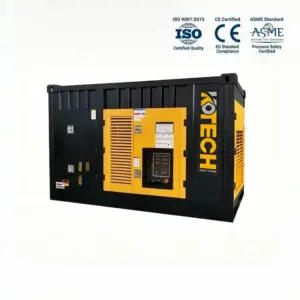
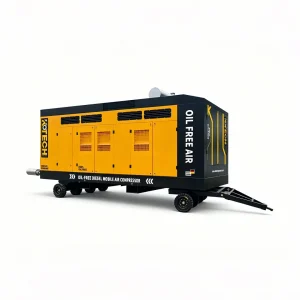
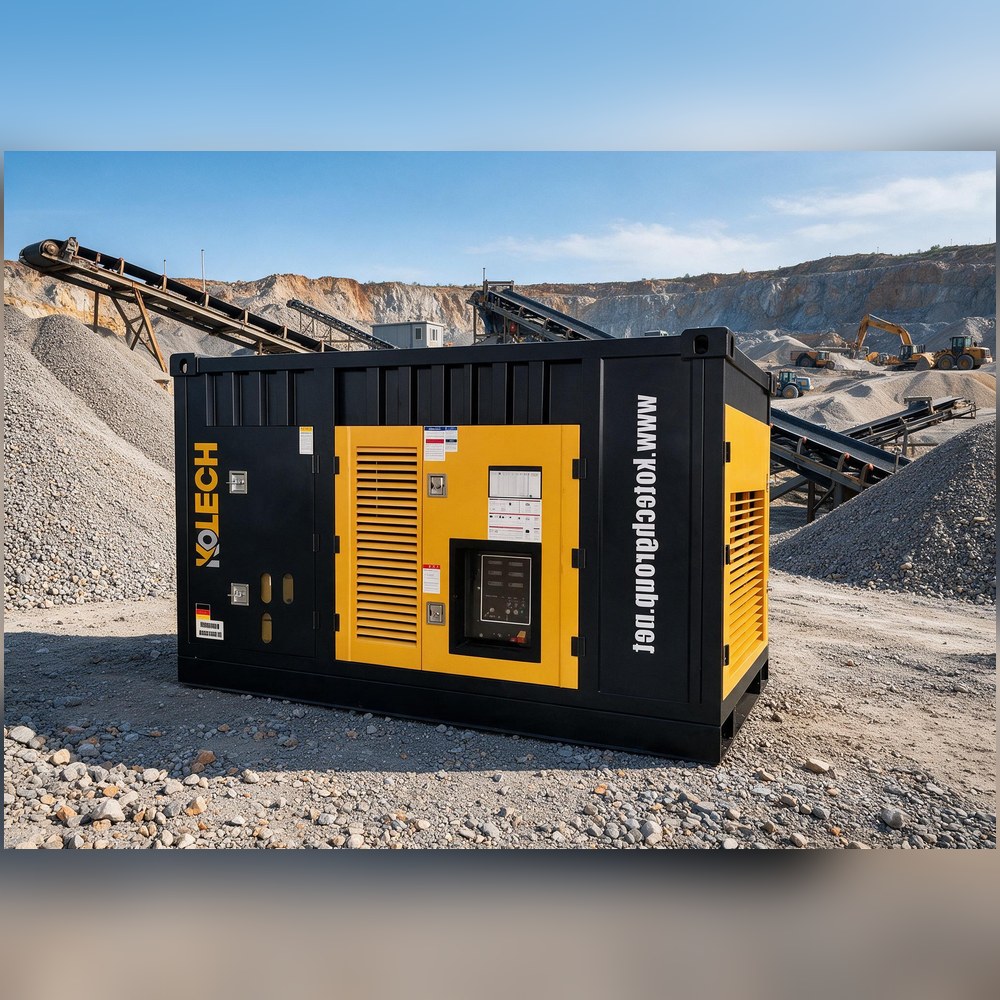
In a quarry, a down-the-hole (DTH) drill is only as productive as the air pushing through it. Pick a compressor that runs too low a pressure and the hammer slows to a knock; pick one too large and you burn diesel you never get back. The right high-pressure skid-mounted diesel compressor matches the drill’s CFM and PSI while running cleanly in dust, heat and vibration. This guide uses real KOTECH KDS figures to make that match straightforward.
Why DTH drilling demands high pressure, not just high flow
A DTH hammer is a pneumatic impact tool. The piston inside strikes the bit, and the exhaust air also lifts the cuttings out of the hole. Two numbers therefore matter together. Free air delivery, measured in CFM or m³/min, sets how fast cuttings are flushed and how hard the hammer can cycle. Working pressure, measured in PSI or bar, sets the energy of each blow.
Many quarry crews oversize flow and undersize pressure. A compressor that delivers plenty of CFM at only 7 bar (100 PSI) will run a hammer weakly, because most DTH tools are designed around 17 to 24 bar and lose penetration fast below their rated pressure. Drop the supply pressure by 20 percent and you can lose a similar share of drill rate, even with the same bit and steel.
That is why a skid-mounted package built for quarry DTH work is offered in stepped pressure ratings rather than one universal machine. KOTECH KDS units span roughly 17 bar (246 PSI) up to 35 bar (508 PSI), so the compressor can be matched to the hammer instead of forcing one machine onto every job.
Skid-mounted versus tow-behind for a fixed quarry
Quarries differ from road and pipeline jobs because the drill moves within a fairly fixed footprint and often works the same benches for months. A skid-mounted compressor sits on a steel base with forklift slots and lifting lugs, with no wheels or tow bar. It is repositioned by loader or excavator and set down level beside the drill.
The advantages are practical. There is no tyre, axle or brake assembly to maintain on rocky ground, the centre of gravity is lower on uneven benches, and the package tolerates being lifted and set down repeatedly. For a single quarry running one or two drills, skid units are typically easier to own than dedicated tow-behind trailers.
- Lower maintenance: no running gear, tyres or lights to damage on benches.
- Stable platform when the drill and compressor work close together.
- Easy to lift with the loaders already on site and relocate as the face moves.
- Hard-connected hoses and a fixed position reduce daily setup time.
How to match a KDS compressor to your DTH hammer
Start from the hammer, not the compressor. The drill or hammer manufacturer lists a recommended air volume and a minimum operating pressure for each tool size and hole diameter. Add a realistic allowance for line loss, leaks and altitude derating, then select the smallest KDS model that clears both numbers with margin rather than picking the largest machine in the budget.
As a worked example, mid-range quarry hammers commonly sit in the 600 to 900 CFM band at 17 to 24 bar. In that band, KOTECH offers the KDS-18/17 at 636 CFM and 246 PSI, the KDS-20/20 at 706 CFM and 290 PSI, and the KDS-21/24 at 742 CFM and 348 PSI. Moving to larger holes or deeper flushing duty, the KDS-26/30 delivers 918 CFM at 435 PSI and the KDS-28/35 reaches 989 CFM at 508 PSI.
If your site sits above roughly 1,000 metres, ask for derated figures rather than using sea-level CFM, because naturally aspirated and turbocharged engines lose output with thinner air. KDS packages are rated for ambient temperatures up to 50 °C, which covers most hard-rock quarry conditions.
Real KOTECH KDS high-pressure skid compressors
Selected KDS models suited to quarry DTH drilling, with free air delivery, working pressure, engine and rated power from the current product-page specification table.
These figures come directly from the KOTECH KDS product-page tables. Pressure and flow rise together across the range because higher-pressure hammers and deeper holes need both more blow energy and stronger flushing. Note the jump in engine power on the 30 and 35 bar units; compressing to those pressures is genuinely more work, which is why right-sizing matters for fuel cost.
Read across the row for a candidate model and confirm that its CFM clears your hammer requirement while its PSI meets the tool’s rated pressure. Choosing the model that just covers both, rather than the biggest available, keeps hourly fuel use in line with the hole you are actually drilling.
Buying tips
- Size to the hammer plate first: cover both minimum CFM and rated PSI with margin, not just one.
- Add line-loss and altitude allowance before choosing a model, especially above 1,000 m.
- Specify the largest fuel tank practical if the drill runs long shifts between refills.
- Check that hoses, couplings and the outlet connection match the compressor; a narrow hose quietly costs pressure.
- Plan a service position on the bench so filters and oil can be changed without rigging a full lift.
- Compare on total cost per drilled metre, including fuel, not purchase price alone.
Frequently asked questions
What size compressor do I need for a quarry DTH drill?
Is higher CFM or higher PSI more important for DTH drilling?
Why choose a skid-mounted compressor instead of a tow-behind for a quarry?
Can one compressor run different DTH hammers?
How does altitude affect a diesel DTH compressor?
What pressure should a quarry DTH compressor run?
If you are equipping a quarry DTH drill, the KOTECH KDS line gives you matched high-pressure packages from 17 through 35 bar, all on a durable skid base. Share your hammer model, hole size and site altitude and KOTECH will confirm the correct CFM and PSI package for your benches.
Related Applied Cases