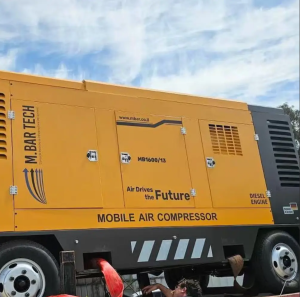
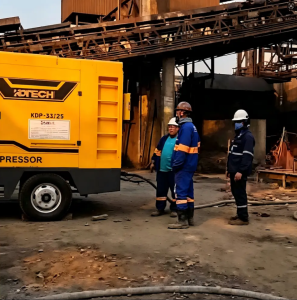
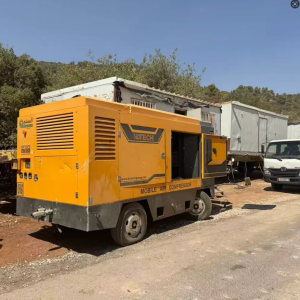
Buyers often ask for a portable compressor when their site actually never moves. If the unit is going to sit on one pad for years, bolting a skid-mounted air compressor to a concrete foundation is usually cheaper, safer and easier to live with than towing a box around. The choice is not about which machine is better, it is about whether the job moves.
What a skid-mounted compressor actually is
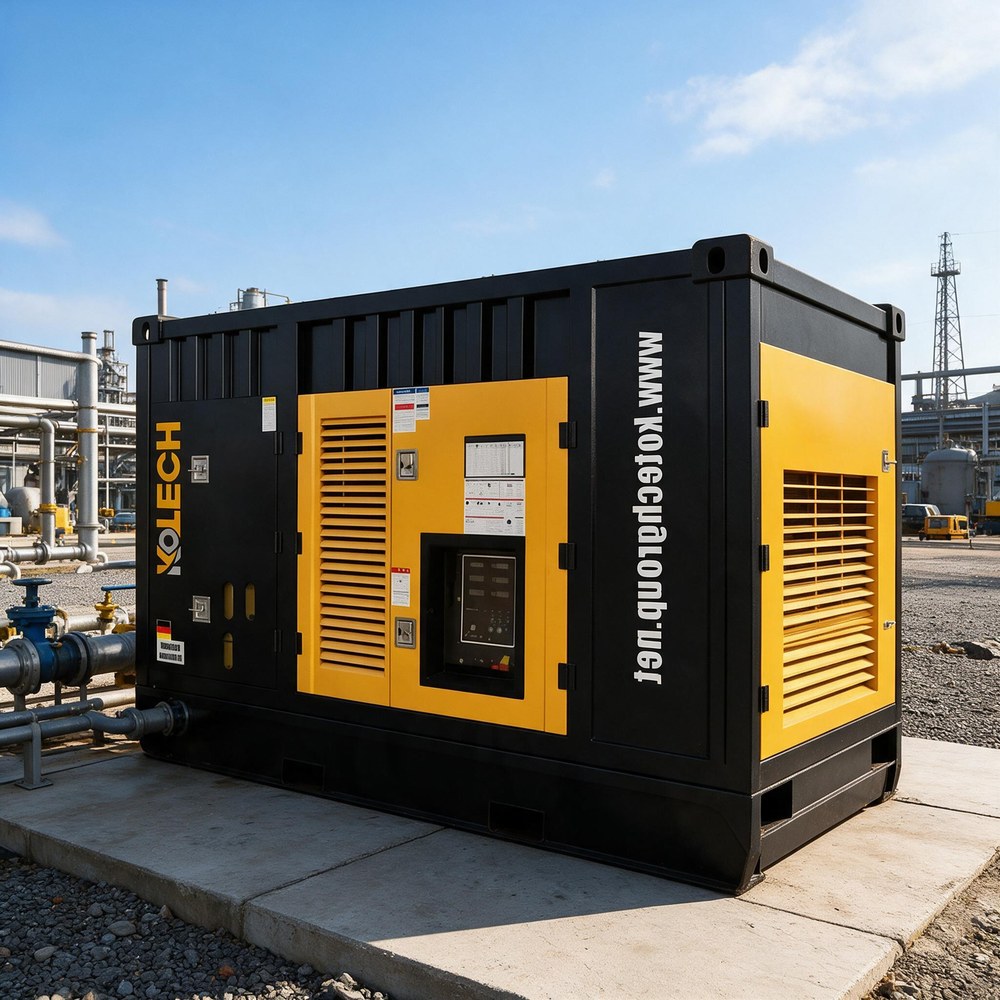
A skid-mounted (or skid) compressor is built on a rigid steel frame or inside a containerized enclosure with forklift slots and lifting points, but no wheels and no tow bar. It is delivered by truck, lifted or forklifted into position once, and then anchored to a foundation or platform.
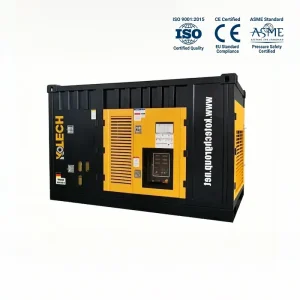
The KOTECH KDS range is the skid version of the same diesel screw packages used in the field. Inside the container you get the engine, screw air end, cooler, controls and outlet plumbing, weather-sealed and sound-attenuated. What changes versus the tow-behind KDP is the base frame: instead of axles and a hitch, you get a weld-on skid built to stay put.
Skid versus tow-behind: where each one wins
Tow-behind units are built for mobility. Skid units are built for a fixed installation. Most of the confusion comes from comparing them on price alone instead of on how the equipment is used.
- Skid-mounted: best when the compressor stays at one plant, mine portal, workshop or booster station for months or years. Lower center of gravity, no tyres or braking system to maintain, and easy to plumb permanently into a ring main.
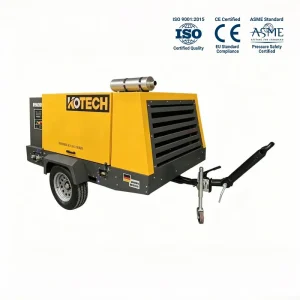
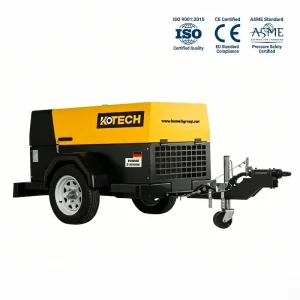
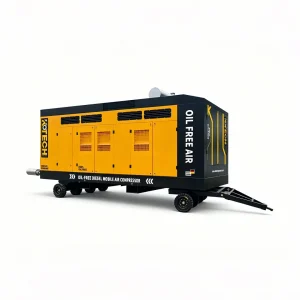
- Tow-behind: best when the same compressor has to follow the work across multiple holes, contracts or sites. You pay for the running gear, tow hitch, lights and road compliance because you genuinely move it.
- Containerized skids also suit sites with limited shelter: the enclosure is the weather protection, so you do not need a separate compressor room.
- On noise-sensitive sites a sealed skid container is easier to site, fence and ventilate than an open tow-behind frame.
Fixed sites where a skid package pays off
Across mining and industry, KDS-type skid compressors show up wherever air demand is continuous and the location is stable. Typical installations include permanent quarry and mine air supply, crusher and conveyor dust-control, plant instrument and process air, booster stations feeding a ring main, tunnelling and shaft service, and backup air for factories that cannot share the main house.
At these sites the installation work, lifting and foundation pour happen once. After that the machine is piped, fueled (often from a bulk tank) and serviced in place, which removes the daily towing, levelling and reconnection that go with a portable unit.
Real KOTECH KDS skid-mounted models
Factory-rated figures straight from the KDS product specification table. Every package is rated for a 50°C maximum ambient and carries CE/ISO certification.
| Model | Free air delivery | Working pressure | Engine | Rated power |
|---|---|---|---|---|
| KDS-3.5/7 | 123 CFM | 100 PSI | Yanmar | 26.8 kW |
| KDS-6/10 | 214 CFM | 145 PSI | Cummins | 60 kW |
| KDS-10/10 | 353 CFM | 145 PSI | Cummins | 97 kW |
| KDS-13/13 | 460 CFM | 188 PSI | Cummins | 110 kW |
| KDS-15/13 | 530 CFM | 188 PSI | Cummins | 132 kW |
| KDS-10/20 | 353 CFM | 290 PSI | Cummins | 158 kW |
| KDS-18/25 | 635 CFM | 362 PSI | Cummins | 242 kW |
| KDS-30/10 | 1060 CFM | 145 PSI | Cummins | 242 kW |
The KDS ladder covers a wide spread. Small packages like the KDS-3.5/7 and KDS-6/10 suit workshops and light plant duty; the KDS-10/10 and KDS-13/13 are the workhorses for medium process and mining air; the KDS-15/13 adds flow, while the KDS-10/20 and KDS-18/25 step up to high-pressure DTH and booster duty. At the top, the KDS-30/10 delivers 1060 CFM for large fixed networks. Pick from the air demand and pressure your tools actually need, not from the biggest frame available.
Installation and foundation points buyers miss
A skid unit is permanent, so the install has to be done right the first time.
- Foundation: a level, load-rated concrete pad sized for the operating weight (KDS packages range from roughly 442 kg up to around 1700 kg and more for the largest frames), with anchor points aligned to the skid.
- Lifting and access: confirm forklift slot or crane access for both delivery and a future engine-out service; containerized units need clearance at the service doors.
- Permanent piping: plumb the outlet into a fixed manifold with isolation and relief valves rather than running temporary hoses, and route exhaust and cooling air away from walls.
- Fuel and containment: on remote fixed sites, a bulk tank or scheduled supply plus a bunded base removes the weakest link in long unattended runs.
- Ventilation: even a weather-sealed container needs clean inlet air and hot-air discharge, especially in the 50°C ambient conditions these packages are rated for.
When the portable tow-behind is still the right call
Do not over-commit to a skid if the compressor genuinely has to relocate. Contractors moving between boreholes, short-term rentals, emergency hire fleets and multi-site service teams are better served by a wheeled, towable package that can be hitched and gone in minutes. A skid unit can be relocated, of course, but every move means a truck, a lift, re-leveling and reconnection rather than just a tow bar. If mobility is part of the weekly routine, look at the portable packages instead of the KDS, as covered in our guide to reliable off-grid portable diesel compressors. For permanent plant and pipeline work, the choice flips back to fixed installations, which we compare in diesel compressors for remote pipeline and construction projects.
Buying tips
- Map the air demand first. Audit every tool and the duty cycle, then size CFM and pressure to the real load; a fixed skid is harder to swap than a rental, so avoid undersizing.
- Decide mobility before you spec the frame. If it does not move at least monthly, you are usually paying for running gear you will never use on a tow-behind.
- Budget the install, not just the machine. Pad, lifting, permanent piping, exhaust routing and fuel supply are part of a skid project, not optional extras.
- Match the package to the climate. Fixed outdoor pads in desert heat want the full high-ambient build and clear ventilation, not a derated unit tucked against a wall.
- Plan service access on day one. Position the skid so filters, oil and the engine can be reached without a second rigging job.
Frequently asked questions
Can a skid-mounted air compressor be moved later?
Does a skid-mounted compressor need a compressor room?
How do I size the concrete foundation for a skid compressor?
Are skid-mounted compressors cheaper than tow-behind units?
Can a skid package handle high-pressure DTH drilling?
Tell us your air demand, working pressure, site layout and whether the unit will be fixed or moved. We will match a KDS skid package and the right foundation envelope to your project instead of overselling a portable frame.
Related Applied Cases