A PET stretch blow-moulding machine is unforgiving about air pressure: if the high-pressure supply dips below the threshold the preforms need, bottles fail to stretch correctly, scrap rises and the line stops. At the same time, small and mid-size bottlers do not have the budget or the volume for a large engineered high-pressure central station. A medium pressure piston compressor in the 20 to 40 bar range hits the practical middle ground, delivering the pressure PET blowing demands in a compact, serviceable package. Sizing it correctly is a question of bottle volume, blow pressure and how the high-pressure air is stored, not simply of buying the largest motor available.
Why PET blowing needs a dedicated medium-pressure machine
General plant air normally runs at 7 to 10 bar, but PET stretch blow moulding operates in a different pressure world. The high-pressure air that stretches and inflates the preform against the mould is typically required at 20 to 40 bar, depending on bottle design, preform material and machine type. Feeding that demand from the standard factory compressor would mean running the whole plant at high pressure, which is both inefficient and hard on equipment designed for normal plant pressure.
The efficient layout separates the two pressure levels. A standard compressor feeds the low-pressure utilities — conveyors, actuators, drying and conveying air — while a dedicated medium- or high-pressure compressor, often a reciprocating piston unit, charges a high-pressure receiver that serves the blow moulder. Piston technology suits this duty well because positive-displacement reciprocating compression builds high discharge pressure efficiently in multiple stages, and the machines tolerate the cyclic loading of blow-moulding batches better than many continuous-duty rotary designs.
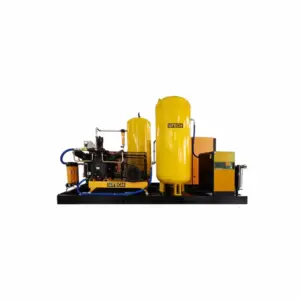
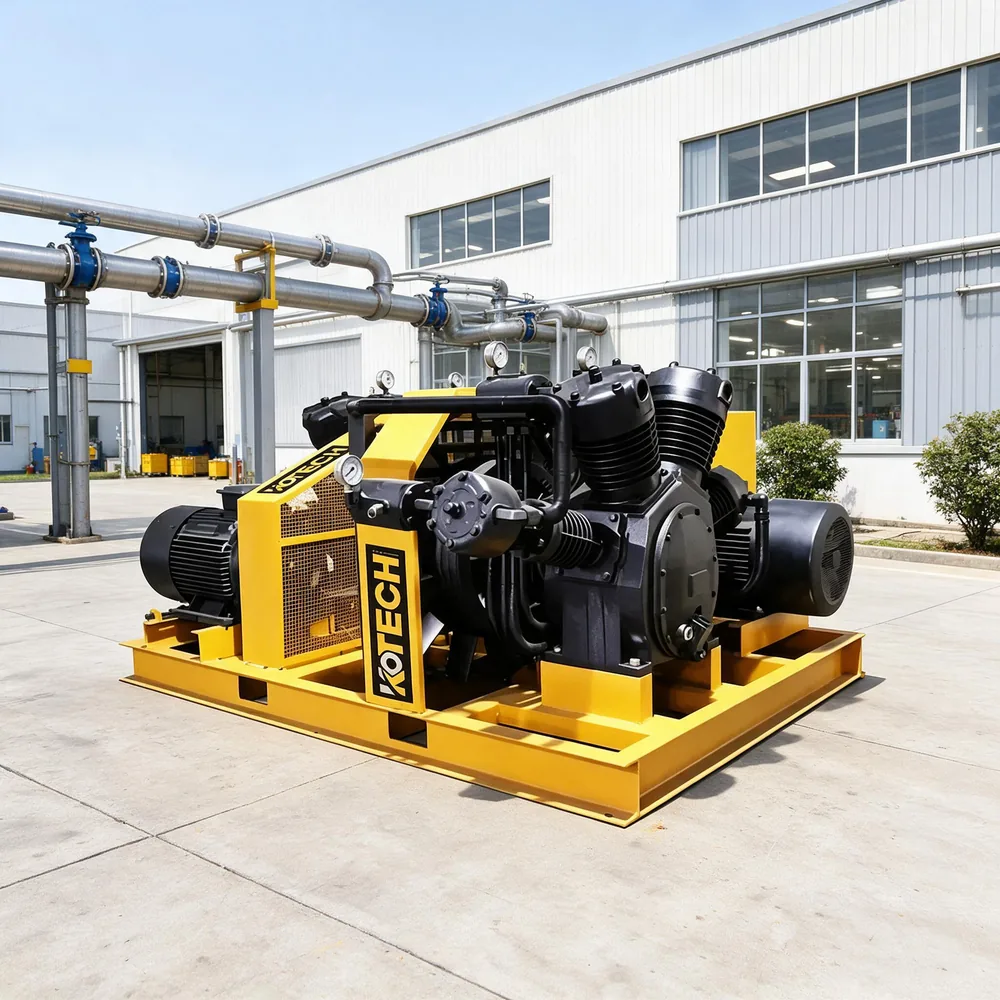
The KT range is purpose-built for this window. It covers two- and three-stage medium-pressure piston packages with discharge pressures of 30 and 40 bar (3.0 and 4.0 MPa) and motor powers from 11 to 22 kW in the single-unit frames, with multi-unit parallel packages available for larger flows.
- PET blow moulding requires 20 to 40 bar, far above normal 7 to 10 bar plant air
- Separate high-pressure and low-pressure systems instead of running the whole plant at high pressure
- Multi-stage piston compression builds medium pressure efficiently and tolerates cyclic duty
- A high-pressure receiver buffers the short, heavy air pulses of each blow cycle
Sizing from bottle output and blow pressure
The starting point is the blow-moulder’s air consumption, expressed per bottle or per cavity per cycle. Each moulding cycle consumes a defined volume of high-pressure air, so multiplying bottle output by the per-bottle consumption and accounting for machine speed gives the average high-pressure flow the compressor must replenish. Peak instantaneous demand is much higher than the average, which is exactly why a correctly sized high-pressure receiver matters: the compressor charges the tank between cycles while the tank delivers the sudden pulse of each blow.
Pressure selection follows the product. Many carbonated soft drink and water bottles blow around 30 bar, while heavier containers, large handles or particular preform designs may call for 40 bar. Choosing a compressor whose rated pressure sits comfortably above the machine’s requirement, rather than right at its limit, extends valve and seal life and keeps delivery stable as components wear. The two-stage 30 bar frames such as the KT-1.0/30 at 1.0 m³/min and 11 kW and the KT-1.2/30 at 1.2 m³/min and 15 kW cover smaller lines, while the three-stage KT-2.0/40 at 2.0 m³/min, 40 bar and 22 kW serves higher output or the heavier bottles that need the extra pressure.
Because these flows are modest in cubic-metre terms — roughly 35 to 70 CFM across the single frames — bottle count and receiver volume, not raw CFM, usually drive the decision. Parallel multi-unit packages that combine several compressor blocks on a common skid allow plants to scale high-pressure flow without jumping to a completely different machine class.
- Calculate average high-pressure flow from per-bottle consumption times line output
- Use a high-pressure receiver to handle the peak pulse of each blow cycle
- Pick rated pressure above the machine’s requirement to protect service life
- Scale flow with parallel multi-unit packages rather than oversizing a single block
Real KOTECH KT medium-pressure piston compressor models
Live product-page data for single-unit PET-duty frames; parallel multi-unit packages extend flow further.
These are live product-page figures for single-unit KT frames. Discharge pressure is shown in MPa as recorded in the source table (3.0 MPa = 30 bar, 4.0 MPa = 40 bar); multi-unit parallel packages extend the available flow for larger lines.
Air treatment and system layout
High-pressure air for PET must be dry and clean. Moisture reaching the blow circuit causes inconsistent bottle quality, corrosion in high-pressure vessels and valve problems, while oil carry-over affects food-contact compliance and can mark bottles. A complete medium-pressure station therefore pairs the piston compressor with appropriate drying and filtration matched to the high-pressure rating, plus condensate management rated for the working pressure. The receiver, safety valves and piping must all be specified for the full discharge pressure, not for ordinary plant pressure.
Layout also influences performance. Locating the high-pressure compressor and receiver close to the blow moulder minimizes the length of expensive high-pressure piping and reduces pressure loss. Ventilation and cooling around a reciprocating machine deserve attention because piston units reject heat and run best with clean, cool intake air. A sensible plant keeps the medium-pressure station on its own clearly identified circuit, with isolation and pressure protection, so maintenance on the high-pressure side never requires shutting down the general plant air.
- Specify high-pressure-rated drying, filtration, receiver, valves and piping
- Keep oil carry-over and dew point within food-contact and bottle-quality requirements
- Place the station near the blow moulder to shorten expensive high-pressure pipework
- Provide clean cool intake air and adequate ventilation for heat rejection
Maintenance expectations for reciprocating PET duty
Piston compressors have more wearing components than screw machines — valves, rings, liners and bearings — but in the medium-pressure PET role their service requirements are well understood and predictable. Routine work centres on monitoring valve condition, checking inter-stage pressures and temperatures, replacing wear parts on the maker’s schedule, and keeping the crankcase lubricant at the correct level and condition. Inter-stage pressure readings are a valuable diagnostic: a drift from the normal balance between stages signals a leaking valve or worn ring long before a failure.
Because blow-moulding is often batch-based, the compressor may start and stop frequently, so controls and the pressure switch band should be set to limit cycling, with the receiver providing the buffer. Logging running hours and keeping the standard valve and seal kit on site turns a scheduled service into a short, planned stop rather than an emergency. For a bottler, where the high-pressure machine gates the entire line, that predictability is worth as much as the headline pressure rating.
- Monitor inter-stage pressures and temperatures for early valve or ring warnings
- Service valves, rings and liners on the scheduled interval with genuine kits
- Use the receiver and a wide pressure band to reduce frequent cycling
- Keep standard wear kits on site to keep high-pressure downtime short
Buying tips
- Compute high-pressure demand from per-bottle air consumption and real line output, then size the receiver for the blow-cycle pulse.
- Choose 30 bar frames for standard bottles and a 40 bar three-stage frame where preform or container design genuinely needs it.
- Keep rated pressure above the working requirement to extend valve and seal life.
- Budget for the complete high-pressure station — drying, filtration, receiver and pressure-rated piping — not just the compressor.
- Plan for reciprocating maintenance with valve and ring kits, inter-stage monitoring and adequate ventilation.
Frequently asked questions
What pressure does a PET bottle blowing compressor need?
Why use a piston compressor instead of a screw compressor for PET?
How do I size a PET compressor for my bottle output?
Do I need a separate compressor from my normal factory air?
What air treatment does high-pressure PET air require?
Related Applied Cases