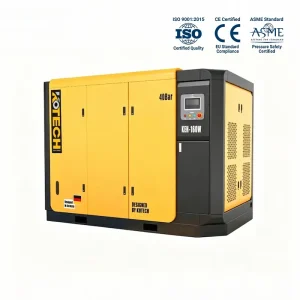
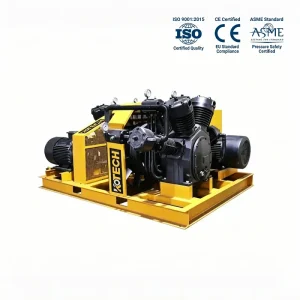
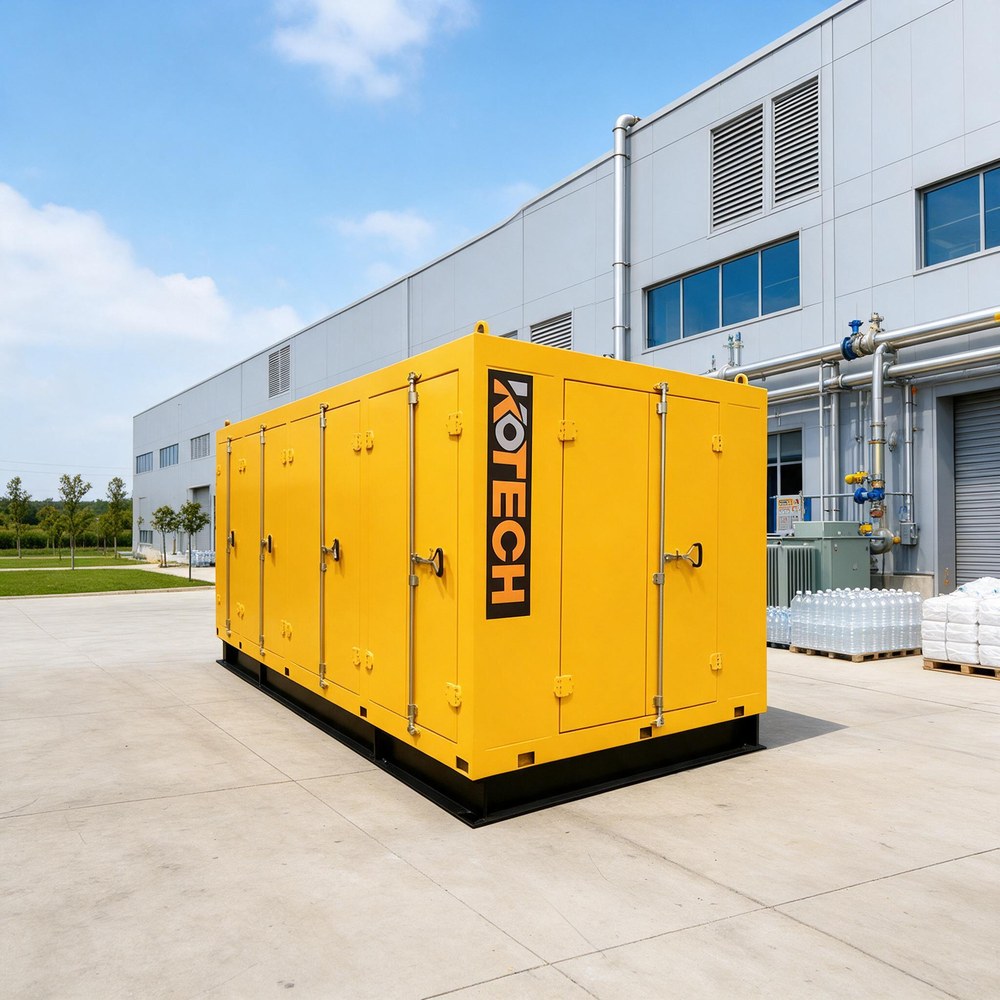
A PET stretch blow molding machine does not run on ordinary shop air. While the rest of a packaging plant works comfortably at 7 to 10 bar, the blow molding station needs roughly 35 to 40 bar to push preforms into shape in a fraction of a second. A high-pressure booster compressor takes the compressed air you already produce and raises just that portion to PET pressure, which is almost always more efficient than running a single large compressor at 40 bar all day.
Why PET bottle plants need high-pressure air
In two-stage PET stretch blow molding, a preform is heated, stretched with a rod, and then inflated against a cooled mold. The inflation step is fast and forceful: low pressure air is used for the pre-stretch, but high pressure air, typically 35 to 40 bar for most carbonated soft drink and water bottles, finishes the blow and holds the material against the mold wall long enough to set.
If that pressure is low or unstable, the bottle never reaches the corners of the mold. Operators see weak base formation, off-center necks, uneven material distribution, bottles that fail top-load or burst tests, and higher scrap rates. Because the high-pressure demand is concentrated in one part of the line rather than across the whole factory, treating all plant air as 40 bar air wastes a great deal of energy.
What a booster compressor actually does
A booster is a second compression stage that sits between your general-purpose air system and the PET blow molding machine. It draws air that has already been compressed to a moderate inlet pressure, often 7 to 13 bar, and compresses that same air a second time up to the outlet pressure the blower needs.
This staged arrangement matches the real load profile of a PET plant. The main compressor station supplies the entire factory at an efficient, stable pressure, while the booster runs only when the blow molder calls for high-pressure air. KOTECH high-pressure booster models cover outlet pressure from about 15 bar up to 60 bar, so the same range serves water bottles, carbonated drinks, and other high-pressure packaging duties.
- Lower total energy use than compressing all plant air directly to 40 bar.
- Stable high-pressure supply protects bottle quality and cuts scrap.
- A separate machine isolates PET pressure fluctuations from the rest of the plant.
- The booster can be added to an existing air system without replacing the main station.
Real KOTECH high-pressure booster models
These are current KOTECH booster models with the inlet and outlet pressure ranges and motor power taken from the product page specifications.
The table lists real KOTECH booster models with the inlet pressure they accept, the outlet pressure they deliver, and their motor power. Exact output depends on the chosen inlet and outlet conditions, so sizing should be confirmed against the actual blow molding air demand rather than motor power alone.
Sizing a booster for a blow molding line
Sizing starts from the blow molder, not from a horsepower number. Each cavity consumes a fixed amount of high-pressure air per cycle, so total demand is the air per bottle multiplied by the number of cavities and the cycle rate, with allowance for purge, leakage, and the recovery time of the high-pressure side.
- Count cavities and bottles per hour to establish the high-pressure flow demand.
- Include pre-blow and final-blow pressure steps in the calculation.
- Allow recovery capacity so the machine is not waiting on pressure between cycles.
- Account for ambient temperature, ventilation, and the heat rejected by the booster.
- Plan a receiver on the high-pressure side to smooth short peak demands.
Installation, cooling, and maintenance
A booster compressing air for a second time produces heat, so ventilation or cooling water must be sized correctly and the area around the machine kept clear. The inlet air feeding the booster should be dry and clean, because moisture or oil carried from the first stage is concentrated by the second compression and can contaminate both the booster and the PET product. Filtration and drying upstream of the booster are therefore part of the installation, not an accessory.
Routine maintenance follows the same pattern as any industrial compressor: monitor inlet and outlet pressure, track discharge temperature, inspect valves and seals, and service the lubrication and cooling system on schedule. A slowly rising discharge temperature, or a booster that runs longer to reach the same pressure, is an early warning that a valve, seal, or cooler needs attention before bottle quality is affected.
What to check before buying a PET booster
- Confirm the exact final-blow pressure your bottles and molds require, not a rounded 40 bar guess.
- Calculate flow from cavities and cycle speed instead of choosing by motor power.
- Verify the inlet pressure your existing air system can supply to the booster.
- Specify drying and filtration upstream so the booster receives clean, dry air.
- Provide adequate ventilation or cooling water for the heat of the second stage.
- Include a high-pressure receiver and pressure monitoring in the scope.
Frequently asked questions
What pressure does a PET blow molding machine need?
Can I just run my main compressor at 40 bar for the whole plant?
How is a booster different from a regular compressor?
Why do my bottles have weak bases or uneven walls?
Does the booster need its own dryer?
How do I know what size booster to buy?
If you are planning a PET line or adding a high-pressure stage to an existing packaging plant, KOTECH can size a booster to your cavity count, inlet pressure, and final-blow requirement.
Related Applied Cases