Key Takeaways
Factory operators know compressed air is expensive. What most don’t realize is how much power their compressor systems waste every single day. Real-world testing shows standard compressed air setups squander 25% to 50% of total energy usage due to preventable problems. For many plants, undetected air leaks alone account for nearly 30% of all energy waste.
To put this in perspective: a 500 kW compressor often burns 125–250 kW of power hourly with zero productive output. For mid and large-scale factories, that’s tens of thousands in unnecessary electricity costs month after month.
The good news? Almost all these losses are avoidable. Most fixes require minimal upfront investment yet deliver fast, long-term returns. This checklist breaks down the most effective energy-saving measures—from basic leak repairs and pressure tuning to smart controls and heat recovery.
A Real Story: When a Plant Manager Did the Math
A local paper mill ran two 250 kW compressors around the clock. Then their electricity bills jumped 18% year-over-year with no clear explanation. They brought in energy auditors to diagnose the system. The results exposed some costly, long-overlooked issues:
- Air leaks wasted 28% of the plant’s total compressed air output
- System pressure was set 1.2 bar higher than actual production requirements
- One compressor sat idle and unloaded for 40% of its total runtime
- No heat recovery infrastructure was in place
The numbers spoke for themselves: the plant unlocked $47,000 in annual energy savings, with a one-time upgrade cost of only $12,000. The entire investment paid for itself in just three months.
As the site manager put it: “We’d been bleeding money for years and never knew it.”
Why Compressed Air Is So Expensive
Compressed air is one of the least efficient industrial utilities available. For every unit of electricity pumped into a compressor, less than 10% converts into usable power for production tools. The rest is lost through waste heat, pipeline pressure drops, air leakage, and poorly optimized operation.
When calculating full lifecycle costs, the picture is clear: energy consumption makes up around 75% of a compressor’s total lifetime operating expenses. The initial equipment purchase only accounts for 15%. For any factory focused on long-term profitability, optimizing energy efficiency always delivers better returns than simply upgrading hardware.
The Energy-Saving Checklist
1. Find and Fix Air Leaks
Air leaks are the single biggest cause of energy waste in compressed air systems. Factories with inconsistent maintenance typically lose 20% to 30% of total air output to leaks. Older piping networks often see even higher losses that go unnoticed for years.
How to check: Conduct routine systematic leak audits using ultrasonic detectors or standard soap testing. Mark all leak points and schedule timely repairs.
Estimated savings: Full leak remediation can eliminate up to 40% of unnecessary system energy waste.
2. Lower System Pressure
Running system pressure higher than your machinery actually needs creates continuous, silent energy waste. Even minor overpressure forces compressors to work harder during every hour of operation, stacking up huge monthly power costs.
How to check: Gradually reduce system pressure while monitoring tool performance and production stability. Lock in the lowest safe pressure that fully supports all operational processes.
Estimated savings: 3–5% lower energy use for every 0.5 bar of excess pressure eliminated.
3. Install Variable Speed Drives (VSD)
Fixed-speed compressors are notoriously inefficient for facilities with fluctuating air demand. They run at full power regardless of actual usage, leading to extensive unloaded runtime and massive energy waste. VSD-equipped compressors adjust motor speed dynamically to match real-time demand, cutting idle energy loss entirely.
How to check: Track your compressor’s load and unload cycles. If idle runtime exceeds 20%, a VSD upgrade will deliver clear, measurable ROI.
Estimated savings: 10–40% overall energy reduction. KOTECH’s VSD compressors achieve an additional 8% efficiency gain over standard variable-speed models during partial-load operation.
4. Upgrade to Two-Stage Compression
Two-stage compression drastically reduces internal energy loss compared to traditional single-stage designs. Built-in intercooling lowers discharge temperatures and minimizes internal friction, delivering far better efficiency during long-hour operation. For 24/7 manufacturing facilities, the typical payback period ranges from 10 to 18 months.
Estimated savings: 15–20% reduction in specific energy consumption.
5. Recover Waste Heat
Up to 96% of the electricity powering a compressor turns into thermal heat. Without a recovery system, this valuable energy vents straight into the atmosphere. With proper heat recycling, factories can repurpose this waste heat for:
- Workshop space heating during cold weather
- Industrial process water heating
- Boiler feedwater preheating
Estimated savings: Up to 96% of input energy can be captured and reused.
6. Optimize Compressor Location & Ventilation
Compressor efficiency depends heavily on cool, clean intake air. Confined, poorly ventilated equipment rooms trap heat, raising intake temperatures and forcing compressors to consume extra power. As a proven rule, every 3°C drop in intake temperature delivers roughly 1% energy savings.
How to check: Compare intake air temperature with ambient workshop conditions. Upgrade ventilation or reposition units if intake heat remains consistently elevated.
Estimated savings: Up to 3% energy reduction with proper placement and optimized airflow.
7. Replace Air Filters on Schedule
Clogged, dirty inlet filters restrict airflow, create unwanted pressure drops, and force compressors to overwork. Skipping regular filter replacements gradually erodes system efficiency over months of operation.
How to check: Inspect filters monthly and replace them once pressure drop exceeds the manufacturer’s recommended threshold.
Estimated savings: Prevents progressive efficiency loss from restricted airflow.
8. Install Intelligent Centralized Controls
Modern smart compressor controllers synchronize multiple units, match air supply to real-time factory demand, and fine-tune system pressure automatically. Advanced digital and AI-driven control eliminates manual adjustment errors and redundant unit operation.
Estimated savings: 10–15% energy savings through precise unit sequencing and dynamic pressure optimization.
9. Stick With Genuine OEM Spare Parts
Generic aftermarket parts have loose tolerances and inferior material quality. They trigger unplanned pressure drops, accelerate wear, and create gradual long-term energy waste. Genuine OEM parts are precision-engineered for specific compressor models, preserving factory-rated efficiency.
Estimated savings: Maintains original system efficiency and prevents incremental energy loss from substandard components.
10. Conduct Regular Team Training
Even the most efficient compressor system will waste energy without standardized operating habits. Train your on-site team on core energy-saving practices: powering down idle units during breaks and off-shifts, reporting air leaks promptly, and understanding how pressure settings impact monthly costs.
Estimated savings: 5–10% energy reduction through standardized, efficient operator workflows.
A Real Plant Example: The Numbers Don’t Lie
A large paper manufacturing plant completed a full compressed air system optimization, upgrading to high-efficiency permanent magnet VSD compressors, zero-consumption air dryers, and intelligent centralized controls. The on-site results delivered outstanding efficiency gains:
| Metric | Before | After |
|---|---|---|
| Specific power | 7.9 kW/(m³/min) | 5.6 kW/(m³/min) |
| Energy saving rate | – | 29.1% |
| Annual electricity saving | – | 5 million kWh |
| Annual cost saving | – | ¥3.5 million |
| Payback period | – | 3 years |
Source: Chinese government official energy efficiency case study
What KOTECH Can Do for You
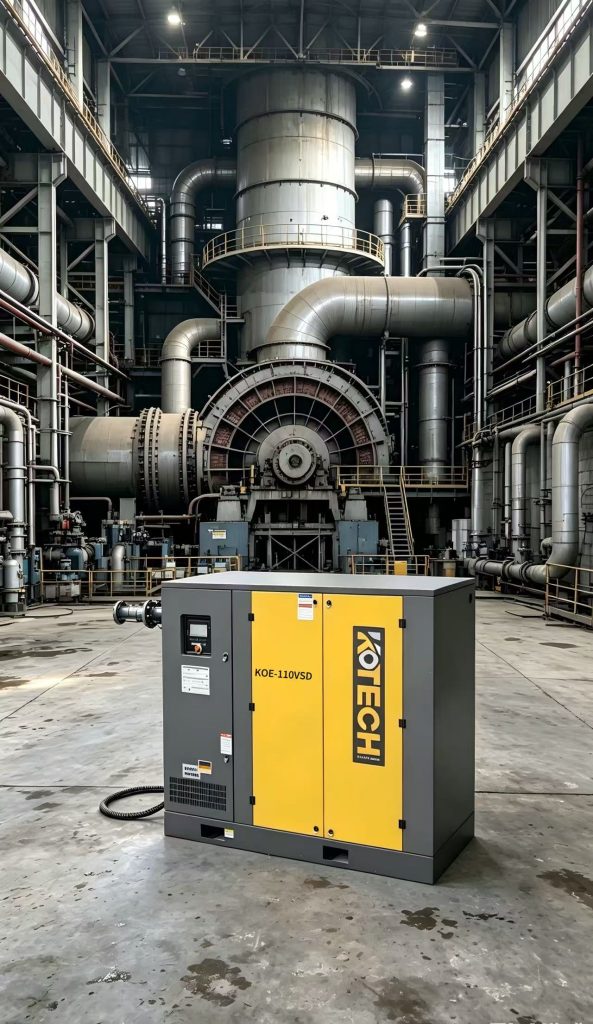
KOTECH’s KOE Series rotary screw compressors are built for long-term energy efficiency and stable industrial operation, delivering tangible, bottom-line cost savings for manufacturing facilities:
- Two-stage high-efficiency design: Cuts energy use by up to 20% compared to conventional single-stage compressors
- Siemens premium motors & controls: IE4 ultra-high-efficiency motors deliver an extra 8% savings during partial-load operation
- Smart thermal management: Enables up to 96% waste heat recovery for on-site energy reuse
- Optimized VSD configuration: Reduces energy consumption by 10–40% for facilities with variable air demand
- High-temperature adaptability: 46°C ambient rating guarantees stable performance in harsh, high-heat factory environments
Conclusion
Is your air compressor silently draining nearly half your factory’s electricity budget? If your system hasn’t had a professional energy audit in three years or more, the answer is almost certainly yes. Most facilities waste 25% to 50% of their compressor energy on avoidable inefficiencies—and nearly all of these losses can be eliminated.
Start optimizing today with this practical checklist. Seal leaks, calibrate pressure to match real production needs, upgrade to VSD and two-stage compression, recycle waste heat, stick to routine filter maintenance, and standardize team operating procedures.
These upgrades deliver verified energy savings and fast payback. For industrial facilities, choosing to ignore compressor inefficiency is the costliest decision of all.
Frequently Asked Questions
Q1: How much energy can I save by fixing air leaks?
Standard poorly maintained systems save up to 30% energy after leak repairs. Facilities with severe pipeline leakage can achieve up to 40% energy savings following full system remediation.
Q2: What’s the payback period for a VSD compressor?
For factories with fluctuating air demand, VSD upgrades typically pay for themselves within 2–3 years. The premium hardware cost is fully offset by consistent monthly energy savings, especially for sites with frequent partial-load operation.
Q3: Does lowering pressure really save energy?
Yes. Pressure calibration is one of the simplest yet most effective energy-saving methods. Minor pressure reductions create immediate energy savings while reducing mechanical wear, extending the service life of your compressor and pipeline components.
Q4: How much heat can I recover from a compressor?
Up to 96% of the electricity consumed by a compressor converts into usable thermal heat. This recycled heat can support workshop heating, process water heating, and boiler preheating to cut auxiliary energy costs.
Q5: How do I know if my compressor is oversized?
If your compressor runs unloaded for over 20% of total runtime, or system pressure consistently exceeds your production requirements, your unit is likely oversized. A professional compressed air audit can confirm optimization potential and upgrade solutions.
Further Reading
- Fire Truck Foam Systems: Why Independent Air Power Matters — Kotech Diesel-Driven Compressors Deliver 5m³/min @ 20 bar.
- 5 Questions You Must Answer Before Buying an Air Compressor.
- Oil Refineries, Chemical Plants, Ports, and Industrial Sites — Kotech's Diesel Air Compressor Powers Foam Systems Where It Matters Most.
- Pure Air, Zero Risk: KOTECH Oil-Free Compressors for Airports.
- industrial compressor manufacturer – Single-Stage or Tw
- Why Does Two-Stage Compression Save 15%–20% More Energy Than Single-Stage? The Principle Is Simpler Than You Think.
- Could a Drop of Oil Ground Your Entire Fleet? KOTECH Oil-Free Compressors Keep Airport Operations Safe.
- Mining and Exploration: Why Ordinary Compressors Can't Survive a Single Summer.
Related Applied Cases