When a plant needs thousands of cubic feet of oil-free air every minute, around the clock and for years, the choice usually moves from screw to centrifugal. Air separation units, steel works, refineries and large chemical sites value steady, oil-free flow at high volume more than they value a low purchase price. A correctly specified centrifugal package delivers exactly that. This guide explains where centrifugal compressors win and how to read the KOTECH KOA range.
What a centrifugal compressor does differently
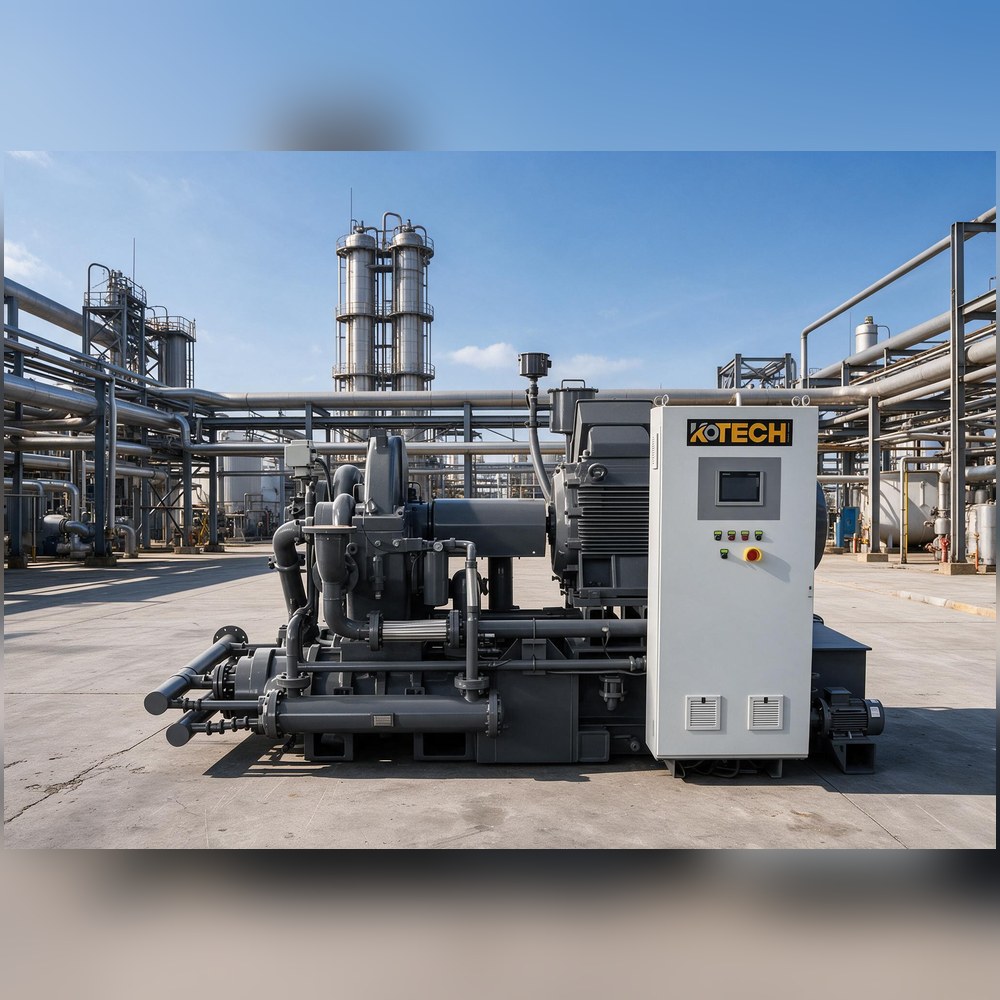
A centrifugal, or dynamic, compressor does not trap a pocket of air and shrink it the way a screw or piston machine does. Instead, a high-speed impeller accelerates the air and a diffuser converts that velocity into pressure. Because nothing rubs against the air in the compression path, a centrifugal machine produces genuinely oil-free air without relying on filters to remove lubricant later.
The design favours a narrow band of very high flow. Within its designed range a centrifugal package is smooth, has few wearing parts and runs for long periods between overhauls. It is less tolerant of deep, frequent turn-down than a screw machine, however; pushed too far below design flow it can approach surge, an unstable reversal that controls are built to prevent.
This is why centrifugal and screw are not simply competitors across all sizes. They are matched to different duty shapes: high, steady, oil-free flow points toward centrifugal, while variable and moderate flow often points toward screw.
Why air separation units rely on centrifugal air
An air separation unit separates atmospheric air into oxygen, nitrogen and argon by cooling it until the components distil at different temperatures. The main air compressor is the largest energy user in the train, and two characteristics are non-negotiable.
First, the air must be oil-free. Even trace hydrocarbon contamination is unacceptable at cryogenic temperatures, where it can freeze onto heat exchangers and create a safety hazard. Centrifugal compression keeps the process air clean at the source. Second, the flow is large and continuous; the plant is designed to run for months without stopping, so the compressor must hold a steady volume with high availability.
The same logic carries into steel works, non-ferrous smelters, large refineries, fertilizer complexes and integrated chemical sites. They share a demand for high-volume oil-free air that a well-applied centrifugal package is built to meet.
How to select a centrifugal package for a heavy plant
Selection starts from the process requirement: a defined flow in m³/min at a defined discharge pressure in bar(g), at the site’s ambient conditions. Unlike a screw machine, which is often picked from a catalogue model, a centrifugal package is selected around an operating point, so the more accurate the design data, the better the efficiency over the plant’s life.
KOTECH centrifugal packages cover a wide span through its KOA, KOS and KOT ranges. The KOA line covers roughly 25 to 100 m³/min at 0.8 to 11 bar(g), the KOS line extends from about 100 to 240 m³/min at up to 16 bar(g), and the KOT line handles roughly 200 to 400 m³/min at up to 11 bar(g). Above these, larger multi-stage frames continue into much higher flows.
Give the supplier the true pressure and temperature across the year, not only a single summer point, and state how much the load will vary. A plant that runs a near-constant process is an ideal centrifugal application; one that swings widely may be better served by centrifugal baseload plus a smaller variable-speed screw for trim.
Real KOTECH centrifugal package ranges
KOTECH KOA, KOS and KOT centrifugal packages, with flow, pressure and power envelopes from the current product data. Specific packages are engineered to the required operating point.
The ranges below are operating envelopes from the KOTECH centrifugal product data rather than a single fixed point; within each range a package is engineered around the specific flow and pressure the process requires. Notice how power climbs steeply with flow; the main compressor dominates the electricity use of an air separation train, which is why a carefully matched impeller pays back for years.
Read the row that brackets your process flow, then confirm the required pressure sits within that frame. Providing accurate ambient and turn-down data lets the package be built near its most efficient point rather than merely clearing a conservative margin.
Buying tips
- Define a precise flow and pressure operating point; centrifugal packages are engineered rather than simply selected.
- Provide real ambient temperature and humidity across the year so the machine is matched to site air.
- State expected turn-down honestly; pair centrifugal baseload with a VSD screw if demand swings widely.
- Verify oil-free design and the cooling and control arrangement against process safety requirements.
- Plan access for cooler and bearing maintenance and space for the larger acoustic and ventilation footprint.
- Evaluate on lifetime energy cost, since the main compressor dominates plant electricity use.
Frequently asked questions
Why do air separation units use centrifugal compressors?
Is the air from a centrifugal compressor really oil-free?
When should I choose centrifugal instead of screw compression?
What is compressor surge and why does it matter?
How are centrifugal compressors sized for a process plant?
Can a centrifugal compressor handle variable demand?
For an air separation train or a heavy-industry plant needing high-volume oil-free air, KOTECH centrifugal packages span the KOA, KOS and KOT ranges and are engineered around your exact operating point. Share your design flow, pressure and ambient conditions and KOTECH will propose the matched package.
Related Applied Cases