Centrifugal Air Compressor: Working Principle, Selection Guide & Applications
Related topics (expand)
- centrifugal air compressor technology
- industrial centrifugal compressor system
- high efficiency compressed air solution
- oil-free compressed air system
- large capacity air compressor
- continuous duty air compressor
- industrial compressed air equipment
- high volume air compression system
When a chemical plant or a large air separation unit runs around the clock, compressed air is never just a utility, it is the central pulse of the entire production stream. When continuous airflow demands cross into hundreds or thousands of cubic meters per minute, standard positive-displacement compressors simply hit a wall. Mechanical wear, high maintenance overheads, and the constant risk of oil contamination rule them out for heavy duty.
This is where centrifugal air compressors take over.
Instead of trapping and squeezing air inside a fixed chamber, centrifugal machines use high-speed aerodynamics. A precision-forged titanium or stainless steel impeller flings air outward at near-sonic speeds, and a stationary diffuser converts that kinetic velocity into steady, high-pressure plant air.
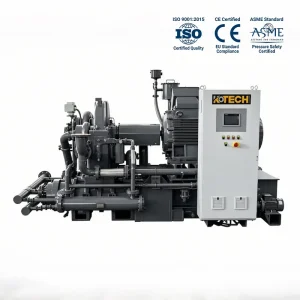
Built on industrial engineering platforms like the Kotech KOA, KOS, KOT, and KOL series, this guide breaks down how centrifugal compressors actually work, where they shine, how to prevent catastrophic operating failures like surge, and how to spec the right unit for your facility.
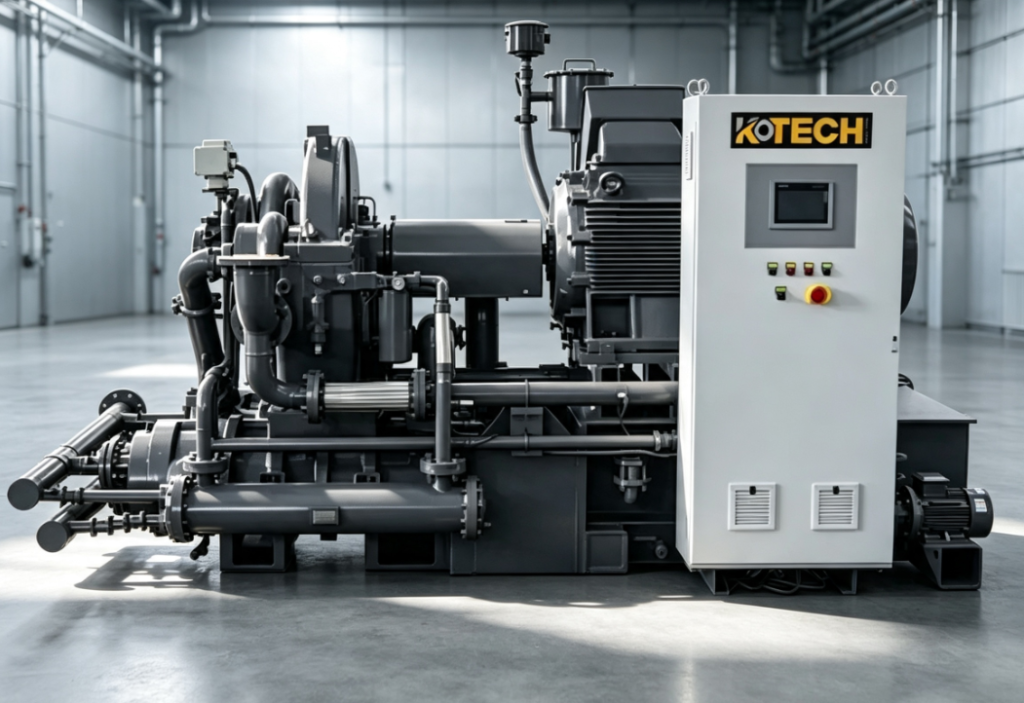
1. Thermodynamic Anatomy: How Velocity Becomes Pressure
A centrifugal compressor is essentially a momentum-exchange machine. The transformation from ambient suction air to high-pressure plant utility follows a precise fluid dynamic sequence:
- Inlet Control (IGV): Atmospheric air enters through an intake duct managed by an Inlet Guide Vane (IGV). Actuating the IGV adjusts the pre-rotation angle of the incoming air stream, allowing the compressor to modulate capacity smoothly when plant demand drops.
- Kinetic Acceleration: The air enters the eye of a rotating impeller driven by a high-speed gearbox and motor. As the impeller spins, its blades impart immense centrifugal force, accelerating the gas outward at high velocities.
- Pressure Recovery in the Diffuser: Leaving the impeller tip, the high-velocity air enters a stationary diffuser section. As the flow area expands, the air velocity abruptly drops. Per Bernoulli’s principle, that deceleration converts kinetic energy directly into static pressure.
- Multi-Stage Compression & Intercooling: A single stage can only handle so much pressure before the air overheats. Industrial units use multi-stage setups (typically 2 to 5 stages) with water-cooled intercoolers positioned between them. Stripping heat out of the air between stages keeps compression close to an isothermal process, saving massive amounts of electrical power over years of continuous operation.
2. Core Mechanical Engineering & Air Purity
If you pull the casing off an industrial turbo compressor, you will find a design engineered entirely around high-speed stability and absolute contamination control.
Rotor Dynamics and Bearings
Operating at tens of thousands of RPM leaves zero room for error. Rotors require rigorous dynamic balancing, supported by advanced tilting pad journal bearings. These pads self-adjust to shifting oil-film vectors, eliminating high-speed oil whirl instabilities and damping vibration. Furthermore, horizontally split gearbox casings allow maintenance teams to inspect pinions and gears without tearing down the entire plant piping infrastructure.
The Class 0 Oil-Free Advantage
In industries like electronics fabrication, pharmaceuticals, and food processing, even a microscopic trace of oil ruins a production batch. Centrifugal compressors achieve ISO 8573-1 Class 0 oil-free air naturally. Because the compression air path is completely separated from the lubrication system and uses non-contact labyrinth or carbon-ring seals, there is zero chance for lubricating oil to migrate into the air stream.
3. Industrial Performance Metrics and Tiers
Compressor sizing relies on matching volumetric output and discharge pressure to real plant loads. The following parameters outline standard metrics across industrial centrifugal compressor categories:
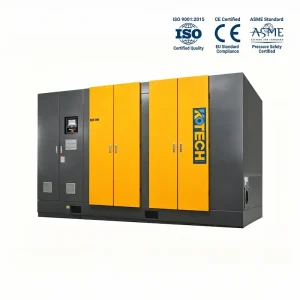
| Series Identifier | Capacity Range (m3/min) | Discharge Pressure Range | Drive Motor Power Range | Typical Physical Footprint & Dry Weight |
| KOA Series | 25 – 100 | 0.8 – 11 bar(g) | 100 – 600 kW | ~3,400 × 2,200 mm 7,000 – 8,000 kg |
| KOS Series | 100 – 240 | 0.8 – 16 bar(g) | 300 – 1,350 kW | ~4,000 × 2,300 mm 9,000 – 11,000 kg |
| KOT Series | 200 – 400 | 0.8 – 11 bar(g) | 600 – 2,000 kW | ~5,000 × 2,300 mm 16,000 – 20,000 kg |
| KOL Series | 400 – 1,500 | 0.8 – 25 bar(g) | 1,500 – 6,000 kW | ~12,000 × 6,500 mm 20,000 – 70,000 kg |
(Note: Standard electrical configurations support industrial medium-to-low voltage ranges including 380V, 3kV, 6kV, and 10kV at 50Hz/60Hz multi-phase inputs.)
4. Operational Survival: Managing Compressor Surge
Unlike positive-displacement units that can push hard against a closed valve (risking mechanical over-pressure), centrifugal compressors are bound by strict aerodynamic laws. If downstream air demand drops too low, the compressor can experience surge—a violent aerodynamic breakdown where airflow reverses direction inside the stage, creating severe pressure fluctuations and destructive shock loads on the impeller blades.
To protect the machine, modern automated PLC control loops constantly monitor suction pressures, discharge heads, vibration spectra, and temperatures. When the system senses the operating point approaching the surge limit, fast-acting blow-off or recycle valves instantly dump or loop air back to suction, maintaining safe minimum flow rates.
5. Engineering Trade-Offs: Centrifugal vs. Screw Compressors
Plant engineers often debate whether to install a turbo compressor or stick with multi-bank screw compressors. The choice comes down to duty cycles:
- Choose a Centrifugal Compressor When: Your plant requires continuous baseload airflow exceeding several hundred $m^3/min$, electricity consumption is a primary cost concern, and 100% oil-free air is a mandatory requirement (e.g., air separation, large petrochemical complexes, steel mills).
- Choose a Screw Compressor When: Your air demand fluctuates wildly throughout the day, total required volume is moderate, or you need redundancy split across multiple smaller, modular units in tight physical spaces.
6. How to Spec Your Next Centrifugal Compressor
When procurement and engineering teams sit down to size a centrifugal compressor, looking only at the initial price tag is a critical mistake. Over a 10-year service life, electricity accounts for over 80% to 90% of total operating costs.
Before calling manufacturers, nail down these five parameters:
- True Baseload vs. Peak Flow: Avoid over-sizing out of fear. Oversized centrifugal compressors operate too close to their choke or surge limits, tanking efficiency.
- Site Elevation and Ambient Temperature: Thin air at high altitudes or hot summer ambient temperatures directly degrades mass flow capacity. Always request corrected performance curves based on site-specific weather data.
- Cooling Water Quality: Because intercoolers rely on external plant cooling water, knowing water temperature and fouling factors prevents premature thermal degradation.
- Turndown Requirements: Evaluate how low your plant demand drops during night shifts or partial production runs. Ensure the IGV and blow-off valve range can handle those dips safely without excessive recycling waste.
Further Reading
- Rotary Screw Air Compressor Maintenance Guide
- How to Choose Reliable Compressed Air Equipment for Harsh Environments
- The Hidden Cost of Compressed Air: Why the Lowest Purchase Price Is Not Always the Best Choice
- How Can I Choose the Right Air Compressor for My Business?
- drilling air compressor – Fire Truck Foam Sy
- 5 Questions You Must Answer Before Buying an Air Compressor.
- Oil Refineries, Chemical Plants, Ports, and Industrial Sites — Kotech's Diesel Air Compressor Powers Foam Systems Where It Matters Most.
- Pure Air, Zero Risk: KOTECH Oil-Free Compressors for Airports.
Related Applied Cases

Frequently Asked Questions
A centrifugal air compressor uses a high-speed impeller to increase air velocity and convert that energy into pressure.
Yes. Properly designed centrifugal compressors provide oil-free compressed air because the compression chamber is separated from lubrication systems.
Centrifugal compressors are suitable for large plants requiring continuous airflow, high efficiency, and clean compressed air.
Surge occurs when airflow demand drops below the compressor's stable operating range, causing unstable pressure and flow conditions.
With proper maintenance, industrial centrifugal compressors can provide reliable service for decades.