Key Takeaways
Compressed Air Foam Systems (CAFS) have changed the game in industrial firefighting. They cut water use by up to 85% compared to conventional methods, knock down flames faster, and leave a foam blanket that stops re-ignition. But here’s the thing: a CAFS is only as good as its air supply. Without steady, high-pressure air, foam consistency goes bad right when you need it most.
That’s where standalone diesel-driven compressors shine. Unlike PTO setups that depend on the fire truck’s transmission, self-contained diesel compressors run entirely on their own. They don’t care if the engine is running, if the transmission is engaged, or if the truck is sitting still.
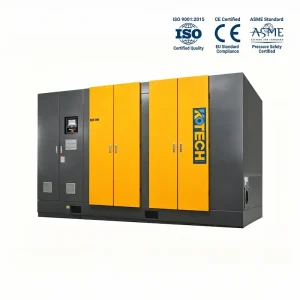
Kotech’s diesel-powered CAFS compressor module delivers a steady 5m³/min (176 CFM) at 20 bar — well above the typical industry benchmark of 70–100 CFM at 8–10 bar. With its own diesel power unit, it runs independently of grid power and truck engine limitations, delivering reliable air pressure for the toughest industrial firefighting jobs.
Why Compressed Air Foam Systems Need a Dedicated Air Source
CAFS works by precisely blending water, foam concentrate, and compressed air in a mixing chamber. The compressed air expands the mixture to create a dense, high-energy foam that outperforms conventional foam in coverage and stopping power.
The air has to be consistent. Even small pressure fluctuations give you uneven foam texture and spotty coverage — exactly what you don’t want when a fire is burning.
Most standard fire trucks use PTO-driven compressors that pull power from the vehicle’s transmission. The problem? Airflow and pressure drop significantly at idle or when the truck is stationary. Under these common emergency conditions, the compressor can’t sustain the stable air volume the CAFS needs. Some fleets add auxiliary engine-driven compressors to fix this, but that adds cost and mechanical complexity.
Self-contained diesel-driven compressors eliminate these weaknesses. They have their own engine, fuel supply, and cooling system. They deliver rock-solid air pressure whether the truck is moving, idling, or parked.
Independent Diesel Drive: How It Works
Kotech’s diesel-driven CAFS compressor module is a self-contained, vehicle-mountable unit built for rugged firefighting conditions. Here’s what’s inside:
- Diesel engine: Fully independent power, separate from the fire truck’s powertrain
- Rotary screw compressor: Consistently delivers 176 CFM at 20 bar — exceeding industry requirements
- Integrated cooling system: Keeps both engine and compressor at optimal temperature during heavy-duty use
- Smart control panel: Full CAFS controls, real-time gauges, and automatic safety shutdowns
The module draws fuel directly from the truck’s main tank and supports dual-operation — control it from the CAFS operator station or the cab console. Drivers can activate and adjust the system without leaving the vehicle, speeding up emergency response.
Industry specs typically require 60 to 120 CFM at 125 psi for effective CAFS operation. Kotech’s 176 CFM at 20 bar (290 psi) gives you a solid performance buffer for demanding missions like long-range foam delivery or running multiple nozzles at once.
What Makes Kotech’s Compressor Different
Stable 5 m³/min Air Output: The unit delivers uninterrupted 5 m³/min (176 CFM) at 20 bar — the steady high-pressure air that professional CAFS depends on. That means uniform foam quality, extended discharge range, and stable multi-nozzle operation.
Autonomous Diesel Power: Completely independent of the fire truck’s engine and transmission. The compressor maintains full rated performance whether the vehicle is stationary or idling. No power degradation.
Space-Saving Vehicle Integration: Compact, modular design mounts seamlessly on fire trucks, rescue vehicles, and custom rigs without taking up valuable equipment space. Adapts to most existing vehicle platforms with minimal modification.
Comprehensive Safety Protection: Built for volatile fireground conditions. Multi-layered safety systems: high-temperature auto-shutdown, overpressure protection, low oil pressure cutoff, and full fault interlock systems.
A Real Story: When CAFS Made the Difference
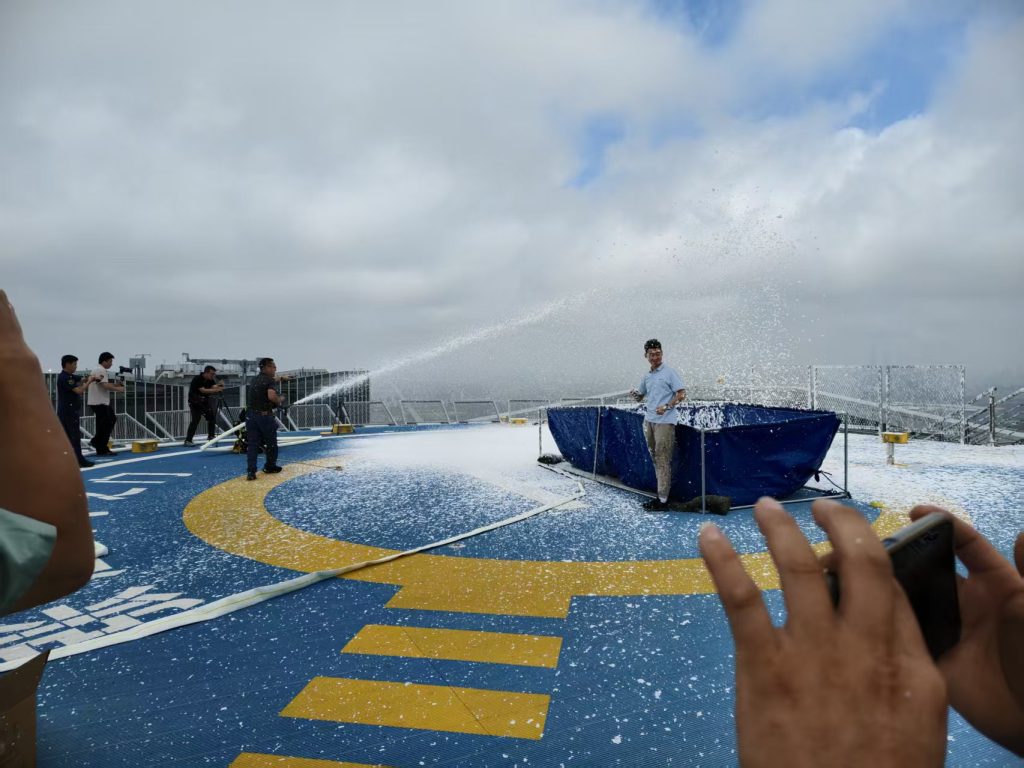
In 2006, firefighting technologists and CAFS specialists ran a series of controlled fire tests to validate real-world performance. Over eight days, nearly 100 firefighters completed repeated suppression exercises, burning 192 pallets under monitored conditions. The results: CAFS cut water use by 80% or more, delivered rapid flame knockdown, and offered decisive advantages in water-limited emergency environments.
CERN, the European Organization for Nuclear Research, also put CAFS through rigorous live-fire testing to certify it for protecting sensitive underground research infrastructure. Over 10 days, teams completed 33 independent fire trials, burning over 240 pallets and complex electronic assemblies. The test data confirmed that CAFS cuts water usage by up to 85% while achieving faster fire extinction than traditional methods.
CAFS systems now serve as standard fire protection equipment across CERN’s global facilities. If the technology is trusted to safeguard the world’s most advanced scientific infrastructure, it’s more than capable of protecting refineries, chemical plants, and port terminals. But every CAFS performance benefit hinges on one thing: consistent air supply — and that’s exactly what Kotech delivers.
Key Applications
Oil Depot & Chemical Plant: Refineries and chemical facilities face constant fire risks from flammable liquids and volatile gases. Kotech’s standalone diesel compressors sustain continuous foam generation even during on-site power outages.
Industrial Firefighting: Manufacturing facilities, warehouses, and processing plants need flexible, dependable fire protection. Kotech’s modular units integrate with mobile fire trucks and fixed on-site CAFS systems.
Port & Dock Applications: Ports handle high volumes of flammable cargo daily, requiring high-volume, long-distance foam coverage. The unit’s 20 bar output extends foam discharge range for large-scale port protection.
Emergency Rescue Vehicles: For versatile rapid response, Kotech compressor modules fit onto dedicated rescue vehicles. The independent diesel power guarantees full operational functionality at any emergency site, independent of external power or host vehicle performance.
Conclusion
In high-stakes industrial firefighting, reliable equipment often separates contained incidents from catastrophic disasters. CAFS has proven its performance in the most demanding environments — from CERN’s underground tunnels to industrial test grounds worldwide.
But CAFS effectiveness depends entirely on stable, high-quality air delivery. Kotech’s diesel-driven compressors deliver consistent 5m³/min at 20 bar — the reliable air performance professional foam systems need. With independent diesel operation, flexible modular integration, and industry-grade safety systems, Kotech provides the dependable air power that modern industrial CAFS systems rely on.
Further Reading
- 5 Questions You Must Answer Before Buying an Air Compressor.
- Oil Refineries, Chemical Plants, Ports, and Industrial Sites — Kotech’s Diesel Air Compressor Powers Foam Systems Where It Matters Most.
- Pure Air, Zero Risk: KOTECH Oil-Free Compressors for Airports.
- Single-Stage or Two-Stage? Kotech Compressor Delivers 80–88% Efficiency for Demanding Industrial Applications
- KOTECH compressor – Why Does Two-Stage
- Could a Drop of Oil Ground Your Entire Fleet? KOTECH Oil-Free Compressors Keep Airport Operations Safe.
- Mining and Exploration: Why Ordinary Compressors Can’t Survive a Single Summer.
- Pure Air, On Demand: KOTECH Oil-Free Compressors Keep Airports Operating Without Interruption.
Related Applied Cases