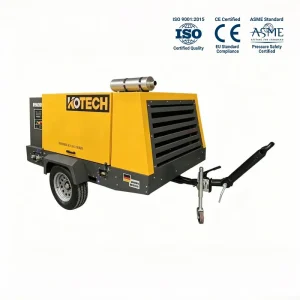
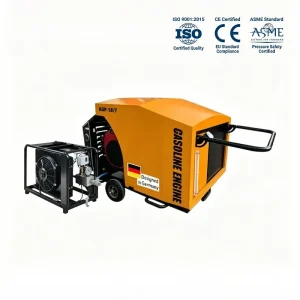
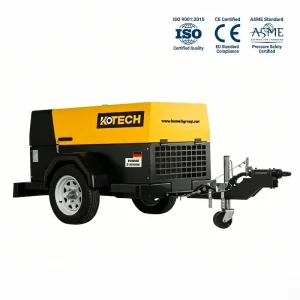
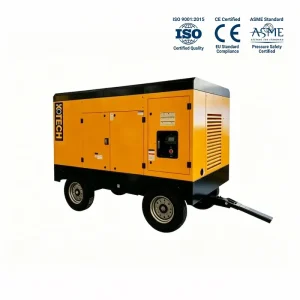
KOTECH KGP Series: Portable Gasoline Air Compressor for Off-Grid Construction and Field Work
Related topics (expand)
- gasoline air compressor
- portable air compressor
- Honda GX630 air compressor
- off-grid air compressor
- mobile compressed air system
- petrol air compressor
- construction air compressor
- remote jobsite air supply
- pneumatic tool air compressor
- field compressor without electricity
- best portable gasoline air compressor for construction sites
- Honda GX630 air compressor specifications
- gasoline air compressor for remote drilling sites
- portable air compressor without electricity for jobsite
- KGP-1.6/7 vs KGP-0.9/15 air compressor comparison
- how much does a portable gasoline air compressor weigh
- oil-free portable air compressor for sandblasting
- gasoline air compressor fuel consumption per hour
When Compressed Air Is Needed Beyond the Power Grid
A construction team arrives at a remote project site. The tools are ready, the workers are prepared, but there’s one problem—there’s no reliable electricity supply.
A drilling contractor starts a new operation far from existing infrastructure. A maintenance team needs compressed air for pneumatic tools, but bringing in a complete industrial compressor system is too much for a short-term job.
These situations happen every day across construction, mining, drilling, and field service work.
The challenge isn’t simply producing compressed air. It’s this:
How do you get reliable air power where the work actually happens?
For fixed industrial facilities, a stationary compressor system is usually the right choice. For mobile applications, remote locations, and outdoor projects, flexibility matters just as much as raw performance.
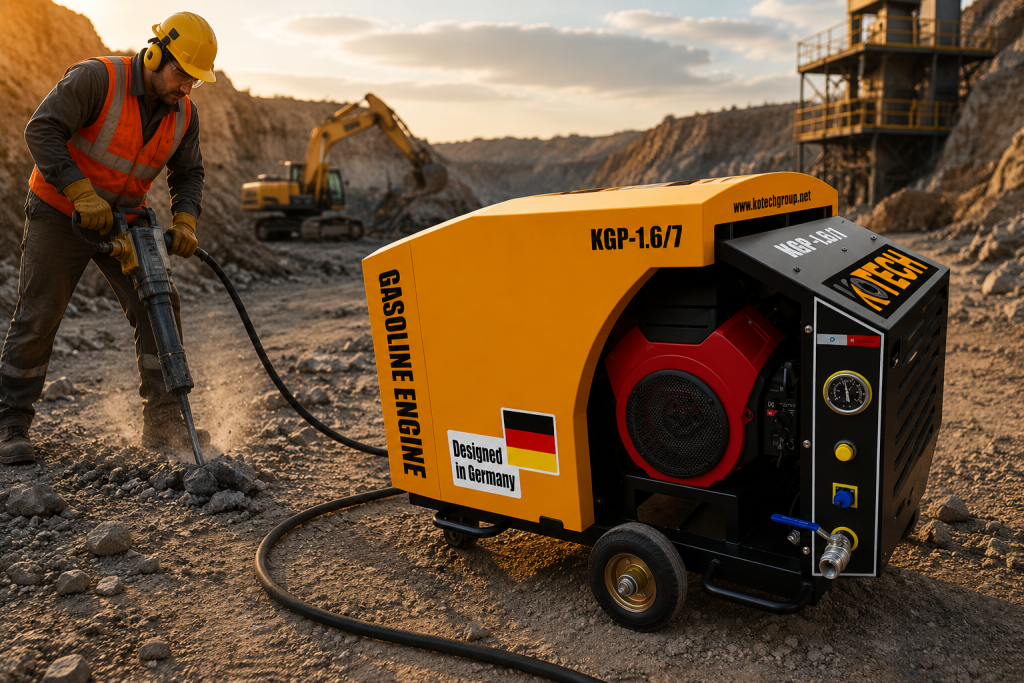
That’s where portable gasoline air compressors earn their place. The KOTECH KGP Series is built for users who need dependable compressed air without depending on a fixed electrical connection—combining a compact structure, gasoline engine power, and multiple pressure options into one flexible solution for construction, drilling support, maintenance, and other field applications.
Why Traditional Compressors Aren’t Always Suitable for Outdoor Jobs
A common mistake is assuming a bigger compressor automatically means a better solution. In reality, the right choice depends on the working environment.
A factory-installed compressor operates under controlled conditions: stable electricity, a fixed location, a protected environment, and easy maintenance access.
Outdoor job sites offer none of that guarantee. A field compressor may face no available power source, frequent relocation, dust and uneven terrain, changing weather, and limited maintenance resources. Equipment designed only for factory conditions often becomes inefficient or simply inconvenient once it’s moved outdoors.
For mobile applications, the equipment needs to be designed around the job, not the other way around.
The Real Challenges of Remote Compressed Air Applications
No electricity means no air supply. Most electric compressors depend on a stable power connection, but many projects—road construction, remote drilling, mining, outdoor maintenance—happen where grid power is unavailable or temporary power isn’t practical. A gasoline-powered compressor solves this by generating its own power; it runs wherever fuel is available.
Transportation becomes part of productivity. A compressor that needs heavy lifting equipment or a complex setup slows down daily operations. The questions that matter for mobile users: Can it be moved easily? Does it fit existing transport vehicles? Can operators reposition it quickly on their own? A portable compressor should support the workflow, not become another logistics problem.
Field conditions are harder than factory conditions. Dust, vibration, temperature swings, and uneven ground all affect performance and service life. That’s why equipment purpose-built for field operation, not adapted from a factory design matters.
KOTECH KGP Series: Built for the Field
Unlike large stationary systems designed for permanent installation, the KGP Series is built around flexibility.
| Feature | Customer Benefit |
|---|---|
| Honda GX630 gasoline engine, 15.5 kW | Independent operation without fixed electricity |
| Compact structure (~200–204 kg) | Easier transportation and positioning |
| Three pressure/flow configurations | Better matching to different applications |
| Portable design with side and folding handles | Suitable for frequently changing job locations |
| Integrated control panel | Easier operation and maintenance tracking |
The goal is simple: reliable compressed air wherever the job requires it.
Reliable Engine Performance for Independent Operation
The KGP Series runs on a Honda GX630 gasoline engine rated at 15.5 kW, meeting the EU Stage V emissions standard. For field users, engine reliability isn’t just a spec on paper; it directly affects productivity. A dependable engine means faster setup, fewer starting problems, more confidence during outdoor work, and easier access to service and parts, since the GX630 platform is widely used across industrial and commercial equipment.
The unit supports electric key-start with an ignition choke for reliable cold starts, and a 20-litre fuel tank carries it through a full working shift, burning roughly 3.8 l/h under load and 2.8 l/h unloaded.
A Control Panel Worth Having
The integrated monitoring on the KGP Series isn’t just a checkbox feature. It includes a pressure gauge, a running-hour counter, and a temperature sensor giving operators a way to catch pressure drift or overheating before it turns into downtime, and giving maintenance teams a real running-hour record to schedule service against instead of guesswork.
Designed for Mobility: Move the Compressor With the Job
A portable compressor has to be practical in real working conditions. The KGP Series comes in at an operating weight of roughly 200–204 kg, with compact dimensions of about 1300 × 1050 × 900 mm, side handles for lifting, and a foldable handle for easier repositioning on site. It’s compact enough to fit in the back of a lorry alongside other equipment.
That matters because field projects rarely stay in one place; a contractor may need to move between construction areas, transport the compressor with other tools, or reposition it mid-operation. A compact, genuinely portable design removes a layer of logistics that a larger unit would add.
The housing itself is polyethylene, available in blue (RAL 5017), red (RAL 3020), orange (RAL 2009), white (RAL 9010), or green (RAL 6024), useful for fleet identification as much as durability. A single G½ compressed air outlet keeps hookup simple, and sound levels stay at ≤97 dB(A) sound power / 76 dB(A) sound pressure.
Selecting the Right Model: Airflow and Pressure Matter
One of the most common mistakes when buying an air compressor is choosing based on size alone. The right selection comes down to two factors: required airflow and required working pressure, and higher pressure isn’t automatically better. More pressure usually means less airflow capacity, so the compressor has to match the actual application, not the biggest number on the spec sheet.
| Model | Air Delivery | Working Pressure | Typical Application |
|---|---|---|---|
| KGP-1.6/7 | 1.6 m³/min (57 CFM) | 7 bar (100 psi) | Pneumatic tools, general construction |
| KGP-1/10 | 1.0 m³/min (35 CFM) | 10 bar (145 psi) | Medium-pressure applications |
| KGP-0.9/15 | 0.9 m³/min (30–35 CFM) | 15 bar (215 psi) | Higher-pressure requirements |
A jackhammer may need higher airflow at moderate pressure; another application may need higher pressure with lower air consumption. The correct compressor is the one that matches the tool, not the one with the most impressive number.
KGP Series Applications
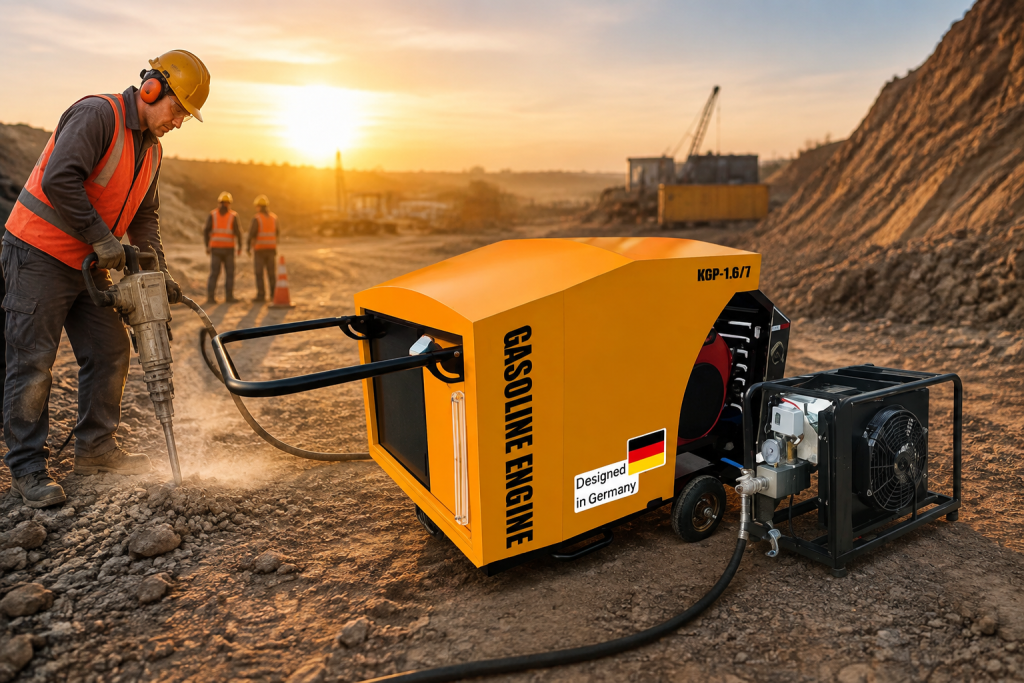
Construction projects: pneumatic breakers, air drills, sanders, cleaning tools, and general site support, with the ability to bring compressed air directly to the working area.
Drilling support: many drilling applications happen away from permanent infrastructure; portable gasoline compressors support drilling tools, field installation, pipe and cable work, and remote operations.
Sandblasting applications: compressed air quality and stability directly influence blasting results. The KGP Series can be fitted with an optional aftercooler and filtration setup to reduce moisture and contaminants for cleaner air.
Maintenance and repair operations: maintenance teams working across multiple locations get a flexible air source for equipment cleaning, pneumatic tools, and repair work.
Portable Gasoline Compressor vs. Electric Compressor
Choosing between gasoline and electric power depends entirely on the application.
| Gasoline Portable Compressor | Electric Compressor | |
|---|---|---|
| Power source | Fuel-powered | Requires electricity |
| Mobility | Excellent | Limited |
| Remote operation | Well-suited | Requires power availability |
| Installation | Simple | Usually fixed |
| Best application | Field work | Factory or workshop |
Neither option wins in every situation; the right choice depends on where and how the compressor will actually operate.
Is the KGP Series Right for Your Business?
The KGP Series is a strong choice when you need:
- Portable compressed air
- Outdoor operation
- Remote jobsite flexibility
- Independent power supply
- Easy transportation between sites
It’s likely not the ideal fit for large factories requiring continuous 24/7 air supply, high-volume production systems, or centralized compressed air networks. A stationary rotary screw compressor system is usually the better call there.
Further Reading
Related Applied Cases
Frequently Asked Questions
The KGP Series is a portable gasoline air compressor built for jobs where grid electricity isn't available or practical. It's commonly used for pneumatic tools on construction sites (breakers, drills, sanders), drilling support and pipe/cable installation, sandblasting, and general field maintenance and repair work.
No. It's powered entirely by a Honda GX630 gasoline engine (15.5 kW), so it runs independently of any electrical connection. That's the core reason it's used on remote sites, road projects, and locations where installing temporary power isn't worth the cost or delay.
They're three separate configurations of the same platform, each trading airflow for pressure: the KGP-1.6/7 delivers 1.6 m³/min at 7 bar, the KGP-1/10 delivers 1.0 m³/min at 10 bar, and the KGP-0.9/15 delivers 0.9 m³/min at 15 bar. Higher pressure means lower flow, so the right model depends on what your tool actually requires — not which number looks biggest.
It burns about 3.8 litres per hour under load and 2.8 litres per hour when unloaded, drawing from a 20-litre fuel tank — enough to cover a full working shift before refueling.
Operating weight is roughly 200–204 kg, with dimensions of about 1300 × 1050 × 900 mm. It's compact enough to fit in the back of a lorry, and comes with four side handles plus a foldable handle so it can be repositioned on site without a crane or forklift.
Not by default, but compact models can be fitted with an optional external aftercooler, condensate separator, and filter combination that delivers technically oil-free, drier air — useful for sandblasting finish quality or applications sensitive to moisture and oil carryover.
It includes a control panel with a pressure gauge, a running-hour counter, and a temperature sensor, so operators can catch pressure drift or overheating early and schedule maintenance based on actual running hours instead of guesswork.