Choose Reliable Compressed Air Equipment for Harsh Environments
Related topics (expand)
- compressed air solutions for mining operations
- reliable equipment for harsh environments
- portable air supply for remote locations
- compressor performance in extreme conditions
- outdoor industrial compressed air systems
- how to choose a mining air compressor
- portable air compressor for mining applications
- best air compressor for rock drilling
- mining compressor selection guide
- air compressor for drilling and construction
- reliable compressed air equipment for harsh environments
- diesel portable air compressor for mining
- gasoline portable air compressor for construction
- what size air compressor is needed for mining
- portable compressor for remote work sites
Why Mining Requires a Different Approach to Compressor Selection
Compressed air is a backbone utility in mining and heavy construction; it drives rock drills, powers pneumatic tools, and supports exploration and infrastructure work in places where no other energy source is practical. Because of that, a compressor failure doesn’t just idle one machine; it can stop a drilling crew, a blasting schedule, or an entire remote site.
Selecting a compressor for a mine site is a fundamentally different exercise than selecting one for a factory floor. A factory installation is fixed, powered from stable grid electricity, and operates in a controlled, predictable environment. A mine site offers none of that: it’s remote, dusty, subject to temperature extremes, often lacking reliable infrastructure, and the equipment itself has to move as the work moves.
Under those conditions, “reliable” means more than rated airflow and pressure on a spec sheet. It means the compressor can be transported without a crane, serviced by a two-person crew with basic tools, and kept running when dust and vibration are working against every moving part in the machine. The right selection process starts with the application what’s actually connected to the compressor and how it will be used not with picking the largest or highest-pressure unit available.
1. Understanding the Role of Compressed Air in Mining Applications
Mining operations use compressed air across a wide range of tasks, and each one places different demands on airflow, pressure, and equipment design.
Rock Drilling Operations
Drilling is the most air-intensive application on most sites. Pneumatic drills rely on a stable, uninterrupted air supply to drive the drilling mechanism, clear cuttings from the hole, and maintain a consistent penetration rate. When airflow or pressure drops even briefly, penetration rate falls off and cuttings can pack around the bit, both of which slow the crew down and increase bit wear.
Sizing a compressor for drilling requires working through four variables together, not in isolation: the air volume the drill actually consumes at full load, the working pressure the drill is rated for, the depth of hole being drilled (deeper holes mean longer air columns and more line loss), and how many drills or tools will run off the same compressor at once. As a rough reference point, a typical pneumatic rock drill in the 25–38 mm hole-diameter class consumes somewhere in the range of 2.5–4.5 m³/min at 6–7 bar; larger down-the-hole (DTH) hammers used for blast-hole drilling can require considerably more, sometimes 15–25 m³/min at higher pressure. These figures vary by manufacturer and bit design, so always confirm against the specific tool’s data sheet rather than a general guide.
Pneumatic Tools
Beyond drilling, portable compressors commonly power rock drills used for secondary breaking, jackhammers, pavement breakers, grinders, air guns, and sandblasting equipment. Each tool has a distinct air draw, and a common and costly mistake is sizing a compressor around pressure rating alone while ignoring cumulative airflow demand. A compressor that meets the pressure spec but falls short on volume will still starve connected tools the practical result is slow tool cycling, longer job times, and more fuel or electricity burned per unit of work completed.
Construction and Infrastructure Projects
Compressed air is also central to work where a permanent compressor installation isn’t practical road construction, bridge work, pipeline installation, underground utility work, and other temporary sites. In these settings, portability and quick setup/breakdown often matter as much as raw output.
2. Key Factors When Choosing a Mining Air Compressor
2.1 Airflow Capacity: Matching Compressor Output With Equipment Demand
Airflow, typically expressed in m³/min or CFM, is the single most important sizing parameter, and it’s the one most often gotten wrong. Sizing airflow correctly means adding up the air consumption of every tool that could realistically run at the same time, not just the single largest tool on site. Because tools are rarely run at 100% duty cycle simultaneously, engineers commonly apply a diversity (or simultaneity) factor often in the 0.6–0.8 range for a typical mixed-tool crew, rather than simply summing nameplate consumption, which would oversize the compressor. It’s also worth budgeting 10–15% headroom for future tools or line losses over long or worn hose runs, since undersizing is expensive to fix once a fleet is committed.
Undersizing causes pressure droop under load, which cascades into every tool connected to the line. Oversizing has its own cost: a compressor running well below its rated capacity burns more fuel per unit of delivered air and accelerates wear from constant load/unload cycling. The goal is a machine sized to the realistic peak demand of the site, not the theoretical maximum of every tool running at once.
2.2 Working Pressure Requirements
Required pressure varies by application; general pneumatic tools, rock drilling, sandblasting, pipeline testing, and specialized industrial processes all sit at different points on the pressure scale. As a reference range, KOTECH’s KGP Series portable gasoline compressors are available with working pressures from 7 to 15 bar and airflow from 0.9 to 1.6 m³/min, depending on model.
The rule is straightforward: match compressor working pressure to the equipment’s actual pressure requirement, not to whatever pressure the compressor happens to produce. Running above the required pressure wastes energy and accelerates seal and hose wear; running below it starves tool performance and can trip low-pressure cutoffs on sensitive equipment.
2.3 Mobility and Transportation Requirements
Mining compressors move with the job, which puts real design constraints on the machine: a compact footprint, a frame strong enough to survive repeated loading onto a flatbed or trailer, proper lifting points rated for the unit’s full weight, and trailer or towing compatibility where the unit needs to follow the crew across the site.
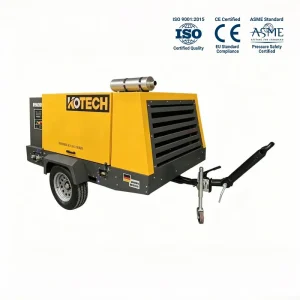
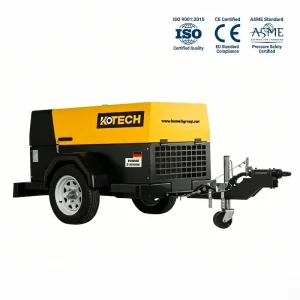
For light mobile applications, compact units offer the most flexibility. KOTECH’s KGP Series is built as a portable gasoline solution with a compact frame, lifting handles, a foldable handle design, and an operating weight of roughly 200 kg depending on configuration, making it practical to move by hand or small trailer.
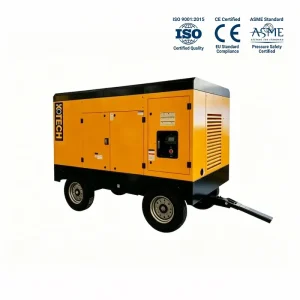
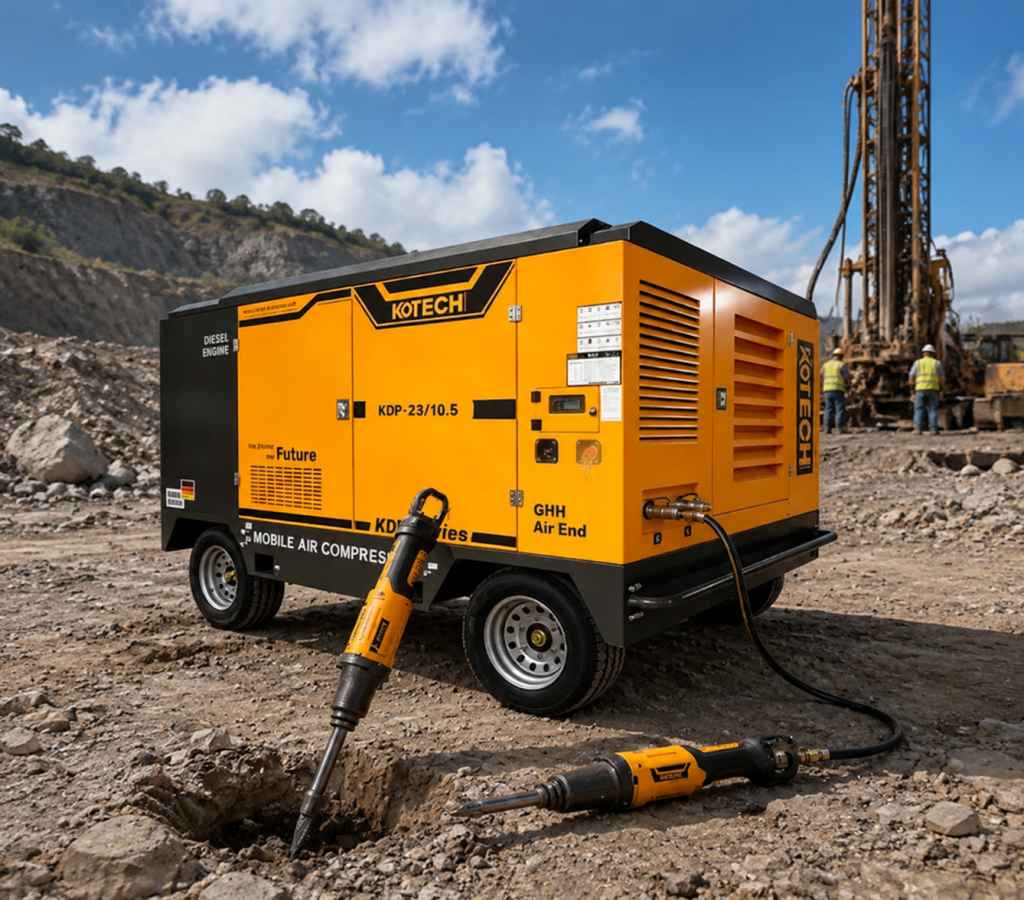
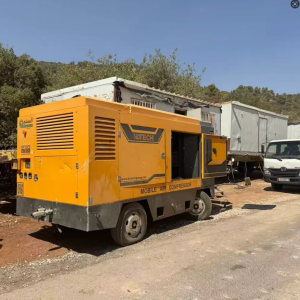
For higher-output mining and construction work, diesel portable compressors are the more common choice because they don’t depend on external power and can sustain longer, heavier-duty cycles in the field. KOTECH’s KDP Series is built specifically for mining, drilling, construction, and other demanding outdoor applications.
3. Selecting the Right Power Source
Gasoline Portable Compressors
Gasoline units suit small construction projects, maintenance work, mobile pneumatic tools, and any application where the compressor needs to be moved and set up quickly by one or two people. They’re compact, simple to deploy, and generally the lightest option in a given output class, but gasoline engines typically have a shorter service life under continuous heavy load than diesel, and fuel consumption per unit of work is usually higher, so they’re better matched to intermittent or shorter-duration tasks than to sustained multi-shift drilling. KOTECH’s KGP Series uses Honda GX630 gasoline engines and is built for portable applications needing flexible, on-demand air supply.
Diesel Portable Compressors
Diesel is the standard choice for heavier outdoor mining and drilling work, mining operations, drilling projects, remote construction sites, and long-duration outdoor use. Diesel engines generally offer better fuel efficiency per unit of compressed air delivered, longer service intervals, and more robust duty-cycle ratings for continuous multi-shift operation, at the cost of higher unit weight and upfront price than an equivalent gasoline machine. KOTECH’s KDP Series is built for mining and construction applications with configurations focused on mobility and sustained outdoor operation.
Electric Compressors
Where reliable grid or generator power is already available, electric compressors offer lower emissions at the point of use, simpler energy management, and generally lower maintenance requirements than combustion engines. Their practical limitation on a mine site is dependency on stable electrical infrastructure; without it, an electric unit either needs a dedicated generator (which adds its own fuel and maintenance burden) or isn’t a realistic option for a remote or frequently relocated location.
Oil-Free vs. Oil-Lubricated Design
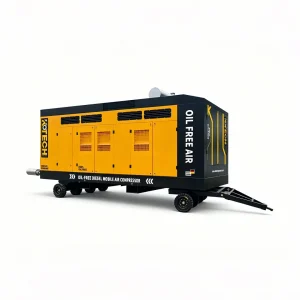
The choice between oil-free and oil-lubricated (oil-injected) compressor elements is a separate axis from fuel type, and it matters for specific mining applications. Oil-lubricated units are the standard for general pneumatic tools, drilling, and construction work; they’re more efficient and less expensive per unit of output. Oil-free units are typically required for applications where any trace of oil carryover into the airstream is unacceptable, most notably breathing air for mine rescue or confined-space work, and some sandblasting or coating operations where oil contamination would ruin the finish. Confirm which category a given application falls into before specifying, since retrofitting oil-free capability after the fact is not straightforward.
4. Environmental Challenges and Compressor Design Considerations
Dust and Contamination Protection
Mine sites generate heavy dust loads, and dust ingestion is one of the leading causes of premature compressor failure in the field. Fine particulate degrades air filter life, fouls cooling fins and reduces heat rejection, accelerates wear on engine internals, and shortens component life across the machine. Filtration needs to be matched to site conditions; heavy-dust environments generally call for higher-capacity or multi-stage intake filtration and shorter filter-change intervals than the manufacturer’s default schedule assumes, and filters should be inspected on a fixed schedule (daily visual check, filter change or cleaning typically every 50–100 operating hours in dusty conditions) rather than left to run until performance visibly drops.
Temperature and Altitude Conditions
Ambient temperature affects cooling efficiency, engine performance, and overall reliability, and outdoor compressors need to be rated for the actual conditions they’ll face rather than a generic average. KOTECH’s KDP Series is designed for outdoor use, with published specifications supporting operation in ambient temperatures up to 50°C for certain configurations.
Altitude is a related factor that’s easy to overlook: both engine power and compressor airflow output derate as elevation increases, because the air is less dense. As a general engineering rule of thumb, expect roughly 3–4% loss in output for every 300 m of elevation above about 1,000 m, though the exact derating curve depends on the specific engine and compressor design. For high-altitude mine sites, this needs to be factored into sizing up front — a compressor sized correctly at sea level can fall meaningfully short of site airflow requirements once installed at elevation.
Vibration and Transportation
Mining equipment runs on uneven ground and gets relocated often, both of which stress the frame and internal components over time. A compressor built for this environment should have a structurally reinforced frame, transportation stability (low center of gravity, secure mounting points for tie-down), and maintenance access points that remain reachable even when the unit is mounted on a trailer or skid.
5. Portable Compressor vs. Stationary Compressor for Mining
| Factor | Portable Compressor | Stationary Compressor |
|---|---|---|
| Mobility | High — designed for frequent relocation | Low — fixed installation |
| Remote operation | Well suited; self-contained diesel/gasoline options | Requires existing power and site infrastructure |
| Typical duty cycle | Intermittent to continuous, depending on engine type | Continuous, industrial-grade |
| Typical airflow range | ~0.5–25+ m³/min depending on model | Often larger, centralized capacity |
| Installation | Minimal — towed or skid-mounted | Permanent foundation, piping, and electrical work |
| Best application | Mining, drilling, construction, temporary sites | Factories, plants, and fixed industrial facilities |
| Power options | Diesel, gasoline, or electric | Predominantly electric |
| Relative footprint/cost | Lower upfront cost, higher cost per unit of air at large scale | Higher upfront cost, lower cost per unit of air at scale |
For temporary projects and remote locations, portable compressors generally offer the better balance of flexibility and independence. For permanent industrial facilities with stable infrastructure, stationary systems can offer better efficiency and centralized management at scale.
6. Common Mistakes When Selecting Mining Compressors
Choosing only by horsepower. Horsepower is an input to the compressor’s performance, not a measure of it. Two machines with the same horsepower rating can deliver meaningfully different airflow depending on compressor efficiency and design — airflow, pressure, and application fit are what actually determine suitability.
Ignoring actual tool requirements. Before specifying a compressor, list every piece of connected equipment, note how many will realistically run at once, and confirm the required performance against that list rather than a rule of thumb.
Overlooking maintenance conditions. Remote sites often have limited access to technical support, so maintenance accessibility, local spare-parts availability, and realistic service intervals need to be part of the selection decision, not an afterthought once the machine is already on site. A reliable design should minimize unplanned downtime, and that starts with choosing equipment the site can actually keep running.
Selecting without margin for future needs. Mining projects evolve — additional equipment, deeper drilling, or new working areas can all increase demand over the life of a project. Building in reasonable capacity margin up front is generally cheaper than a mid-project replacement.
Skipping air treatment considerations. Moisture and particulate in the compressed air line degrade drilling performance and shorten tool life, particularly in humid climates or during wet drilling. Depending on the application, an aftercooler, moisture separator, or receiver tank sized for the system may be necessary — this is often left out of initial specs and added later at extra cost.
7. KOTECH Portable Air Compressor Solutions for Mining and Construction
KOTECH develops portable compressed air solutions for mining, construction, drilling, sandblasting, and other industrial outdoor applications where a factory-grade compressor isn’t a practical fit.
The KGP Series provides a compact portable gasoline solution built for mobility and flexible, short-duration deployment. For heavier mining and construction demand, the KDP Series provides portable diesel solutions engineered for outdoor, heavy-duty operation and extended duty cycles.
Selecting the right model comes down to matching required airflow, working pressure, application type, transportation requirements, and site environmental conditions against the specific model’s rated specifications — not defaulting to the largest unit in the lineup.
8. Final Thoughts: Reliability Starts With Correct Selection
Choosing a mining air compressor isn’t a matter of picking the highest pressure or largest capacity model available. It’s a matter of sizing airflow and pressure to the actual connected equipment, choosing the right power source and lubrication type for the application, accounting for dust, temperature, and altitude at the specific site, and confirming the machine can realistically be maintained where it’s going to operate.
A compressor that performs well in a controlled factory setting is not automatically the right choice for a remote mine site — the two environments demand different engineering priorities. When airflow, pressure, mobility, and durability are sized correctly against real working conditions, a portable compressor stops being just a power source and becomes a dependable part of keeping mining and construction operations moving.
Further Reading
- Rotary Screw Air Compressor Maintenance Guide
- Centrifugal Air Compressor Engineering: Principles, Selection, and Industrial Applications
- The Hidden Cost of Compressed Air: Why the Lowest Purchase Price Is Not Always the Best Choice
- How Can I Choose the Right Air Compressor for My Business?
- Compressed Air Solutions – Fire Truck Foam Sy
- 5 Questions You Must Answer Before Buying an Air Compressor.
- Oil Refineries, Chemical Plants, Ports, and Industrial Sites — Kotech's Diesel Air Compressor Powers Foam Systems Where It Matters Most.
- Pure Air, Zero Risk: KOTECH Oil-Free Compressors for Airports.
Related Applied Cases
Frequently Asked Questions
Mining operations commonly use portable diesel or gasoline compressors depending on airflow requirements, pressure needs, and site conditions.
Key factors include airflow capacity, working pressure, mobility, power source, environmental conditions, and maintenance requirements.
Portable compressors allow compressed air generation at remote locations where fixed compressor systems are difficult to install.
The required pressure depends on drilling equipment, operating conditions, and application requirements.
Compact gasoline compressors are suitable for smaller mobile applications. Larger mining and drilling operations usually require higher-capacity diesel portable compressors.