How to Choose the Right Air Compressor for Your Business
A few months back, we got a call from a plant manager whose electricity bill had jumped well beyond what anyone expected after installing a new compressor. On paper everything looked fine. The unit had enough capacity, the pressure rating matched the spec sheet, and production hadn’t missed a beat.
Turned out the compressor wasn’t the issue. Whoever designed the system had sized it for the plant’s absolute peak demand and stopped there — never looked at what happened the rest of the day, when demand was much lower and the compressor was still running, just not doing much useful work.
We see this more often than you’d think.
Picking the right compressor isn’t really about matching a motor to a number on a spec sheet. It’s about understanding what happens to that air from the moment it’s compressed to the moment it’s used — and a system that’s actually well designed holds steady pressure, runs reliably, and doesn’t waste energy doing it.
Start With the Process, Not the Compressor
Before you even look at compressor models, you need to understand what’s actually consuming the air.
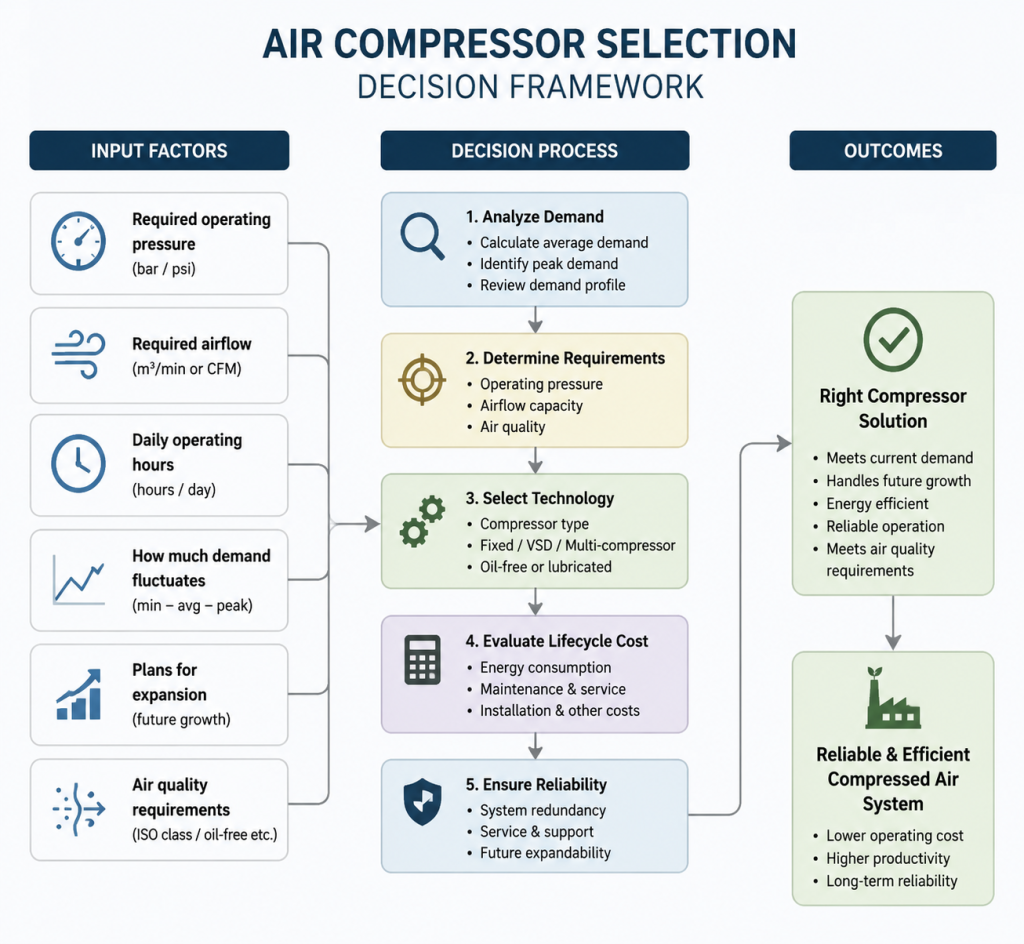
No two plants have the same demand curve. A line running around the clock is a completely different problem than a workshop where a couple of air tools get used a few hours a day. So before anyone specs equipment, it’s worth working through.
Say a plant runs at 7 bar, averages 18 m³/min, but hits 30 m³/min at peak, across 6,000 hours a year. If you size the system for that 30 m³/min peak and call it done, you’ve built something that spends most of its life running well below where it’s efficient. The real work is in balancing what happens at peak against what happens the other 90% of the time.
Don’t Assume Bigger Is Better
This is probably the most common mistake we run into: sizing for the worst case and nothing else.
A bigger compressor gives you headroom, sure. But if it spends most of its time loafing along under its efficient operating range, you’re paying for that headroom every single hour, whether you need it or not. Take a 110 kW unit sized for a 25 m³/min peak — if the plant’s actual average is 12-15 m³/min, that compressor is going to spend a lot of time unloading or cycling inefficiently. Add that up over a few thousand hours and it’s real money.
What we actually look at is average demand, minimum demand, how long peaks last, the load/unload pattern, and what kind of control the compressor uses.
A lot of the time, the better answer isn’t one big compressor — it’s two or three working together. One fixed-speed unit handling the steady base load, a variable-speed unit tracking the swings, and something held in reserve for when things break. That combination tends to track actual demand far better than a single oversized machine ever will.
Pressure Costs More Than People Realize
Everyone pays attention to airflow. Pressure gets ignored, and it shouldn’t.
Pushing discharge pressure higher takes more energy, full stop. And a lot of plants are running higher pressure than they actually need — not because production requires it, but because the distribution system is leaky, undersized, or badly laid out, and cranking up the compressor is the easiest way to compensate.
Say a process only needs 7 bar at the point of use, but the compressor’s running at 8.5 bar just to make up for losses along the way. That extra 1.5 bar isn’t helping anyone downstream — it’s just paying for bad piping, blocked filters, too many fittings, or a distribution run that’s too long to begin with.
As a rough rule of thumb, every extra bar of discharge pressure adds somewhere around 6-7% to your energy bill. Good practice is keeping total pressure drop across the distribution system under about 0.3-0.5 bar. Most plants we’ve measured are running well above that without realizing it.
Leaks Are Where the Money Actually Goes
We’ve walked into plenty of facilities with a perfectly good, efficient compressor — and a distribution system leaking air out of a dozen fittings nobody’s looked at in years.
One leak on its own doesn’t seem like much. Run it continuously for a year and it adds up fast.
Here’s a rough sense of scale: a 3mm hole at 7 bar line pressure typically loses somewhere around 1 m³/min of free air. Run that continuously across 6,000 hours a year and you’re looking at roughly 360,000 m³ of wasted air. At a typical 0.11-0.13 kWh per m³ for a 7 bar system, that’s somewhere in the neighborhood of 4,000-5,000 kWh a year from a single leak — and most plants have more than one.
Before anyone starts talking about replacing the compressor, it’s worth walking the plant and checking:
- Pipe connections
- Quick couplings
- Valves
- Pneumatic tools and equipment
- Lines that aren’t even in use anymore
Half the time, the cheapest upgrade available is just fixing what’s already there.
Air Quality Depends Entirely on What You’re Doing With It
Compressed air looks clean coming out of the line. It isn’t. Ambient air carries moisture and oil, and compression concentrates all of it.
How much that matters depends on the job. General manufacturing can usually get by with basic filtration and moisture removal. Paint lines need it drier and cleaner to avoid surface defects. Food and pharma work often needs oil-free air entirely. Electronics manufacturing gets even stricter about contamination.
Getting from raw compressed air to something usable typically means dryers (refrigerated or desiccant), line filters, oil-water separators, receivers, and some way of monitoring all of it. The compressor is just the starting point — everything after it decides whether that air is actually usable.
The Price Tag Is the Smallest Number in This Decision
A lot of buyers focus on the purchase price and stop there. For industrial compressors, that number is usually the least important part of the total cost.
Energy is where the real money goes. Run a 90 kW compressor for 6,000 hours a year over ten years, and the electricity cost over that lifetime dwarfs what you paid for the machine. Which also means a small efficiency improvement, compounded over a decade, ends up mattering a lot more than people expect going in.
When we run the numbers properly, we’re looking at the purchase price, energy use, maintenance, parts, service, and expected service life — together, not the purchase price on its own.
The compressor that’s cheapest to buy is rarely the one that’s cheapest to run.
Reliability Isn’t Optional
In a lot of plants, if the compressed air stops, production stops with it. Equipment shuts down, quality can slip, and the clock starts running on downtime.
The real cost of a compressor failure almost never shows up on the repair invoice. It shows up in what wasn’t produced while the line was down.
That’s why reliability planning looks past the spec sheet, at things like the compressor’s actual track record, how fast service can get on site, whether parts are actually available, and what kind of remote monitoring and preventive maintenance is in place.
Build for Where the Business Is Going, Not Just Where It Is
A system sized exactly to today’s demand tends to become a problem in two or three years, once production grows or new equipment gets added.
Worth asking before you finalize anything: is capacity likely to grow? Is more pneumatic equipment coming? Is demand going to get more variable? Is there even room in the compressor room for a second unit down the line?
Planning for that now is almost always cheaper than tearing out an undersized system later.
It Comes Down to the Whole System, Not the Nameplate
Choosing a compressor was never really about matching a kW number to a job. It’s about understanding how that machine fits into the process, the building, and the business around it.
A system that’s actually working well gives you stable pressure, the right airflow, low energy use, real reliability, manageable maintenance, and room to grow.
The right compressor isn’t the biggest one on the shelf. It’s the one sized to what the business actually needs — running efficiently, reliably, and consistently, for as long as it’s in service.
If you’re not sure where your own system stands, an air audit — actual demand profile, pressure drop, leak load, all measured rather than assumed — is usually the fastest way to find out whether the problem is the compressor, or everything hanging off of it.
We see this more often than you’d think.
Picking the right compressor isn’t really about matching a motor to a number on a spec sheet. It’s about understanding what happens to that air from the moment it’s compressed to the moment it’s used — and a system that’s actually well designed holds steady pressure, runs reliably, and doesn’t waste energy doing it.
Further Reading
- 5 Questions You Must Answer Before Buying an Air Compressor.
- Oil Refineries, Chemical Plants, Ports, and Industrial Sites — Kotech’s Diesel Air Compressor Powers Foam Systems Where It Matters Most.
- Pure Air, Zero Risk: KOTECH Oil-Free Compressors for Airports.
- Single-Stage or Two-Stage? Kotech Compressor Delivers 80–88% Efficiency for Demanding Industrial Applications
- KOTECH compressor – Why Does Two-Stage
- Could a Drop of Oil Ground Your Entire Fleet? KOTECH Oil-Free Compressors Keep Airport Operations Safe.
- Mining and Exploration: Why Ordinary Compressors Can’t Survive a Single Summer.
- Pure Air, On Demand: KOTECH Oil-Free Compressors Keep Airports Operating Without Interruption.
Further Reading
- Rotary Screw Air Compressor Maintenance Guide
- How to Choose Reliable Compressed Air Equipment for Harsh Environments
- Centrifugal Air Compressor Engineering: Principles, Selection, and Industrial Applications
- The Hidden Cost of Compressed Air: Why the Lowest Purchase Price Is Not Always the Best Choice
- 185 CFM diesel air compressor – Fire Truck Foam Sy
- 5 Questions You Must Answer Before Buying an Air Compressor.
- Oil Refineries, Chemical Plants, Ports, and Industrial Sites — Kotech's Diesel Air Compressor Powers Foam Systems Where It Matters Most.
- Pure Air, Zero Risk: KOTECH Oil-Free Compressors for Airports.
Related Applied Cases
Frequently Asked Questions
Almost always a slow pressure drop building up in the distribution system — a clogged filter or new leak. Check filter differential pressure first.
Not necessarily. Often the compressor has spare capacity and the new line just needs its own properly sized piping run.
Check the pressure setpoint against what it was before. Technicians sometimes bump it up "for safety" without flagging it.
Look at compressor room ventilation before the unit itself — this is common once a second compressor or other equipment moves in nearby.
Usually a dryer mismatched to actual airflow, or a receiver drain that's stopped working. Worth checking seasonal ambient conditions too.