Key Takeaways
Every high-risk industrial site shares one non-negotiable safety requirement: firefighting equipment that works perfectly, every single time, under the worst possible conditions. Refineries process unstable hydrocarbons, chemical facilities house reactive hazardous substances, and ports manage round-the-clock fuel transfers and high-risk cargo operations. All of these sites face persistent, fast-spreading fire threats that demand top-tier suppression technology.
Compressed Air Foam Systems (CAFS) have become the go-to firefighting solution for these harsh industrial environments. Far more effective than traditional water-only firefighting, CAFS cuts water usage by up to 85%, extinguishes fires faster, and leaves a foam blanket that stops re-ignition cold.
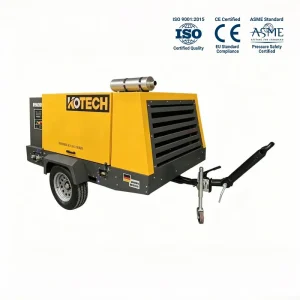
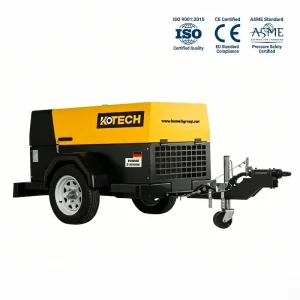
A CAFS system is only as good as its air supply. Without steady, high-pressure compressed air, foam consistency and performance fail when you need it most. Kotech’s diesel-driven compressor modules deliver a reliable 5m³/min airflow at 20 bar — the exact air output needed for stable foam generation and long-distance delivery. Running on a standalone diesel power unit, these compressors work entirely independent of grid power or fire truck engines, delivering dedicated air power for the most demanding industrial firefighting emergencies.
Introduction: Why High-Risk Sites Need Dedicated Air Power
Fire emergencies at refineries, chemical plants, port terminals and heavy industrial sites operate by different rules than standard commercial fires. Flammable liquids, volatile vapors and toxic chemicals can turn a small ignition into a site-wide catastrophe in minutes. Standard firefighting tactics simply cannot keep up with these fast-evolving hazards.
Plain water lacks the cooling ability, smothering power and re-ignition resistance needed for industrial fire protection. Facilities handling hazardous materials rely on Compressed Air Foam Systems to deliver fast, targeted, long-lasting fire suppression that addresses the unique risks of industrial blazes.
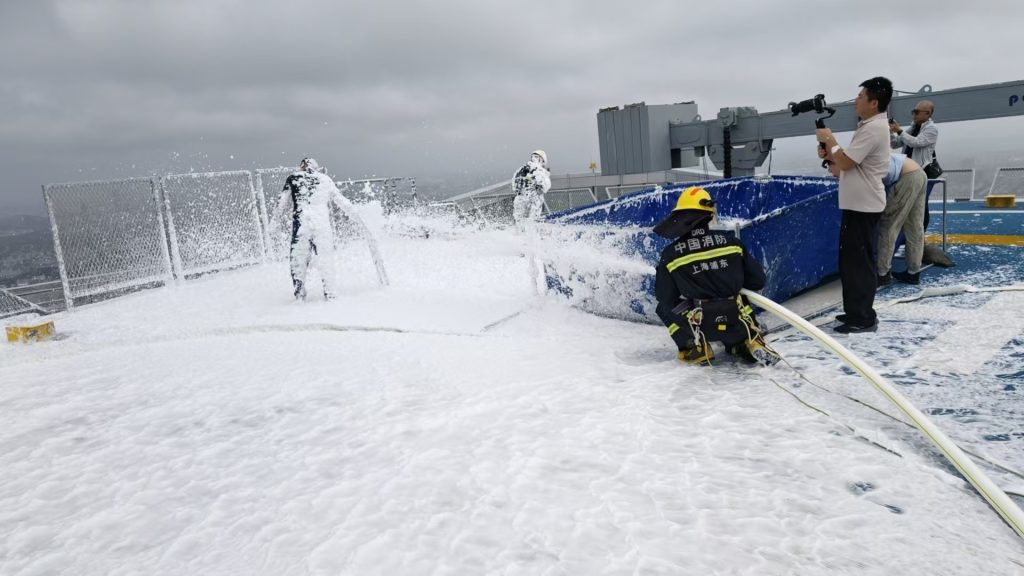
CAFS works by precisely blending water, foam concentrate and compressed air inside a specialized mixing chamber. The controlled aeration process creates a homogeneous, high-energy foam that outperforms conventional foam in every critical category. This field-proven foam delivers four key operational advantages:
- Strong surface adhesion — clings firmly to equipment, tanks and structural surfaces to form a durable fire-resistant barrier and prevent re-ignition
- Superior cooling efficiency — expanded foam surface area dissipates heat far faster to cool overheated assets
- Deep penetration — reduced surface tension lets foam seep into burning materials for complete suppression
- Massive water savings — slashes water consumption and eliminates costly secondary water damage to site infrastructure
None of these benefits hold up with an unreliable air supply. In industrial fire safety, inconsistent compressor performance equals inconsistent foam — a critical vulnerability no high-risk facility can afford.
A Real Story: When Foam Systems Made the Difference
CAFS reliability and efficiency is not theoretical — it has been field-proven in some of the world’s most demanding and precision-critical environments. CERN, the European Organization for Nuclear Research, put CAFS technology through rigorous full-scale testing to validate its safety and performance for sensitive underground infrastructure, including the Large Hadron Collider.
Over 10 days of intensive live-fire trials, teams completed 33 separate tests, burning more than 240 pallets and full electronic equipment assemblies to simulate extreme emergency conditions. The results spoke for themselves: CAFS delivered up to 85% water savings while extinguishing fires noticeably faster than traditional water-based methods.
Today, CAFS systems are fully operational within CERN’s SPS and LHC tunnels, with ongoing rollouts across its North Area facilities. If this technology is trusted to protect the world’s most advanced scientific infrastructure, it is more than capable of safeguarding industrial sites, refineries and port facilities worldwide.
In Australia, Fire and Rescue NSW invested $560,000 in state-of-the-art CAFS Class 2 Pumper Trucks to upgrade municipal and industrial emergency response capabilities. The upgraded CAFS setup lets firefighters tackle structure fires, chemical blazes, petrol fires and wild grass fires with 80% less water than legacy equipment. It also significantly reduces smoke output during active fires, boosting on-site visibility and protecting firefighter safety.
The Technology Behind Kotech’s Diesel-Driven CAFS Compressor
Independent Diesel Drive — No External Power Required
Kotech’s modular CAFS compressors feature a fully independent diesel drive system, requiring no connection to fire truck engines, vehicle power systems or on-site electrical grids. This standalone power design is a game-changer for emergency response, especially in scenarios where:
- Fire damage disables fire truck engines and onboard power systems
- Site power lines are destroyed or offline during emergencies
- Response teams operate in remote, off-grid industrial zones with no grid access
6 m³/min Stable Air Delivery at 20 Bar
The unit consistently delivers 5 m³/min (176 CFM) of airflow at a steady 20 bar working pressure, generating the high-pressure, uniform air supply professional CAFS operations depend on. This robust, stable output supports:
- Consistent foam quality — uniform bubble structure and expansion ratio for reliable fire suppression
- Long-range foam delivery — effective discharge across large storage yards, tank farms and dock facilities
- Simultaneous multi-nozzle operation — supports multiple foam monitors and turrets working in coordination
Industry standards for CAFS typically ask for 70–100 CFM at 8–10 bar. Kotech’s 176 CFM at 20 bar goes well beyond those requirements, giving firefighters extra power when they need it most.
Vehicle-Mounted Integration
The compressor module’s compact, vehicle-mounted design fits cleanly onto fire trucks, rescue vehicles and specialized industrial rigs. Practical advantages include:
- Modular build — adapts to most existing vehicle platforms
- Space-efficient layout — leaves room for other critical rescue equipment
- Low-maintenance layout — easily accessible components simplify daily inspections and fast on-site servicing
Multiple Safety Protections
Kotech diesel compressors come with integrated safety systems designed for hazardous industrial conditions:
- High-temperature shutdown — protects against overheating damage
- Overpressure protection — prevents dangerous pressure spikes
- Low oil pressure shutdown — safeguards the diesel engine from lubrication failure
- Full-condition fault interlocks — automatic shutdown for any critical malfunction
These safety layers eliminate the risk of equipment failure in environments where downtime is not an option.
Why Kotech for Industrial Firefighting?
British Engineering Heritage
KOTECH is a UK-based air compressor brand with R&D roots in British engineering and global manufacturing reach. The brand combines engineering precision with practical field experience, building equipment that holds up under extreme conditions.
Proven in Firefighting Applications
Kotech’s diesel-driven compressor modules are purpose-built for fire truck foam systems, delivering the pressure and flow that modern CAFS technology demands. The 20 bar high-pressure output enables foam delivery over long distances and heights — essential for refinery tank farms, port terminals, and sprawling industrial complexes.
Built for the Toughest Environments
Kotech compressors are designed to handle the harshest industrial firefighting conditions, with proven performance in:
- Oil depot and chemical plant fire emergencies
- General industrial firefighting for manufacturing and processing facilities
- Port and dockside operations
- Multi-purpose emergency rescue vehicle integration
Key Applications
Oil Depot & Chemical Plant
Refineries and chemical plants face extreme fire risks from flammable liquids and volatile gases. These sites require explosion-proof, safety-certified equipment as standard. Kotech’s standalone diesel compressor ensures continuous foam generation even when facility power fails during an emergency.
Industrial Firefighting
Manufacturing plants, warehouses and processing facilities need versatile, high-performance firefighting systems. Kotech modular compressors integrate into mobile fire trucks or fixed on-site systems, delivering the high-pressure air needed for full-coverage foam protection across large operational areas.
Port & Dock Applications
Ports handle massive volumes of flammable cargo daily, requiring long-range, high-volume foam deployment. Kotech’s 20 bar high-pressure output enables extended foam discharge ranges, allowing firefighters to reach cargo ships, storage tanks, and dockside infrastructure effectively.
Emergency Rescue Vehicles
For rapid response to diverse emergencies, Kotech compressor modules fit cleanly onto dedicated rescue vehicles. The independent diesel power system ensures full operational capability at any location, with no reliance on external power or vehicle engine performance.
Conclusion
In high-risk industrial firefighting, the difference between a contained incident and a catastrophic disaster often comes down to the equipment you have on hand. Compressed Air Foam Systems have proven their worth in the world’s toughest environments—from CERN’s underground tunnels to Australian industrial firegrounds.
But a CAFS system is only as good as its air supply. Kotech’s diesel-driven compressor delivers stable 6m³/min at 20 bar—the exact performance spec professional foam systems require. With independent diesel power, vehicle-mounted integration, and comprehensive safety protections, Kotech provides the air power that foam systems rely on.
For oil refineries, chemical plants, port terminals, and industrial sites worldwide, Kotech delivers mission-critical air power—where reliability matters most.
Frequently Asked Questions
Q1: Why do foam systems need high-pressure air?
CAFS systems blend air, water and foam concentrate in a mixing chamber. Compressed air expands the mixture to create a uniform, high-energy foam structure. Higher pressure extends delivery range, improves flame penetration, and delivers more effective suppression.
Q2: What’s the advantage of diesel-driven over PTO-driven systems?
Diesel-driven compressors run completely independently of the fire truck’s engine and transmission. The unit keeps running even when the vehicle is stationary or the engine is off. This reduces drivetrain wear and allows simultaneous full-capacity pump and compressor operation.
Q3: How much water does CAFS save compared to traditional methods?
CAFS cuts water consumption by up to 85% compared to conventional water-based firefighting. This minimizes secondary water damage and enables effective response where water supply is limited.
Q4: What fire types can CAFS handle?
CAFS is effective against Class A (solid materials), Class B (flammable liquids), and certain chemical fires. The foam forms an oxygen-blocking blanket that smothers flames, cools surfaces, and stops re-ignition.
Q5: Where can I find Kotech compressors for fire trucks?
Kotech supplies diesel-driven CAFS compressor modules for fire truck integration through our global distribution network. Contact our industrial firefighting specialist team to discuss your vehicle specifications and application requirements.
Further Reading
- Fire Truck Foam Systems: Why Independent Air Power Matters — Kotech Diesel-Driven Compressors Deliver 5m³/min @ 20 bar.
- 5 Questions You Must Answer Before Buying an Air Compressor.
- Pure Air, Zero Risk: KOTECH Oil-Free Compressors for Airports.
- Single-Stage or Two-Stage? Kotech Compressor Delivers 80–88% Efficiency for Demanding Industrial Applications
- industrial diesel air compressor – Why Does Two-Stage
- Could a Drop of Oil Ground Your Entire Fleet? KOTECH Oil-Free Compressors Keep Airport Operations Safe.
- Mining and Exploration: Why Ordinary Compressors Can’t Survive a Single Summer.
- Pure Air, On Demand: KOTECH Oil-Free Compressors Keep Airports Operating Without Interruption.
Related Applied Cases