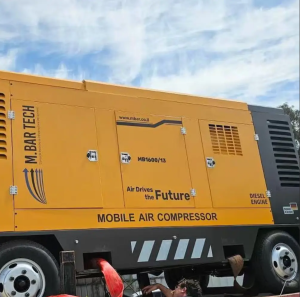
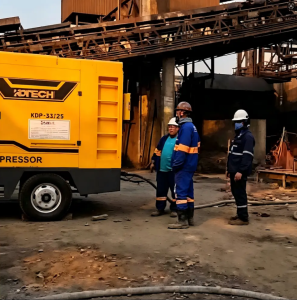
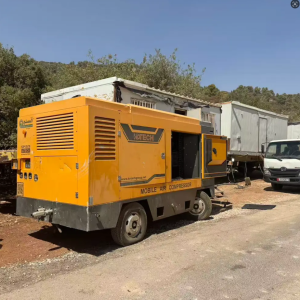
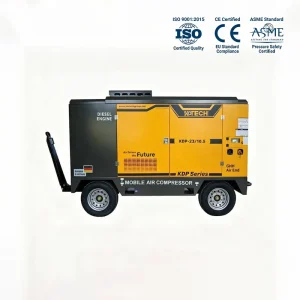
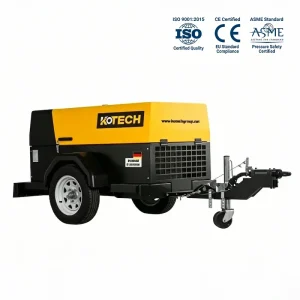
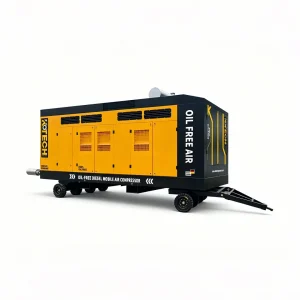
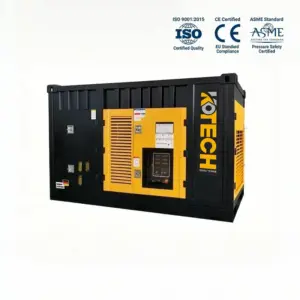
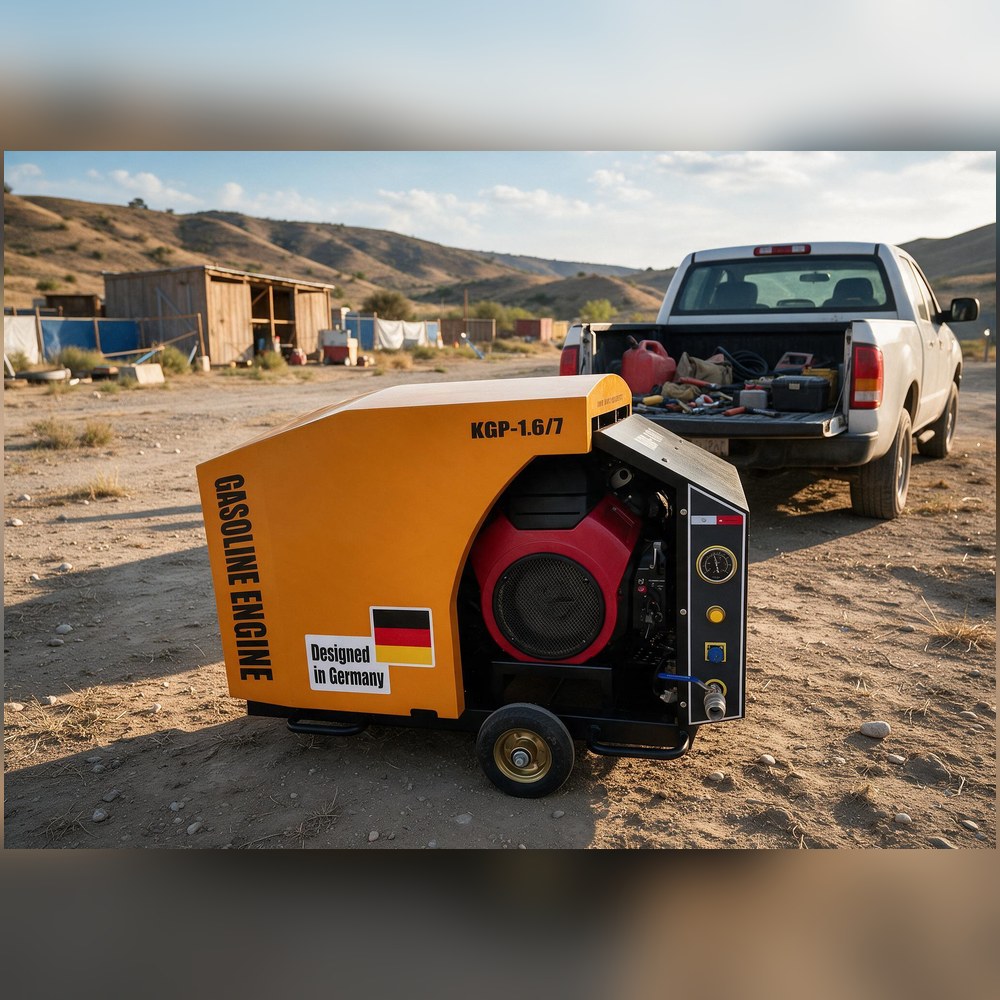
For small contractors working far from the grid, the first equipment question is often diesel versus petrol. Diesel portable compressors dominate large construction and mining fleets, but that does not make them the right answer for every remote job. A lightweight gasoline screw compressor can be moved by two people, refuelled from cans carried on a pickup, started instantly in cold weather and used indoors-adjacent spaces where diesel exhaust is unwelcome. It also gives up something: continuous-duty stamina, peak CFM and fuel economy under long runs. This guide compares the two drives honestly and shows where the compact KOTECH KGP gasoline range, powered by a Honda GX 630 engine, wins — and where diesel still deserves the order.
The jobs where petrol wins
Gasoline portable compressors earn their place on jobs that are small, mobile and intermittent: fence and sign installation, utility service connections, roofing and gutter crews, field repair teams, agricultural maintenance, railway and telecoms civils, and contractors who run a nail gun, small breaker or blower for part of the day rather than continuously. On these jobs the compressor is loaded onto and off a truck several times a day, so weight matters more than maximum output.
Petrol also wins where fuel logistics favour it. Many small contractors already carry gasoline for plate compactors, generators, cut-off saws and water pumps, so one fuel can serves the whole crew. In high-altitude mountain work, gasoline engines are sometimes preferred for easier cold starting and simpler aspiration on small frames, and in residential or indoor-adjacent work — basements, parking structures, retail fit-outs with open walls — a petrol unit can be positioned closer to the work with less exhaust and odour than a diesel, provided it is always operated in a ventilated area per the manufacturer’s instructions.
- Frequent repositioning and two-person lifting: a 200 kg class petrol frame beats a 700 kg plus diesel enclosure.
- Crews already running gasoline saws, generators and compactors share one fuel supply.
- Intermittent tool use — nail guns, blowers, small breakers — rather than all-day blasting.
- Cold-start and altitude sensitivity on small jobs, where petrol starts without the diesel warm-up routine.
Where diesel still deserves the order
Diesel’s advantages are structural rather than incidental. Diesel engines are built for continuous full-load running, hour after hour, with thermal margins and service intervals sized for hire-fleet abuse. Fuel consumption per unit of compressed air is lower, and diesel fuel itself is often cheaper and safer to carry and store in bulk on remote sites. Compression-ignition engines also typically outlast petrol equivalents by a wide margin in accumulated hours, which is why large frames from 185 CFM upward are almost exclusively diesel.
So the crossover is about duty and scale. If a breaker or blast pot runs most of the working day, if the machine is rented out to unknown operators, if the job is in a remote mining or pipeline camp with bulk diesel on hand, or if the crew needs 200 CFM or more, a diesel KDP frame is the lower-risk choice. If the work is short-duty, the crew is small and the machine lives on the back of a pickup, petrol is usually cheaper to buy, easier to live with and faster to deploy.
Real KOTECH KGP gasoline specifications
Current factory figures from the KOTECH product page. All KGP frames use the Honda GX 630 petrol engine at 15.5 kW.
Pressure and flow trade off inside the same power envelope, so choose the rating that matches the tool: 57 CFM at 7 bar for volume air, or 30 CFM at 15 bar when the tool genuinely needs high pressure. Running a 7 bar tool from a 15 bar frame wastes the capability the engine was bought for.
Total-cost comparison on a remote job
Purchase price favours petrol in the small class, and so does mobilisation cost: no trailer licence concerns for the lightest frames, no forklift needed, less tie-down, lower transport weight. Operating cost per hour can favour either side depending on fuel prices and load profile — diesel burns less fuel per CFM under continuous load, but a correctly sized petrol engine running only when tools need air can still cost less per day on intermittent work.
Maintenance calendars differ more than complexity. Petrol engines need spark plugs, ignition care and carburettor or injection service, and they are more sensitive to stale fuel after storage; diesel engines need fuel-filter and injector care plus periodic oil changes but no ignition system. For fleets that park machines for weeks between jobs, specify fresh-fuel discipline or fuel stabiliser on either type, and drain or run the tank down before long storage. Residual value usually favours diesel in markets where second-hand compressors are bought by hire companies.
Specifying checklist for contractors
Decide from the actual duty cycle rather than habit. Time the tools: a crew that fires a nailer and breaker for perhaps two hours of an eight-hour day has a very different compressor from a crew sandblasting continuously. Add the simultaneous CFM as for any compressor selection, check the highest pressure rating among the tools, and count how many times per day the machine will be lifted or towed. Then weigh the fuel already carried by the crew, the expected resale route, and local service for the engine brand. Going through that checklist honestly puts most small, mobile, intermittent jobs on petrol and most continuous, heavy, high-CFM jobs on diesel — which is exactly how the two product ranges were designed to be used.
Buying tips
- Choose petrol for intermittent, mobile, small-tool jobs and diesel for continuous duty above roughly 185 to 200 CFM.
- Match the KGP pressure rating to the tool: 15 bar for high-pressure tools, 7 bar for volume air.
- One shared gasoline fuel can for saws, generators and the compressor simplifies remote logistics.
- Plan fresh-fuel discipline; petrol engines are more sensitive to stale fuel after storage.
- Prefer a world engine such as Honda so parts and mechanics are available in remote regions.
Frequently asked questions
Are gasoline portable air compressors any good for contractor work?
Which is cheaper to run on a remote job, petrol or diesel?
Can a gasoline compressor be used indoors or in a basement?
What can a 57 CFM KGP-1.6/7 actually power?
How important is the engine brand on a small portable compressor?
Does altitude affect gasoline compressors more than diesel?
Tell us your tools, their CFM and pressure, and how often the machine will move each day — we will help you choose between the KOTECH KGP gasoline range and a diesel KDP frame for the remote job.
Related Applied Cases