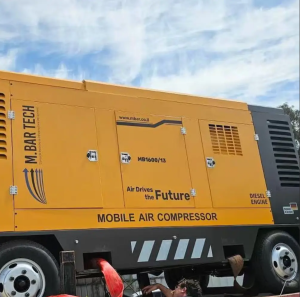
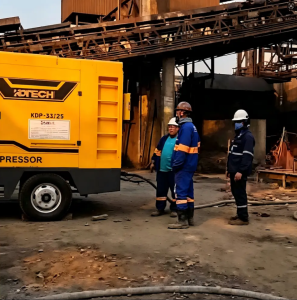
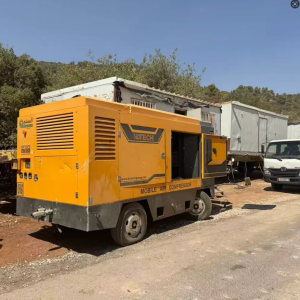
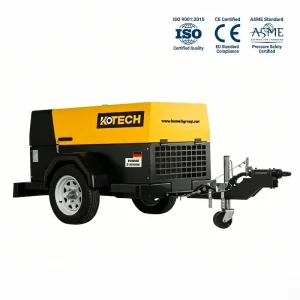
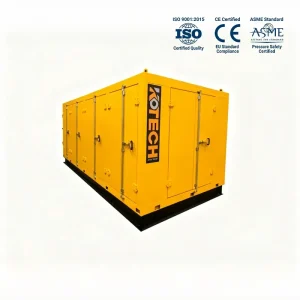
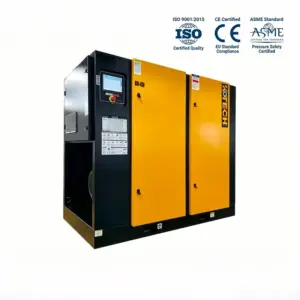
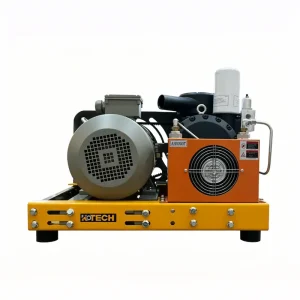
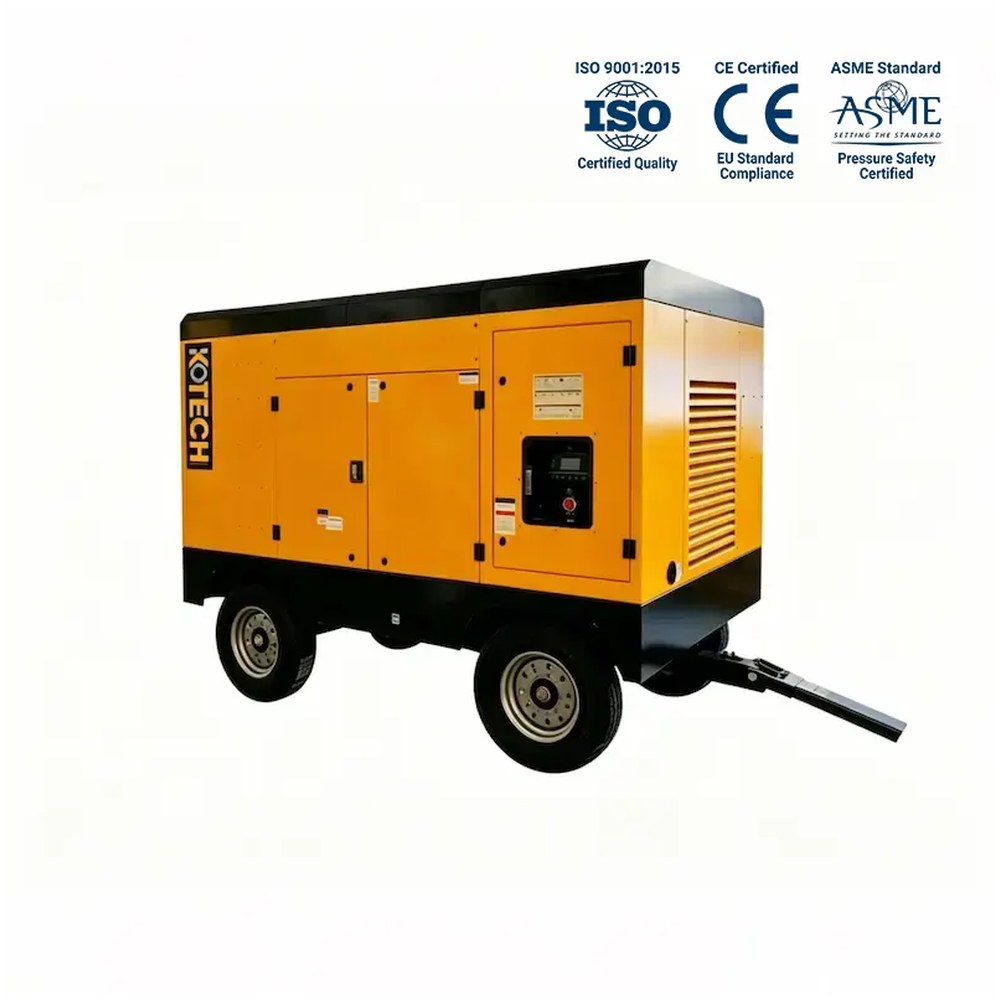
Inside a hydroelectric headrace or diversion tunnel the air problem is different from an open quarry. Work is continuous, often round the clock through multiple headings, and diesel exhaust has nowhere to go once the tunnel deepens. Contractors therefore run mobile electric air compressors on the tunnel power supply: they deliver steady drilling and mucking air with no engine fumes underground, yet stay movable so they can follow the face as it advances. This guide explains how to size one for a tunnel heading and compares the real KOTECH KEP range from 6.2 to 24 m³/min.
Why tunnel work favours electric over diesel
A long tunnel is a confined, poorly ventilated space. Every litre of diesel burned at the face adds heat, exhaust gases and particulates that the ventilation system has to remove, and deeper headings need ever larger ducts to do it. Electric drive removes that source entirely: the compressor contributes no exhaust of its own, so ventilation can be sized around the trucks and loaders rather than the air plant.
Electric machines also suit the duty. Tunnel drilling is a steady, high-utilisation load, and a hydro project already brings substantial electrical capacity to site for pumps, crushers and conveyors. A mobile electric package plugs into that supply and can run a shift without refuelling, while wheels or a skid base let it leapfrog forward as the face moves away from the portal.
The air loads at a tunnel heading
The dominant consumer is the drill jumbo or hand-held rock drills that bore the blast round, which together set the peak free-air delivery. Secondary loads include mucking and scaling tools, blow-off cleaning of drilled holes, occasional concrete spray and grouting equipment, and the air demand of any pneumatic pumps. As heading length grows, line losses in the ducting and pipe become significant, so the machine at the portal must deliver more than the tools at the face nominally require.
Most tunnelling drills work in the 7 to 10 bar range, with higher-pressure rock drills and some grouting work toward 13 bar. Choosing a compressor that covers the upper end avoids a situation where the deepest holes in the round drill slowly because pressure has decayed down a long line.
- Sum the air consumption of all drills and tools firing together during the peak of the round.
- Add a margin for duct and pipe losses that grows as the heading advances.
- Confirm the pressure rating of the highest-pressure drill or grout pump before selecting the frame.
- Verify the site supply: voltage, phase, available capacity and starting method for a large motor.
Real KOTECH KEP mobile electric specifications
Current factory figures from the KOTECH product page. The model suffix indicates nominal flow and pressure, for example KEP-20/10 delivers about 20 m³/min at 10 bar.
The naming reflects the duty: KEP-20/10 delivers about 20 m³/min at 10 bar, and the KEP-24/13 reaches 13 bar. Choose the row that clears both your peak flow at the face and the pressure after line losses, rather than matching only the drill’s nominal consumption.
Power supply and installation underground
Mobile electric compressors are only as mobile as their power connection. KEP frames are built for 380 V, three-phase, 50 Hz site supplies with star-delta starting and direct drive, so the electrical team should confirm transformer capacity, cable sizing and the voltage drop over the trailing cable before the machine is committed to a deep heading. Undersized cable shows up as slow drilling just as surely as an undersized compressor.
Positioning matters for air quality and service. Keep the unit on firm, drained ground near the portal or in a widened bay, protect it from falling rock and runoff, and point the cooler exhaust toward the return-air side. Because it emits no engine exhaust, an electric unit can sit closer to the active face than a diesel machine without worsening the air the crew breathes.
Matching the compressor to the tunnel programme
The drilling rhythm drives the business case. A hydro tunnel that advances on repeated blast rounds needs air available on demand at the start of every cycle; a compressor that limits drill rate stretches the round time and, multiplied over kilometres of tunnel, delays commissioning of the whole project. Sizing with a realistic margin is usually far cheaper than the float it protects.
For long tunnels it is common to stage capacity: a larger machine or multiple units near the main face, with smaller packages serving secondary works such as cross-passages, grouting and the concrete lining. Standardising on one mobile electric series across those roles keeps spare parts, operator training and maintenance simple on a remote site.
Buying tips
- Calculate peak flow from every drill and tool running together in the busiest part of the round, plus a long-line margin.
- Select pressure for the highest-pressure rock drill or grout pump; 13-bar frames like the KEP-24/13 cover demanding faces.
- Confirm 380 V three-phase capacity, cable size and voltage drop with the project electrical engineer.
- Keep the package movable on wheels or a skid so it can follow the advancing face.
- Standardise on one electric series for main and secondary headings to simplify spares and training on remote sites.
Frequently asked questions
Why not just use a diesel compressor inside a tunnel?
What size electric compressor does a tunnel drill jumbo need?
What pressure do tunnel rock drills require?
How do I account for air loss in a long tunnel?
Can a mobile electric compressor be moved as the face advances?
What electrical supply do KEP compressors need?
Share your tunnel diameter, drill jumbo specification, heading length and site voltage with KOTECH to match the right KEP mobile electric compressor and request a quote.
Related Applied Cases