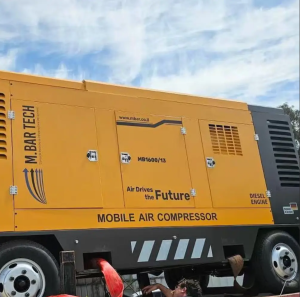
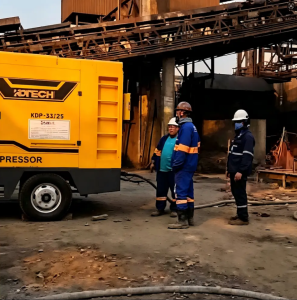
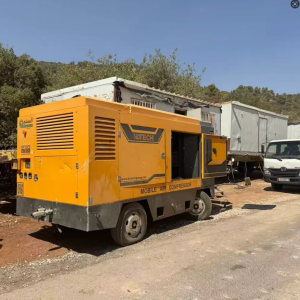
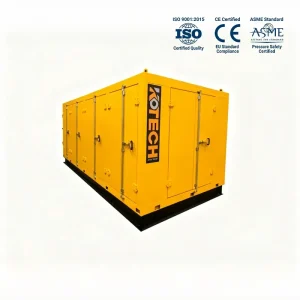
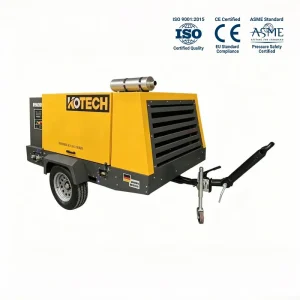
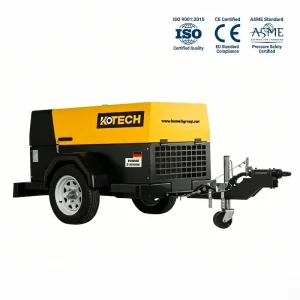
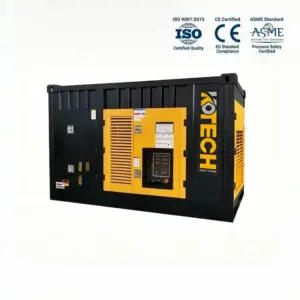
A cross-country pipeline spread moves through open country with no grid power, long distances between service points and several air-hungry tasks running at once: rock drilling ahead of the trench, pneumatic cleaning and purging, and field coating of welded joints. Tow-behind units help at the front, but the main spread is usually served by a skid-mounted diesel compressor that can be craned onto a truck bed, a sled beside the trench or a fixed tie-in pad and left to run for a shift. This guide shows how to size that machine for continuous duty and compares real KOTECH KDS models.
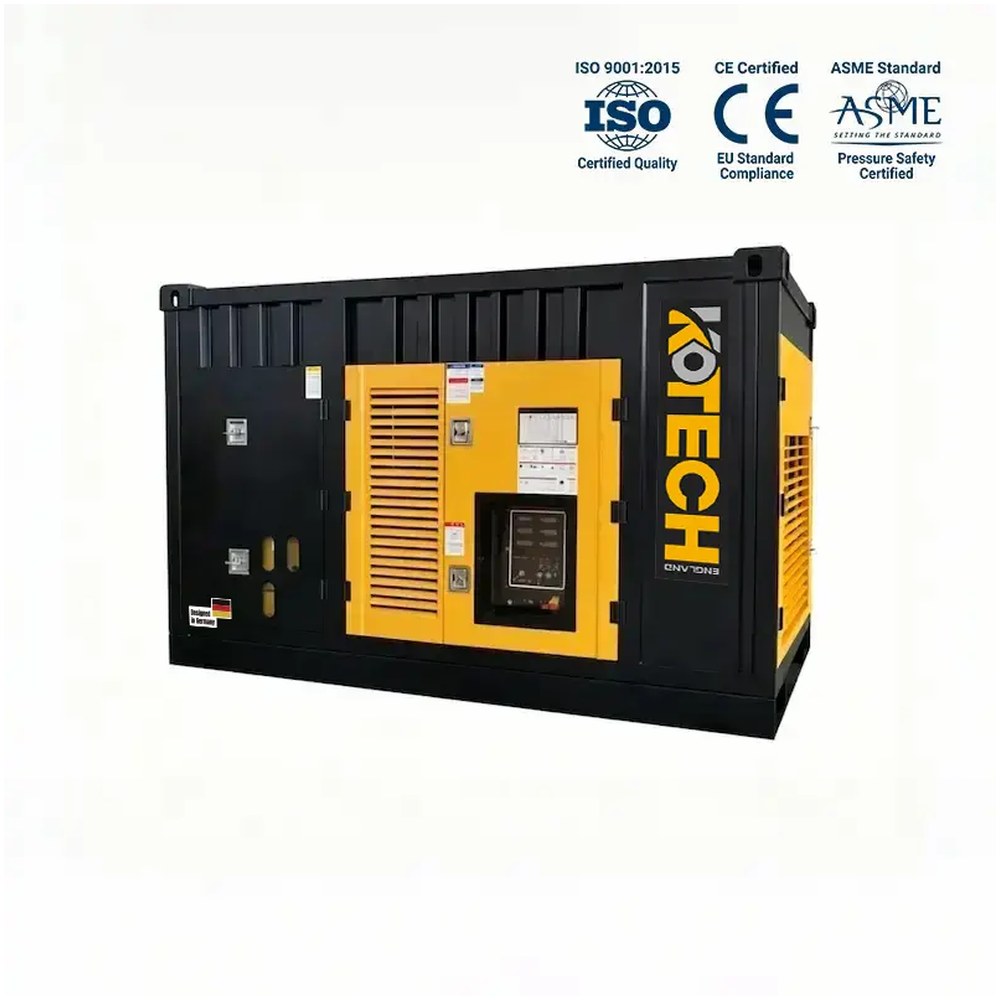
Why pipeline spreads choose skid over tow-behind
Pipeline construction is linear and repetitive. The same compressed-air duties follow the weld-rack kilometre after kilometre, and the equipment has to be repositioned by the spread’s own excavators and side-boom cranes rather than registered and towed on public roads. A skid-mounted package suits that workflow: a single lifting frame, no road-axle maintenance, and a footprint that locks down on a truck, a trailer or a timber-and-steel sled beside the trench.
Skid packages also suit the duty cycle. Purging and coating runs can keep a compressor loaded for long, steady periods, and a base-framed machine with good service access and a large cooling pack tolerates that better than a light portable pushed to its limit.
The air loads on a modern pipeline spread
Three loads dominate. First, pneumatic rock drilling and ground works ahead of the trencher, which demand a high free-air delivery at drilling pressure. Second, drying and purging of completed sections, where a steady flow sweeps moisture and residual gas out before commissioning. Third, field-joint coating and blast cleaning, which need clean, reasonably dry air at the pressure the blast and spray equipment specifies.
The sizing trap is sizing for only one tool. On a busy spread the drill and the cleaning crew can overlap, so the compressor’s free-air delivery has to cover the realistic simultaneous load, not the single largest consumer. Pressure matters too: drilling and some test work run well above the standard seven to eight bar, which pushes the choice toward higher-rated KDS frames.
- Add the CFM of every tool that genuinely runs at the same time, then add a margin for line losses and leakage.
- Confirm the highest pressure any connected task requires before choosing the frame; drilling and testing often exceed 8 bar.
- Plan for a full shift of fuel, or specify easy refuelling, so the spread is not stopped mid-purge.
- Keep the skid level and well ventilated when mounted on a sled or truck bed.
Real KOTECH KDS skid-mounted specifications
Current factory figures from the KOTECH product page. Match the frame to both simultaneous CFM and the highest task pressure.
Because the figures below are factory values at stated pressures, choose the row whose pressure rating matches the real task. A high-CFM frame at low pressure and a lower-CFM frame at high pressure solve different problems; running a long purge is a flow problem, while a pressure test is a pressure problem.
Mounting and operating the skid in the field
A skid package is only as good as its mount. On a truck or sled the frame should sit square on timber or steel dunnage, be tied down at all designated points and leave clear space on the ventilation and exhaust sides. The cooling pack must see clean ambient air; parking a diesel skid in a cut with dust blowing straight into the cooler will pull performance down over a long shift.
Fuel and service planning keeps the spread moving. A machine that runs continuously should have its coolant, fuel filtration and separator service aligned to the pipeline’s planned maintenance windows, and spares should travel with the spread rather than waiting at a depot a hundred kilometres back.
Diesel skids versus other power choices
Where reliable grid power reaches a permanent pump or metering station, a fixed electric compressor can be the cheaper long-term choice. On the moving mainline spread that power simply does not exist, which is why diesel skids remain standard. A well-organised project uses both: diesel skids follow the trench, and electric or permanent packages take over at fixed facilities once they are built.
Emissions and noise rules vary by country and by proximity to settlements, so specify the engine tier and acoustic treatment the contract requires at procurement rather than retrofitting on site.
Buying tips
- Size on realistic simultaneous CFM across drilling, cleaning and coating, with a margin for hose losses.
- Match the frame’s pressure rating to the highest task; drilling and pressure testing commonly need more than 8 bar.
- Choose a single-lift skid with a robust base frame and big service access for daily repositioning by crane.
- Confirm engine emissions tier and sound attenuation against the project country and any nearby-village requirements.
- Plan fuel capacity and carry-filters for the full spread, not just for depot-based servicing.
Frequently asked questions
Why use a skid-mounted compressor instead of a tow-behind for a pipeline?
How much CFM does a pipeline construction spread need?
What pressure do pipeline air tasks require?
Can one skid compressor both drill and purge the pipeline?
How is a skid compressor moved along the trench?
Are diesel skid compressors allowed near villages and environmentally sensitive sections?
Send your pipeline spread’s tool list, working pressures and route length to KOTECH to match the right KDS skid-mounted diesel compressor and request a quotation.
Related Applied Cases