As a water-well hole gets deeper, the air that drives a down-the-hole (DTH) hammer has to do two jobs at once: hold enough pressure to keep the hammer striking hard against the column of water and cuttings, and carry enough volume to flush those cuttings out of the borehole. A standard 7 to 10 bar drill compressor runs out of capability well before the bit reaches target depth on a deep well, which is why deep-well, geothermal and dewatering programs move to 30 to 50 bar air. Where a drill site has grid or generator power, a stationary two-stage high-pressure screw compressor such as the KOTECH KEH range can deliver that air more economically than a second diesel compressor or booster. This guide explains the pressure and flow physics, and where 30 to 50 bar electric screw machines fit the drilling fleet.
Why deep DTH drilling needs high-pressure air
A DTH hammer is powered directly by the compressed airstream: the pressure differential across the piston sets the blow energy, and the exhaust air flows through the bit and up the annulus to clear cuttings. In a shallow, dry hole a 10 to 17 bar compressor is often enough. In a deep or water-bearing hole, however, the compressor must first overcome hydrostatic and annular back-pressure — roughly one additional bar for every ten metres of water column — and still leave enough differential at the hammer for it to run. Below about 150 to 200 metres, particularly where the well produces water during drilling, operators increasingly specify 25 to 40 bar compressors, and the deepest holes or large-diameter geothermal bores can call for the full 30 to 50 bar class.
The second requirement is bailing velocity. Cuttings are lifted by the uphole air velocity, which must typically stay above roughly 15 to 25 metres per second depending on hole geometry, hammer size and whether foam or mist is used. As depth and hole diameter increase, the required free-air delivery rises with them. High pressure without sufficient volume leaves cuttings in the hole; high volume without sufficient pressure leaves the hammer weak. The compressor must be sized for both at the same time.
- Hammer energy depends on the pressure differential remaining after back-pressure is overcome.
- Each ten metres of water column adds about 1 bar of back-pressure on the hammer.
- Bailing velocity, not hammer size alone, sets the minimum free-air delivery.
- Deep, wet or large-diameter holes are where 30 to 50 bar air earns its place.
Stationary high-pressure screw vs diesel booster
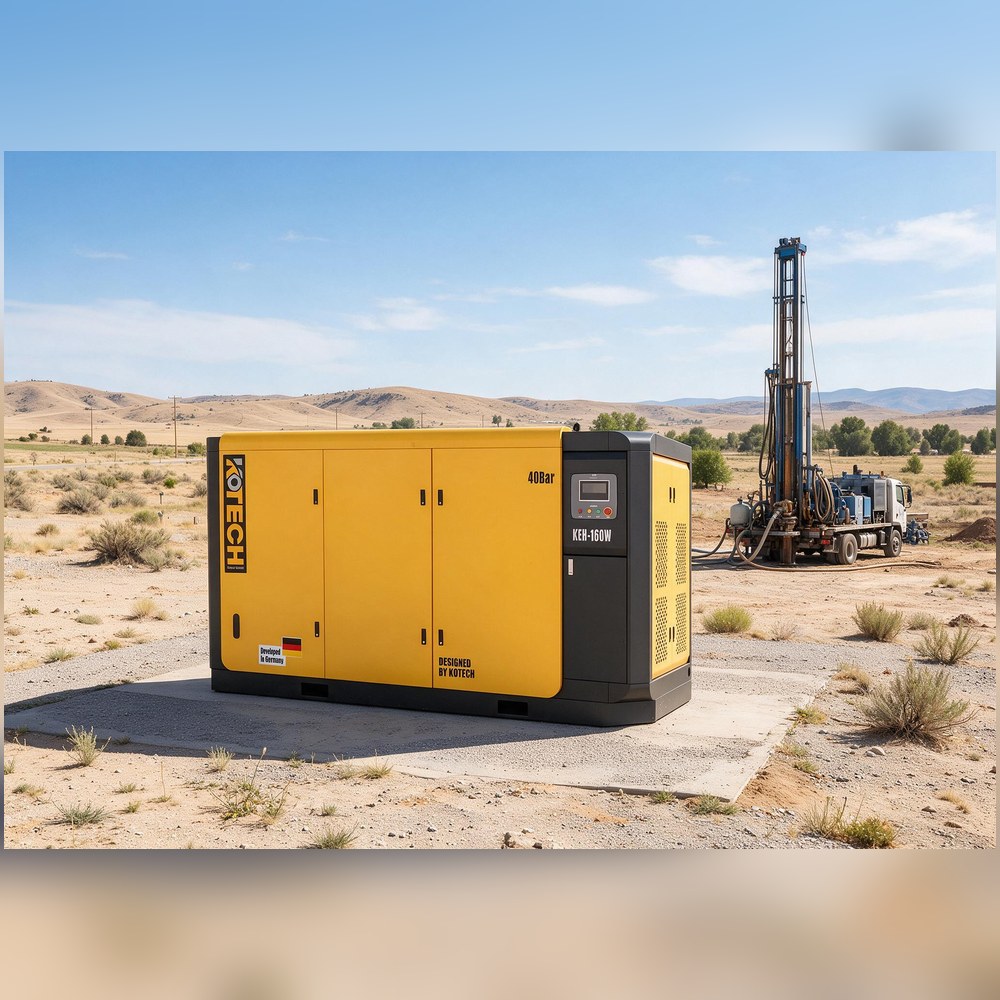
The traditional answer to pressure shortfall is a diesel-driven high-pressure compressor or booster at the rig. That remains the only practical choice in truly remote, off-grid exploration. But a large share of deep water-well work happens where power is available: municipal wellfields, industrial dewatering programs, geothermal projects near infrastructure, agricultural well programs in electrified regions, and mines drilling dewatering wells. On these sites a stationary, electric two-stage screw compressor changes the economics.
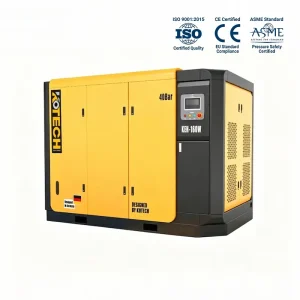
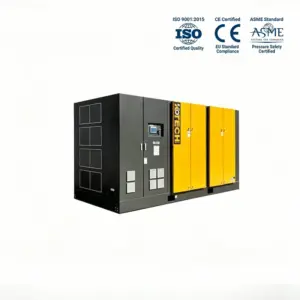
Two-stage screw compression with inter-stage cooling approaches isothermal compression, which is exactly where energy is saved at high ratios: lifting air from ambient to 40 bar in one stage would generate far more heat and waste far more power. The KOTECH KEH range uses a two-stage design with a high-pressure single-screw airend and a permanent-magnet variable-speed motor, giving stable pressure with fluctuation controlled tightly and automatic flow tracking as the hammer cycles. Against a diesel compressor running all shift, the electric drive cuts fuel logistics, engine maintenance, noise and exhaust on site — valuable when a drill operates near a community or inside a permitted industrial area. It is typically paired with the rig as a semi-permanent station or mounted on a support trailer with its own generator for relocation between nearby pads.
Real KOTECH KEH two-stage high-pressure specifications
Current factory figures for the 4 MPa (40 bar) variants from the KOTECH product page; KEH covers 30 to 50 bar and 5 to 25 m³/min with PM VSD drive.
These rows are the 40 bar variants; the same frames are published at 30 and 50 bar ratings where the duty requires. Because free-air delivery falls as rated pressure rises, always read the figure at the pressure the hammer will actually run rather than from a generic brochure maximum.
Sizing procedure for a deep-well program
Start from the DTH hammer specification: recommended operating pressure range and air consumption in m³/min. Add the back-pressure expected at target depth, including the water column, annular friction and any mist or foam injection, to determine the compressor discharge pressure. Then calculate uphole velocity from the compressor flow, hole diameter and drill-pipe outer diameter; if velocity falls short of the cuttings-transport target, increase flow, add a second compressor, or reduce the rate of penetration rather than simply raising pressure.
Integration on site deserves attention. A stationary KEH unit needs a stable pad, power supply sized for the motor plus derating for altitude and temperature, suitable discharge piping to the rig with pressure-rated hoses and a receiver to damp pulsation, plus water management for water-cooled frames. Instrument pressure and flow at both the compressor and the rig, because the difference between them reveals hose and filter losses that quietly steal hammer performance. With those basics in place, an electric high-pressure station can run 24/7 on multi-shift well programs without the engine service cycles that dominate diesel fleet downtime.
When to stay with diesel mobile air
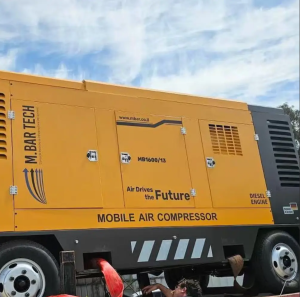
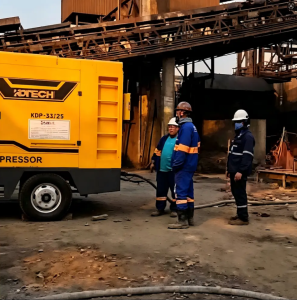
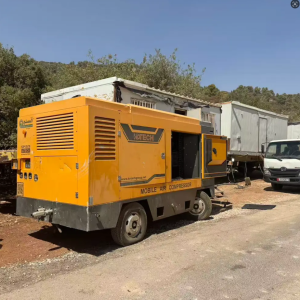
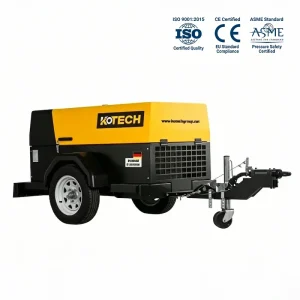
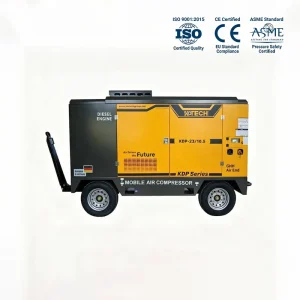
Electric high-pressure screw compression is not universal. Exploration drilling that moves every few days, sites with no grid and no economic generator set, and single remote holes are still best served by a diesel-driven high-pressure mobile compressor such as the KOTECH KDP-18/25 at 25 bar or a dedicated diesel booster. The decision should be made on expected utilisation and power availability: when a drill will spend weeks or months on powered wellfield pads, the electric station’s lower energy and maintenance cost usually repays the installation; when it moves constantly through off-grid terrain, diesel mobility wins. Many mature fleets end up running both — diesel units for exploration and remote holes, KEH electric stations for developed wellfields and geothermal programs.
Buying tips
- Size both pressure (depth plus water-column back-pressure) and flow (bailing velocity) — never one without the other.
- Choose electric KEH stations for long programs on powered wellfields; keep diesel mobile units for off-grid exploration.
- Select the KEH rating at the pressure the hammer actually runs, since flow falls as pressure rises.
- Provide a stable pad, rated discharge hose, a receiver tank and pressure/flow instrumentation at both ends.
- Derate motor and cooling capacity for altitude and ambient temperature on surface drilling sites.
Frequently asked questions
What pressure does a DTH hammer need for a deep water well?
Can an electric screw compressor replace a diesel on a drill rig?
Why does high-pressure compression need two stages?
How much air does a water-well DTH hammer consume?
What is bailing velocity and why does it matter?
Which KEH model suits a typical deep-well rig?
Related Applied Cases