Pick the wrong compressor for a water well rig and you find out the hard way: a hammer that hits soft, a bit that drills slow, or a machine that runs out of air the moment the hole gets deep. Sizing one is not a guessing game once you separate the two numbers that actually matter — CFM and PSI.
Why CFM and PSI decide everything
These two numbers answer different questions, and you need both to be right.
PSI (pressure) is the force that drives the DTH (down-the-hole) hammer’s piston. Drop below the hammer’s rated working pressure and blow energy falls off fast — the hammer still runs, but it stops breaking rock properly. CFM (flow) is the volume that flushes cuttings out of the hole and keeps the hammer cycling. Starve it of volume and cuttings sit at the bit, recirculate, slow everything down, and can seize the string.
In plain terms: pressure makes the hammer hit, flow clears the hole and keeps it cool. Plenty of one without the other still underperforms.
The problem with “one compressor for every job”
A 6-inch domestic borehole to 80 meters is not the same job as a 12-inch irrigation well going to 250 meters in hard rock. As the hole gets wider and deeper, the annulus grows, cuttings climb further, and pressure loss through the drill string adds up. An undersized compressor on the bigger job shows the symptoms every crew recognizes — slow penetration, wet cuttings that won’t lift, and premature hammer wear.
That is why drillers size the compressor to the *largest* hammer and bit combination they realistically run, with headroom rather than right at the edge.
How to match a compressor to your hammer
Start from the tool, not the machine. Every DTH hammer publishes a recommended pressure and a minimum air requirement — treat those as your floor.
- Pressure: many water-well DTH hammers run their best around 145–290 PSI (about 10–20 bar) in the KDP range. Confirm the exact figure with your hammer maker; this is one spec you never estimate.
- Flow: add the hammer’s CFM demand to the extra volume needed to flush a larger annulus and cover losses through hoses and the drill string. Deeper, wider holes want more flow.
- Altitude and heat: a naturally aspirated diesel loses usable power high above sea level, and hot summers tax cooling. Drill high or hot and you size up and specify the high-ambient build.
Real KOTECH KDP models and where each fits
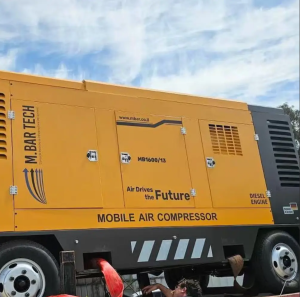
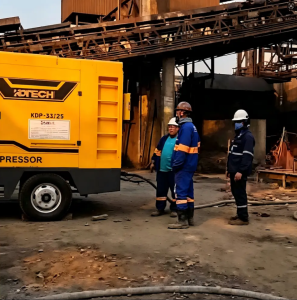
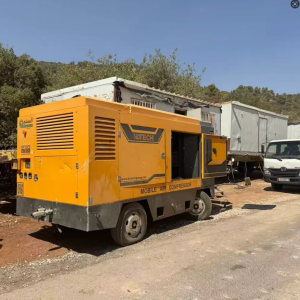
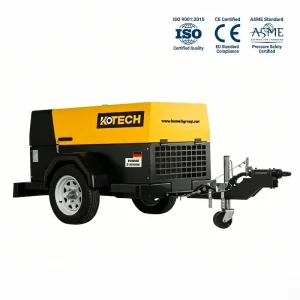
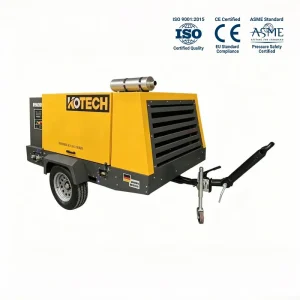
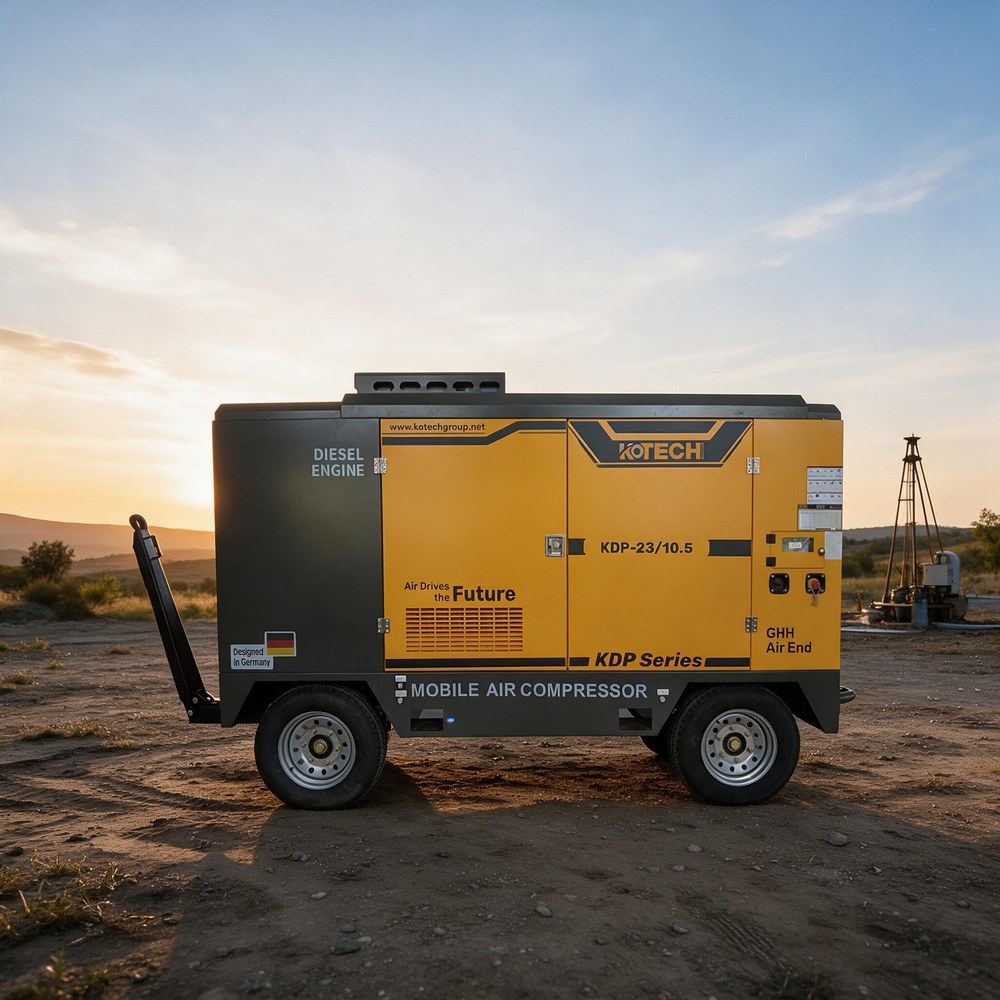
The KDP series is a tow-behind diesel screw compressor built for long shifts in dust, heat and mud. These are the factory figures — straight from the KDP product specification table — for the sizes water-well crews ask about most.
| Model | Free air delivery | Working pressure | Engine | Rated power |
|---|---|---|---|---|
| KDP-6/10 | 214 CFM | 145 PSI | Cummins | 60 kW |
| KDP-10/10 | 353 CFM | 145 PSI | Cummins | 97 kW |
| KDP-13/13 | 460 CFM | 188 PSI | Cummins | 110 kW |
| KDP-12/14 | 441 CFM | 203 PSI | Cummins | 132 kW |
| KDP-14/14 | 494 CFM | 203 PSI | Cummins | 154 kW |
| KDP-10/20 | 353 CFM | 290 PSI | Cummins | 158 kW |
A small domestic rig on a medium-pressure hammer is usually comfortable around 214–353 CFM at roughly 145 PSI — a KDP-6/10 or KDP-10/10. Mid-size boreholes in hard rock that need a firmer hit move toward 441–494 CFM at about 188–203 PSI, where the KDP-13/13, KDP-12/14 and KDP-14/14 sit. Deep, large-diameter holes on high-pressure hammers are the job for the KDP-10/20 at 353 CFM and 290 PSI. These are starting points — your hammer spec and hole geometry set the real number.
If you move between sites with no grid power, that unit has to be a tow-behind diesel. Our walk-through of choosing a reliable off-grid portable diesel compressor covers fuel, towability and run time, and the same air-on-tap logic applies to how mobile diesel compressors support remote drilling projects.
Buying tips that save money later
- Size to your biggest realistic job, not your average one. Headroom beats renting a second unit on the one big contract.
- Pressure and flow are a pair. Don’t chase high CFM on a low-pressure machine if your hammer wants 20 bar.
- Check fuel tank against site access. Remote sites with no bowser want the larger tanks — these KDP models run from 100 L up to 290 L.
- Spec for your climate. In desert summers, confirm the high-ambient package and avoid a derated unit.
- Plan service before you need it. On-site filters, oil and air-end service beat a stranded rig.
Frequently asked questions
How big a compressor do I actually need for a 4-inch water well?
Is it better to have too much CFM or too much pressure?
Can one compressor handle both shallow and deep wells?
What happens at altitude or in very hot weather?
Do I need a separate generator on site?
Send us your hammer model, bit size, target depth, typical rock and drilling altitude. We’ll turn that into a specific KDP model with the CFM and PSI you actually need — not the biggest unit on the page.
Related Applied Cases