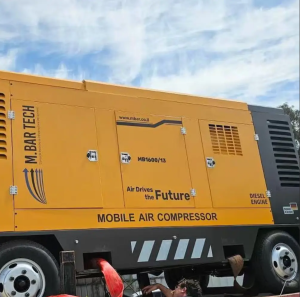
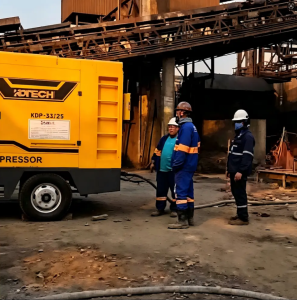
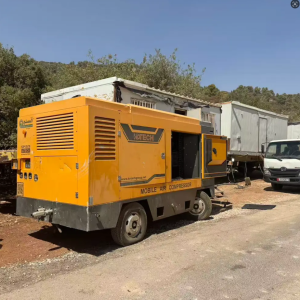
Rental yards and blasting contractors live or die on utilization: one compressor has to earn its keep on a 600 CFM sandblasting pot in the morning and a handful of breakers and pumps in the afternoon. Buying only for the single largest job leaves a machine throttled back and burning fuel on routine work, while buying only for the average job means losing the big contract. The practical answer is to size a portable diesel screw compressor against the real combined tool demand, the pressure each tool needs at the nozzle, and the way a rental fleet actually moves machines between sites.
Why sandblasting dominates the sizing calculation
Abrasive blasting is the hungriest common tool a rental compressor meets. A blasting pot does not consume a steady, gentle flow; it demands a high continuous volume to maintain nozzle velocity, and the moment available CFM drops, the abrasive slows, cleaning rate collapses and the operator holds the trigger longer, wasting both fuel and media. Pressure matters just as much, because hose length, couplings, moisture separators and the nozzle itself all create pressure drop between the compressor outlet and the blast nozzle.
The correct procedure is to size from the nozzle backwards. Confirm the nozzle orifice, the recommended blast pressure at the nozzle (commonly around 100 PSI for many jobs) and the rated CFM of the pot, then add the losses through the hose reel and filtration so the compressor outlet still clears the required nozzle pressure. Multi-tool rental work layers additional demands on top: breakers, chipping hammers, air lances and small pumps may run alongside the pot, and each contributes its own rated consumption and duty cycle.
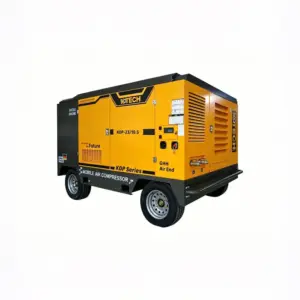
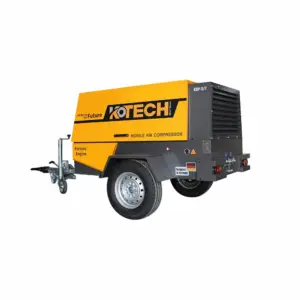
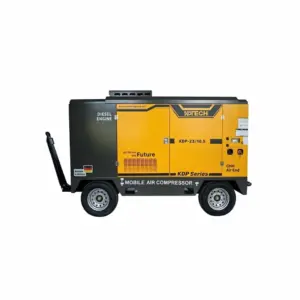
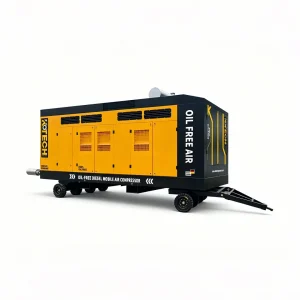
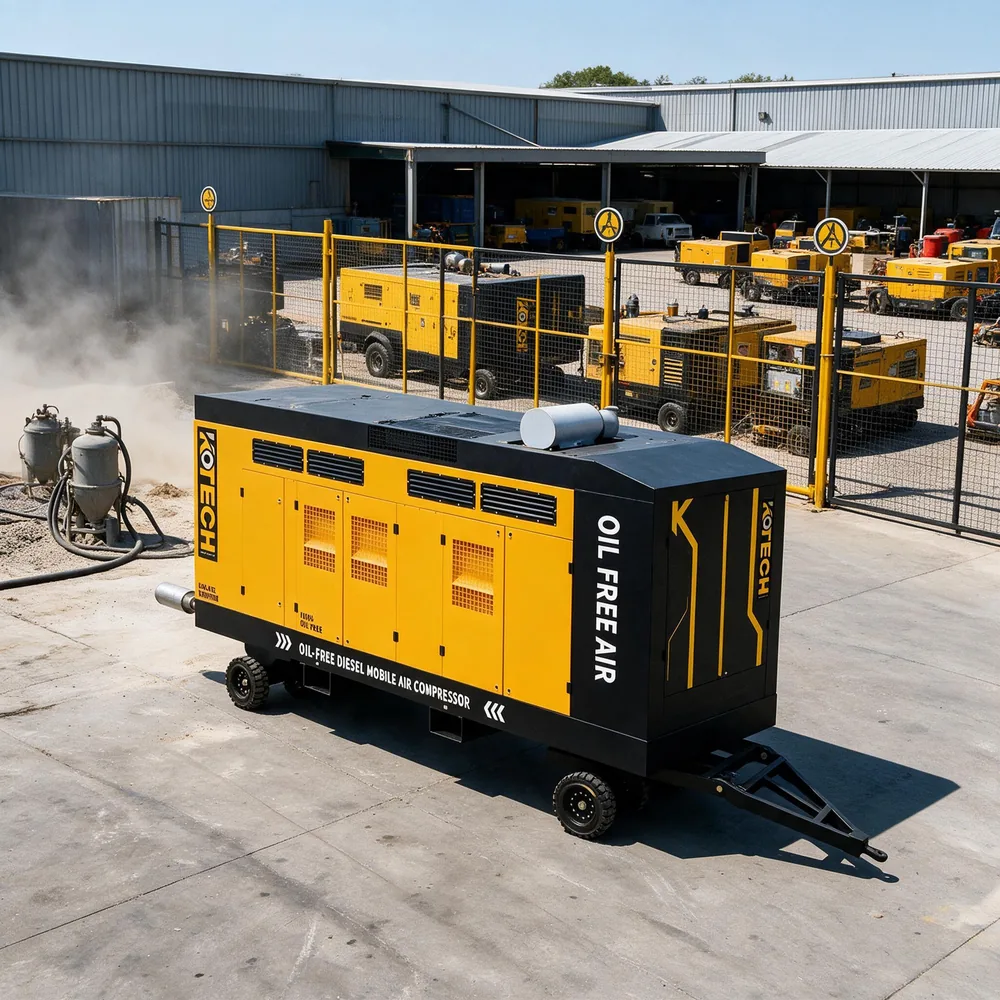
The KOP oil-free portable range spans this spread. The KOP-12/8 delivers 424 CFM at 116 PSI from a 119 kW engine, the KOP-15/10 raises the pressure option to 145 PSI with 530 CFM, the KOP-17/7 favors high flow at 600 CFM and lower 100 PSI pressure, and the larger KOP-27/10.3 reaches 954 CFM at 150 PSI for the biggest pots and simultaneous multi-tool duty.
- Size from the blast nozzle backwards, including hose and filter pressure drop
- Add the CFM of every tool that genuinely runs at the same time
- Match outlet pressure to the nozzle requirement rather than running maximum pressure all day
- Keep a 20 to 30 percent CFM margin so the machine is not held flat out
Matching pressure and flow to the jobs a fleet actually wins
Rental fleets rarely do one kind of work. A unit that goes out on structural steel blasting this week may power road repair breakers next week and pipeline testing the week after. That variety argues against selecting purely on peak pressure. A machine tuned for very high pressure but modest flow will under-serve a large nozzle that wants volume, while a high-flow, low-pressure unit cannot satisfy tools that genuinely need 145 to 150 PSI.
The model naming makes the trade-off explicit. In the KOP line the first figure is free air delivery in cubic metres per minute and the second is working pressure in bar, so the KOP-15/10 and KOP-27/10.3 are the pressure-oriented choices for long hose runs and high-PSI nozzles, while the KOP-17/7 is the flow-oriented choice for high-volume blasting at standard pressure. Offering more than one pressure class in a fleet lets the dispatcher send the right machine instead of forcing every customer onto an oversized unit.
Fuel economy follows naturally from this discipline. Running a large compressor at low load to feed a small tool wastes diesel through part-load inefficiency and unloaded running. A right-sized machine working near its efficient band, paired with correct tyre and tow-brake specification for the route, lowers the cost per rented hour and shortens the payback on the asset.
- Higher-pressure models suit long hoses and high-PSI nozzles; high-flow models suit large pots
- Avoid running a big compressor at low load on small tools
- Specify towing brakes and couplings to match the regions the fleet serves
Real KOTECH KOP portable diesel screw compressor models
Live product-page data; CFM and PSI are the rated figures contractors use for nozzle and tool sizing.
All figures are taken from the current KOTECH product-page specification table. The four frames cover the rental sweet spot from mid-size single-pot blasting up to large pots with simultaneous hand tools, so a yard can standardize on a small number of well-understood machines.
Rental-grade features that protect utilization
A rented compressor is operated by customers with varying skill levels and moved constantly between sites, so durability and simple controls matter more than finely tuned optimization. A robust enclosed canopy protects the air end and cooler from site impact and dust, while large service doors and accessible filters keep turn-around between rentals fast. Oil-free screw compression removes carry-over of lubricating oil into the air stream, which protects blast quality and downstream tools and reduces contamination complaints when the same machine serves sensitive jobs.
Fleet managers should also standardize consumables and service intervals across the rental fleet, specify units with clear instrument panels and shutdown protection for high temperature and low pressure, and check that the canopy, tow bar and lifting points suit the trucks and loading equipment the yard already runs. A machine that is easy to service and hard to misuse stays available for hire, and availability is the single biggest driver of rental revenue.
- Enclosed canopies and protected air ends survive rough rental handling
- Oil-free air protects blast finish and sensitive downstream tools
- Standardized consumables and accessible service points shorten turn-around
- Shutdown protection prevents costly damage by less experienced operators
Practical deployment and maintenance habits
On a blasting site, position the compressor upwind of the dust plume so the intake draws clean air, and place it on level ground with room around the cooler. Use the shortest, largest-diameter hose that reaches the work, because every undersized metre and every extra coupling quietly steals both CFM and pressure. Drain moisture separators regularly, since wet air causes media to clump and accelerates wear of the nozzle and pot valves.
Between rentals, inspect the intake filter (the first victim of blasting dust), check the cooler fins for abrasion, verify couplings and safety valves, and log engine hours so service is based on real running time rather than guesswork. A short standardized return-to-yard checklist catches a blocked filter or a chafed hose before the next customer ever sees the machine, protecting both equipment reputation and repeat business.
- Site the intake upwind of blasting dust and keep clear airflow around the cooler
- Prefer short, large-diameter hoses to preserve CFM and pressure
- Use a return-to-yard inspection checklist after every rental
Buying tips
- Calculate combined CFM from the blast nozzle plus simultaneously running tools, then add 20 to 30 percent margin.
- Choose the pressure class to match your typical hose length and nozzle PSI, not just the highest number on the spec sheet.
- Standardize on two or three frames covering flow-oriented and pressure-oriented jobs rather than one oversized unit.
- Verify towing, braking and lifting specification against the trucks and sites in your operating region.
- Prioritize easy service access, shutdown protection and oil-free air quality to maximize rental availability.
Frequently asked questions
What size portable diesel compressor do I need for sandblasting?
Is higher pressure always better for a rental compressor?
Why choose an oil-free portable screw compressor for rental work?
How do I stop hoses from stealing compressor performance?
What maintenance protects a rental compressor on dusty blasting sites?
If you are equipping a rental yard or blasting crew and need a portable diesel screw compressor matched to your nozzle and tool list, compare the KOP frames against your peak CFM and pressure demand.
Related Applied Cases