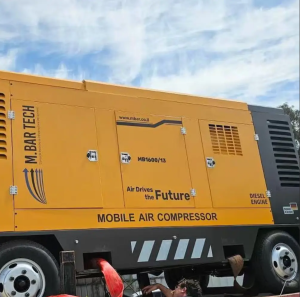
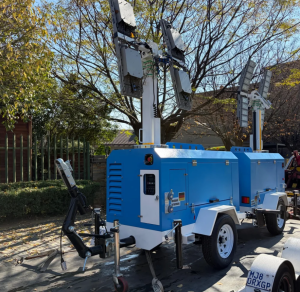
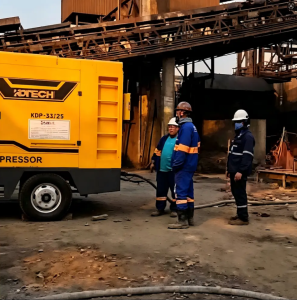
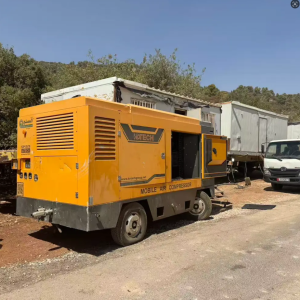
A diesel air compressor for winter construction has to do two jobs at once: deliver the CFM your breakers, drills and heaters actually demand, and start reliably on a morning when the gauge reads below freezing. Undersize the machine and tools stall mid-shift; ignore the cold and you can lose an hour or more to hard starting, gelled fuel or ice in the air lines. This guide walks through CFM sizing for cold jobsites and the operating checks that separate a compressor that works all winter from one that only works in the brochure.
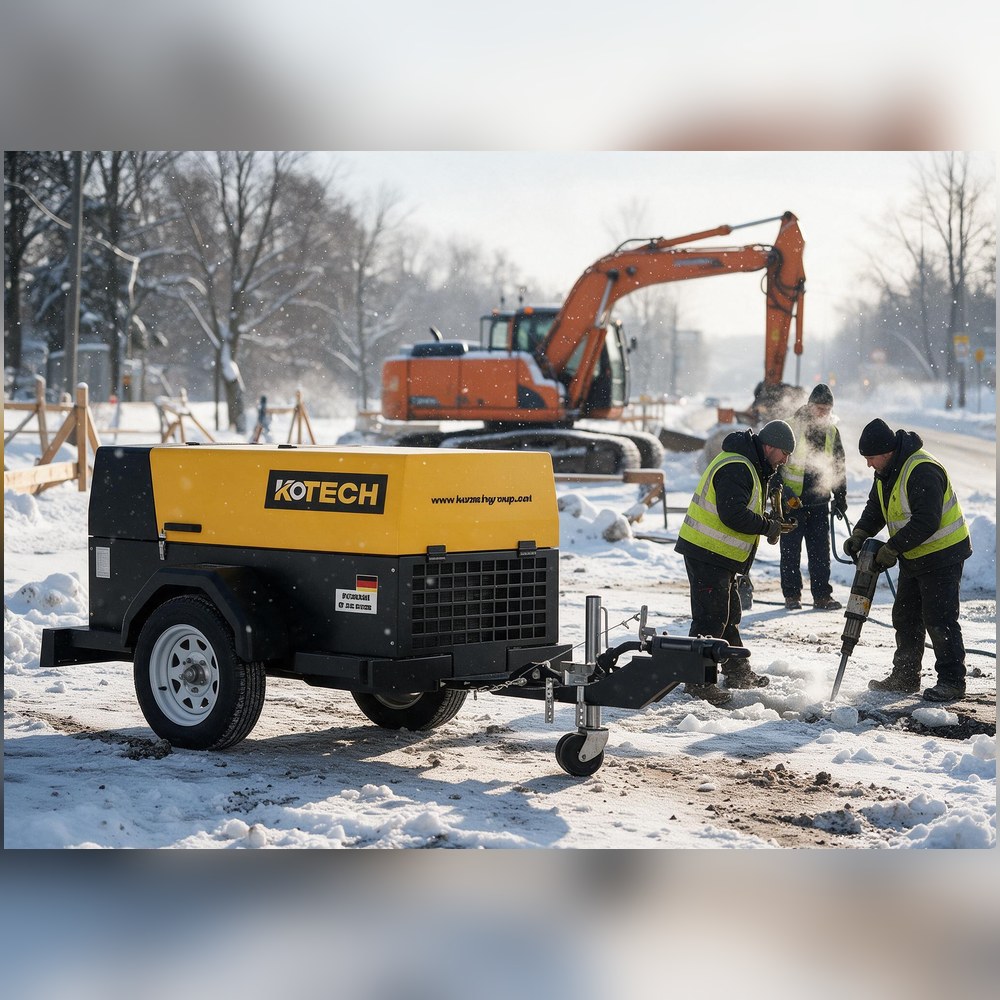
Why winter punishes a portable diesel compressor
Cold weather attacks a diesel air compressor from four directions, and most winter breakdowns trace back to one of them rather than to a failed core component.
First, starting gets harder. Engine oil thickens as temperature drops, battery cranking amps fall, and compressed ignition relies on heat that a cold block does not want to give. Second, diesel fuel itself changes: at the cloud point, paraffin wax begins to form, and below the cold filter plugging point the fuel filter can starve the engine. Third, the air the compressor produces on a summer afternoon leaves the receiver and piping carrying water vapor; at below-freezing ambient temperatures that condensate freezes in drains, hoses and regulators. Fourth, dense cold air alters the balance between rated free air delivery and what the engine has to work against, so a marginally sized summer unit can become an undersized winter one.
- Hard starting: thick oil and a weak battery push cranking speed below what compression ignition needs.
- Fuel gelling: wax crystals plug the filter, usually in the first cold snap before operators switch to winter-grade diesel.
- Frozen condensate: ice blocks drains, regulators and hose couplings overnight.
- No reserve capacity: tools air-starved in summer have no chance when winter losses are added on top.
How to size CFM for a cold jobsite
Sizing starts with the tool list, not the brochure. Add the rated CFM demand of every tool that runs at the same time, multiply by the duty factor (how many minutes per hour each one actually fires), then add a margin for hose losses, leakage and future tool changes. On winter sites we size the margin on the generous side, because every frozen coupling, every long hose run across frozen ground and every partially iced filter element quietly eats into usable air.
A practical floor is 25 to 30 percent above calculated continuous demand. For a typical road or utility crew that means a 185 CFM class machine for one or two light tools, and a 350 CFM class or larger machine once two breakers, a tamper and a blowdown run together. Pressure matters as much as flow: most hand tools are rated near 90 to 100 PSI at the tool, so after hose and filter losses a 100 PSI-rated compressor is the sane choice for general civil work, while DTH drilling and similar high-pressure tools call for a 175 to 290 PSI class unit.
Cold air is denser, which slightly increases the mass of air delivered at a given FAD rating; this does not let you downsize. Tool CFM ratings are free-air figures, and the gains from denser intake air are smaller than the real losses from cold accessories, long lines and reduced engine output until the machine is fully warmed.
- Step 1: list simultaneous tools and their nameplate CFM.
- Step 2: apply each tool’s duty factor, then sum continuous demand.
- Step 3: add 25-30 percent for leakage, hose pressure drop and cold-weather losses.
- Step 4: match pressure at the tool (about 90-100 PSI for civil tools; higher for drilling), not just at the outlet.
- Step 5: prefer the next size up when the result sits between two models.
Real KOTECH KDP models for winter civil work
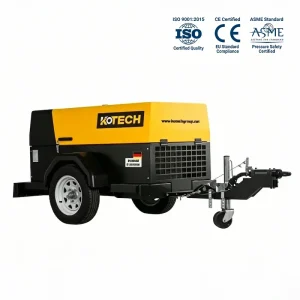
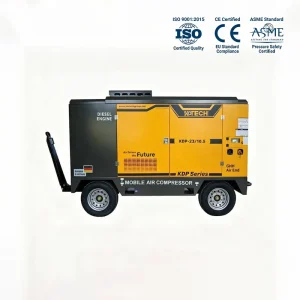
The KDP series is KOTECH’s tow-behind portable diesel range, with closed weatherproof canopies, Cummins, Weichai or Yanmar engines depending on model, and free air delivery from 35 to 1,589 CFM. The table below lists the 100 PSI-class models that cover most winter road, utility and municipal jobs; pick from the top of your calculated range rather than the bottom.
For reference, the KDP-5/7 delivers 185 CFM at 100 PSI from a 36.8 kW Weichai engine with a 70 L tank; the KDP-6/7 steps up to 214 CFM with a 60 kW Cummins; and the KDP-10/7 covers 353 CFM at 100 PSI for multi-tool crews. When the work shifts from breakers to hard-rock or water-well drilling, the two-stage high-pressure end of the family takes over — the KDP-13/13 supplies 460 CFM at 188 PSI, and ratings run up to 290 PSI and beyond on the larger two-stage frames.
KOTECH KDP 100 PSI-class portable diesel compressors
Real current production models for general civil and utility work, from the current KOTECH specification tables.
All figures above come from the current KOTECH product-page specification tables. Tank capacity is worth a second look in winter: larger tanks mean fewer refueling stops in short daylight and let a machine idle through a lunch break without risking a cold restart. CFM and PSI stay the same at the rating point; cold-weather preparation decides whether the machine actually reaches that output on a January morning.
Cold-weather operation that protects the investment
Specifying enough CFM gets the air to the tools. The following habits are what keep a correctly sized KDP running through the season.
Switch to winter-grade diesel before the first hard freeze, and use the supplier’s treated station fuel rather than summer stock carried over in jerry cans. Where temperatures run well below the cloud point, an approved anti-gel additive at the correct ratio gives the filter margin. Check the coolant concentration with a refractometer or test strip instead of guessing from color, keep battery terminals clean and tight, and carry jumper leads rated for diesel cranking. Park the tow bar into the prevailing wind if the site offers no shelter, or use a manufacturer-safe winter enclosure — never a tarp draped against the exhaust.
Drain condensate at the end of every shift while the air is still warm, including receiver tanks, filter bowls and low points in the piping. Open-line blowdowns before shutdown clear moisture that would otherwise freeze overnight. Give the engine a proper warm-up at idle under no load until coolant temperature begins to move, then build air gradually; full-load hammering from a cold start is what shortens turbo and air-end life.
Service intervals should not be stretched in winter. Fuel filters, air filters and separator elements that are near their limits in October rarely survive December, and carrying one spare fuel filter on the truck turns a gelling incident into a ten-minute roadside job instead of a dead day.
- Fill with winter-grade diesel before the cold snap; treat stored summer fuel rather than burning it untreated.
- Test antifreeze concentration; inspect battery and charging output before the first freeze.
- Drain all moisture points warm, at shutdown; blow down lines overnight.
- Warm up under no load, then bring the system up to pressure gradually.
- Pre-service filters ahead of winter and carry a spare fuel filter on site.
A worked example: two breakers on a frozen road job
Say a crew runs two 60 lb class paving breakers rated near 90 CFM each, plus a small trench tamper at about 30 CFM, with all three cycling rather than running flat out. Continuous simultaneous demand lands around 150 to 170 CFM at the tool once duty factors are applied. Adding 30 percent for cold, couplings and a fifty-meter hose layout puts the target near 200 to 220 CFM at 100 PSI.
A 185 CFM KDP-5/7 would keep the breakers alive with nothing in reserve and would sag when the tamper joins in; the KDP-6/7 at 214 CFM covers the calculation, and the KDP-10/7 at 353 CFM is the pick if the crew grows to three hammers or adds a blower line later the same winter. Sizing to the next model is cheaper than demobilizing a frozen, air-starved jobsite.
Buying tips
- Choose on calculated continuous CFM plus a 25-30 percent winter margin, not peak nameplate figures.
- Prefer closed-canopy tow-behind units with brand-name engines and local filter availability for remote sites.
- Match pressure rating to the tool: 100 PSI class for civil work, 175 PSI and up for DTH and high-pressure drilling.
- Check tank size against your shift length to avoid mid-shift cold restarts.
- Ask what cold-weather options the factory supports — winter fuel kits, block heaters and cold-climate spec batteries — before the order ships.
Frequently asked questions
Will my compressor lose CFM in cold weather?
At what temperature does diesel fuel start to gel?
Why does water keep freezing in my air lines overnight?
Is a 185 CFM compressor enough for a winter construction crew?
Should I idle a diesel compressor all night to avoid cold starting?
Tell us your winter tool list, site temperature range and shift length, and KOTECH engineers will size a KDP tow-behind diesel compressor with the right cold-weather specification for your jobsite.
Related Applied Cases