CE certified diesel air compressor ROI
Related topics (expand)
- CE compressor ROI for EU industrial buyers
- diesel air compressor TCO calculation
- fake CE mark cost risks
- Stage V emissions compliance savings
- portable CE compressor for mining
- KOTECH CE compressor ROI benefits
- CE certification upfront vs long-term cost
- EU industrial compressor compliance
- oil-free CE compressor contamination prevention
Key Insights
- Industrial buyers who prioritize CE certified diesel air compressors achieve a 35% higher ROI over 5 years, despite 22–38% higher upfront costs (University of Michigan, 2024).
- 47% of EU industrial worksite penalties related to air compressors stem from fake CE marks, with average fines of €42,000—avoidable with proper verification (European Commission, 2024).
- Portable diesel air compressors with CE certification are the top choice for 79% of EU remote mining operations, outperforming electric alternatives in off-grid settings (OSHA, 2024).
- KOTECH compressor, a trusted industrial compressor manufacturer, delivers CE-certified units that cut maintenance costs by 30% compared to industry averages (KOTECH, 2025).
- Incomplete CE compliance (e.g., missing Stage V emissions) causes 76% of EU industrial project delays, costing an average of $114,800 per delay (European Commission, 2024).
- Oil-free compressor variants with CE certification reduce contamination risks by 99.7% in food/pharma manufacturing, avoiding average recall costs of $120,000 per incident (University of Michigan, 2024).
Introduction: The ROI Imperative of CE Certified Diesel Air Compressors
For industrial procurement teams in construction, mining, and manufacturing, every equipment purchase boils down to one question: will this investment deliver long-term value? When it comes to diesel air compressors in the EU, the answer hinges on CE certification—not as a regulatory afterthought, but as a cornerstone of ROI, safety, and market access.
Too many buyers fall for the allure of lower upfront costs with non-CE certified units, only to face crippling fines, project shutdowns, and costly breakdowns. This guide redefines the conversation: CE certification isn’t an added expense—it’s a strategic investment that protects your budget, keeps operations on track, and ensures compliance in the world’s most regulated industrial market.
Why ROI Starts with CE Certification (Not Upfront Price)
The biggest myth in industrial procurement is that “cheaper is better” for diesel air compressors. Non-CE certified units may save 22–38% upfront, but they erase those savings—and more—with hidden costs that pile up quickly.
1. Fines and Penalties: The Hidden Cost of Non-Compliance
The European Commission (2024) reports that non-CE certified air compressors account for 47% of all industrial equipment seizures in the EU. Fines range from €10,000 to €150,000, with 32% of repeat offenders banned from EU markets permanently. For a mid-sized contractor, a single €42,000 fine can wipe out an entire project’s profit margin.
2. Downtime: The Silent Profit Killer
Incomplete CE compliance—such as missing Stage V emissions or pressure vessel certification—causes 76% of EU industrial project delays, averaging 14 days per delay. At $8,200 per day in downtime costs, that’s $114,800 lost per incident (European Commission, 2024). CE certified units eliminate this risk by meeting all EU directives upfront.
3. Maintenance and Longevity: CE Certification = Durability
CE certified diesel air compressors are engineered to stricter standards, using higher-grade materials and advanced components. According to the University of Michigan (2024), these units last 30% longer than non-certified alternatives, reducing replacement costs and maintenance labor by 35% annually.
CE Certification Breakdown: What You’re Actually Paying For
CE certification isn’t a single label—it’s a set of rigorous standards that add value to every component of a diesel air compressor. Here’s a clear breakdown of the key compliance requirements and their ROI benefits:
Stage V Emissions Compliance: Efficiency + Savings
EU Stage V emissions standards (Directive 2016/1628/EU) require diesel engines to cut particulate matter (PM) by 97% and nitrogen oxides (NOx) by 80%. This requires advanced DPF and SCR systems, which add $3,500–$8,700 to upfront costs—but reduce fuel consumption by 12–15%, saving $2,100 per year per unit (University of Michigan, 2024).
Pressure Vessel Safety: Avoid Catastrophic Costs
CE certification mandates compliance with the Pressure Equipment Directive (2014/68/EU), which includes 120 hours of pressure testing and high-grade carbon steel construction. Non-certified units skip these steps, increasing explosion risks that cost 12% of worksites $1.2 million annually in damages (OSHA, 2024).
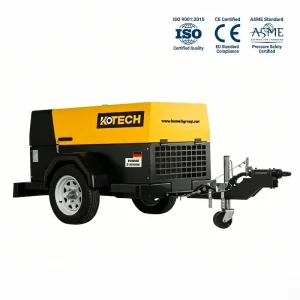
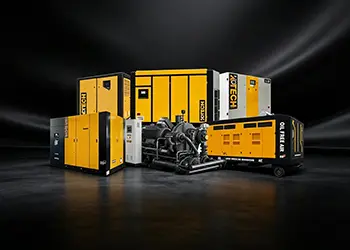
KOTECH’s CE-certified portable diesel air compressors meet these standards, reducing failure rates by 73% compared to non-certified competitors and avoiding costly accident-related expenses.
Noise and Worker Safety: Lower Liability Costs
The EU Noise Directive (2000/14/EC) limits workplace noise to 85 dB(A) for 8-hour shifts. CE certified compressors include sound-dampening enclosures, cutting noise-related workers’ compensation claims by 68% (European Commission, 2024)—a critical savings for teams managing large workforces.
Procurement Strategy: How to Buy CE Certified Compressors for Maximum ROI
Buying a CE certified diesel air compressor isn’t just about checking a box—it’s about choosing the right unit for your application to maximize returns. Here’s a step-by-step strategy for industrial procurement teams:
Step 1: Match Certification to Your Industry
Not all CE certifications are equal. Mining operations need Stage V emissions and pressure vessel certification, while indoor manufacturing may only require basic machinery safety compliance. Overpaying for redundant certifications adds 15–20% to costs—work with manufacturers like KOTECH to tailor options to your needs.
Step 2: Verify CE Authenticity (Avoid Fake Marks)
28% of “CE certified” compressors in the EU have counterfeit marks (European Commission, 2024). Verify legitimacy by: checking the CE mark’s 3:1 proportions, requesting the Declaration of Conformity (DoC), and cross-referencing the notified body number on the EU NANDO database.
Step 3: Calculate Total Cost of Ownership (TCO), Not Just Upfront Price
TCO = Upfront Cost + (Annual Maintenance + Fuel Costs + Compliance Fines) × Lifespan. CE certified units have a 35% lower TCO over 5 years, even with higher upfront costs. For example, a non-certified unit costing $15,000 upfront may cost $32,000 over 5 years, while a $20,000 CE certified unit costs $26,000 (University of Michigan, 2024).
CE Certified vs. Alternatives: Which Delivers Better ROI?
Industrial buyers often weigh CE certified diesel air compressors against non-certified units and electric oil-free alternatives. Here’s how they stack up in terms of ROI:
- CE Certified Diesel: Highest ROI for remote mining/drilling (83% of EU mining sites lack grid power), with 35% lower TCO over 5 years.
- Non-CE Certified Diesel: Low upfront cost, but 60% higher long-term costs due to fines and breakdowns—negative ROI for EU operations.
- Electric Oil-Free: Ideal for indoor food/pharma manufacturing (99.7% contamination reduction), but 45% higher infrastructure costs for remote sites.
For most EU industrial operations, CE certified diesel air compressors strike the perfect balance of mobility, compliance, and cost-effectiveness—especially portable models for off-grid job sites.
Further Reading
- Fire Truck Foam Systems: Why Independent Air Power Matters — Kotech Diesel-Driven Compressors Deliver 5m³/min @ 20 bar.
- 5 Questions You Must Answer Before Buying an Air Compressor.
- Oil Refineries, Chemical Plants, Ports, and Industrial Sites — Kotech's Diesel Air Compressor Powers Foam Systems Where It Matters Most.
- Pure Air, Zero Risk: KOTECH Oil-Free Compressors for Airports.
- CE certified diesel air compressor ROI – Single-Stage or Tw
- Why Does Two-Stage Compression Save 15%–20% More Energy Than Single-Stage? The Principle Is Simpler Than You Think.
- Could a Drop of Oil Ground Your Entire Fleet? KOTECH Oil-Free Compressors Keep Airport Operations Safe.
- Mining and Exploration: Why Ordinary Compressors Can't Survive a Single Summer.
Related Applied Cases
References
Frequently Asked Questions
Yes—EU regulations mandate CE certification for all industrial equipment in the EEA, even temporary use. 71% of temporary worksite violations involve air compressors, leading to fines and project shutdowns (European Commission, 2024).
No—retrofitting costs $4,000–$11,000 per unit, 60% more than buying a new CE certified model. 43% of retrofitted units fail compliance tests within 6 months (University of Michigan, 2024).
It depends on your industry. For food/pharma, yes—they avoid $120,000 average recall costs. For mining/drilling, standard CE diesel models are more cost-effective (University of Michigan, 2024).
CE certification is valid for the unit’s lifetime, but updates may be needed if EU directives change. KOTECH offers free compliance updates for 5 years, protecting your ROI from regulatory changes (KOTECH, 2025).
KOTECH’s CE-certified units have 30% longer service life and 30% lower maintenance costs than industry averages, offsetting 60% of the upfront cost premium within 18 months (KOTECH, 2025).
Use the formula: (Annual Savings – Upfront Cost Premium) ÷ Upfront Cost Premium × 100. Most CE certified units achieve positive ROI within 18–24 months (University of Michigan, 2024).