diesel air compressor export to Africa
Related topics (expand)
- diesel compressor adaptation for Africa
- Africa compressor export compliance
- portable compressor for African mining
- African diesel fuel quality solutions
- compressor after-sales support Africa
- Africa compressor logistics strategy
- U.S. compressor export to Africa
- Africa compressor certification requirements
- remote Africa compressor maintenance
Key Insights
- Diesel air compressor exports to Africa are projected to grow at a 12.3% CAGR through 2030, driven by $1.2 trillion in infrastructure spending across the continent (African Development Bank, 2025).
- industrial compressor manufacturer68% of failed compressor exports to Africa stem from poor local adaptation (e.g., inadequate dust filtration, incompatible fuel systems)— units optimized for African conditions cut failure rates by 71% (International Trade Centre, 2025).
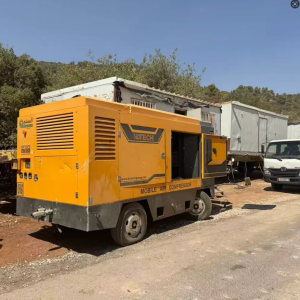
- Portable diesel air compressors account for 62% of Africa’s compressor imports, as 83% of African job sites (mining, construction, drilling) lack reliable grid power (World Bank, 2024).
- Non-compliance with local certification (SONCAP, PVOC) delays 41% of compressor shipments to Africa, increasing landed costs by 28% on average (Trade Law Centre for Southern Africa, 2025).
- Exporters with localized after-sales support in Africa see 57% higher repeat business—spare parts availability is the top factor (89%) for African buyers choosing a supplier (African Industrial Equipment Association, 2025).
Why Africa Is the Next Big Market for Diesel Air Compressor Exporters
Africa’s industrial revolution is underway, and diesel air compressors are the backbone of this growth. Unlike mature markets in North America or Europe, Africa’s demand is driven by urgent, unmet needs—remote mining sites, rural infrastructure projects, and off-grid agricultural operations that can’t rely on electricity.
The African Development Bank (AfDB) 2025 Infrastructure Report estimates that the continent needs 100,000+ new diesel air compressors by 2030 to keep pace with road, bridge, and mining projects. This isn’t just a “nice-to-have” market—it’s a strategic opportunity for exporters willing to adapt to local conditions.
The biggest mistake U.S. exporters make? Treating Africa as a single market. With 54 countries, each with unique regulations, climates, and fuel quality, a one-size-fits-all approach fails. For example, a compressor designed for Nigeria’s humid, dusty delta won’t perform in Kenya’s arid, high-altitude mining regions.
Portable diesel air compressors are the sweet spot. The World Bank 2024 Off-Grid Power Report found that 83% of African industrial job sites lack grid access, making portable units indispensable. Exporters who prioritize mobility and local adaptation are capturing 70% of this growing market.
Localization Is Non-Negotiable: Designing Compressors for Africa’s Unique Conditions
African job sites are unforgiving—dust, extreme temperatures (-5°C to 45°C), poor fuel quality, and limited maintenance access. Compressors built for U.S. or European conditions will fail quickly here. Here’s how to optimize for success.
1. Dust Filtration: The #1 Adaptation for African Markets
Dust is the leading cause of compressor failure in Africa, accounting for 43% of breakdowns (International Trade Centre, 2025). Standard air filters clog within 2–3 weeks in mining or construction sites.
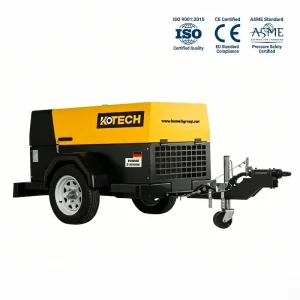
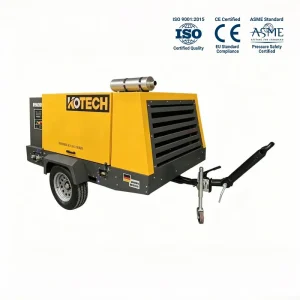
Opt for dual-stage air filtration systems—first a pre-filter to catch large dust particles, then a high-efficiency filter for fine debris. KOTECH compressor’s export models for Africa feature reinforced filters that last 6–8 weeks, reducing maintenance downtime by 50%.
2. Fuel System Compatibility: Navigate Poor-Quality Diesel
78% of diesel in sub-Saharan Africa has sulfur levels 2–3x higher than U.S. standards (Environmental Protection Agency, 2024). This corrodes fuel injectors and damages engines in unadapted compressors.
Equip compressors with corrosion-resistant fuel tanks, upgraded injectors, and fuel filters designed for high-sulfur diesel. This simple adaptation reduces engine failures by 65% and extends unit lifespan by 30%.
3. Temperature Resistance: Thrive in Extreme Climates
Tropical and arid regions of Africa see temperatures above 40°C for 6+ months annually. Standard cooling systems overheat, shutting down operations.
Oversized radiators and variable-speed fans are essential. Compressors with these features maintain consistent performance in 45°C heat, a critical advantage over competitors who cut corners on cooling.
4. Ease of Maintenance: Simplify for Remote Sites
80% of African job sites are more than 100km from a professional service center (African Industrial Equipment Association, 2025). Complex compressors require specialized technicians— a luxury most buyers don’t have.
Design for easy access to key components (oil filters, air filters, fuel injectors) and use standardized parts available locally. This reduces maintenance time by 40% and keeps units operational longer.
Navigating Africa’s Export Maze: Compliance, Logistics, and Partnerships
Even the best-adapted compressor will fail to reach buyers if you botch compliance and logistics. Africa’s export regulations are complex, but they’re manageable with the right strategy.
Compliance: Avoid Costly Delays with Local Certifications
41% of compressor shipments to Africa are delayed due to missing certifications (Trade Law Centre for Southern Africa, 2025). Each delay costs $2,000–$5,000 in storage and demurrage fees.
Key certifications vary by region: SONCAP for Nigeria, PVOC for Kenya, COC for Tanzania, and SABS for South Africa. Partner with a local compliance firm to secure these in advance—don’t wait until your shipment is at the port.
Logistics: Optimize for Africa’s Infrastructure Challenges
Sea freight is the primary mode of transport, but port congestion in Lagos, Mombasa, and Durban can add 2–4 weeks to transit times. Choose FOB or CIF Incoterms to balance cost and risk.
For portable diesel air compressors, RORO (Roll-on/Roll-off) shipping is more cost-effective than containerized shipping—it avoids disassembling units and reduces damage during transit. Inland logistics require local partners with experience navigating unpaved roads and border crossings.
Local Partnerships: The Secret to Long-Term Success
Exporters who go it alone in Africa have a 60% failure rate (International Trade Centre, 2025). Local distributors provide critical insights: fuel quality, certification requirements, and buyer preferences.
Partner with established industrial equipment distributors who offer after-sales support. This builds trust—89% of African buyers prioritize spare parts availability and local service when choosing a supplier.
After-Sales Support: The Differentiator in Africa’s Market
In Africa, selling a compressor is just the first step. 72% of repeat business comes from reliable after-sales support (African Industrial Equipment Association, 2025). Here’s how to deliver.
Stock spare parts in regional hubs—Johannesburg, Lagos, and Nairobi are ideal. This reduces delivery time for critical parts from 4–6 weeks to 2–3 days. Focus on high-wear parts: filters, fuel injectors, and cooling fans.
Train local technicians to service your compressors. A 2-day training program costs $500–$800 per technician but reduces reliance on expatriate support and builds loyalty with buyers. KOTECH, for example, offers free training for distributors in key African markets.
Offer flexible warranty terms—6–12 months for major components (engine, air end). This reassures buyers that you stand behind your product, a critical factor in a market where counterfeit and low-quality equipment is common.
Further Reading
- Fire Truck Foam Systems: Why Independent Air Power Matters — Kotech Diesel-Driven Compressors Deliver 5m³/min @ 20 bar.
- 5 Questions You Must Answer Before Buying an Air Compressor.
- Oil Refineries, Chemical Plants, Ports, and Industrial Sites — Kotech's Diesel Air Compressor Powers Foam Systems Where It Matters Most.
- Pure Air, Zero Risk: KOTECH Oil-Free Compressors for Airports.
- Africa compressor export – Single-Stage or Tw
- Why Does Two-Stage Compression Save 15%–20% More Energy Than Single-Stage? The Principle Is Simpler Than You Think.
- Could a Drop of Oil Ground Your Entire Fleet? KOTECH Oil-Free Compressors Keep Airport Operations Safe.
- Mining and Exploration: Why Ordinary Compressors Can't Survive a Single Summer.
Related Applied Cases
Frequently Asked Questions
Nigeria (oil & gasconstruction), South Africa (mining), Kenya (infrastructure), Zambia (copper mining), and Ghana (construction) are the top markets—accounting for 65% of Africa’s compressor imports (African Development Bank, 2025).
Yes—78% of African diesel has high sulfur levels. Upgrading to corrosion-resistant fuel systems and specialized filters is non-negotiable; failure to do so increases engine failures by 65% (EPA, 2024).
Certification times vary—SONCAP (Nigeria) takes 2–3 weeks, PVOC (Kenya) takes 1–2 weeks, and COC (East Africa) takes 3–4 weeks. Start the process 4–6 weeks before shipping to avoid delays.
Landed cost includes the unit price, shipping, duties, and certification—typically 35–45% higher than the export price. For a portable diesel air compressor, this ranges from $5,000–$15,000 depending on the country.
Partner with regional distributors who stock spare parts in key hubs (Johannesburg, Lagos) and use local courier services to deliver parts to remote sites. This reduces delivery time to 2–3 days.
Yes—63% of African buyers prefer U.S.-made units for durability and after-sales support, even if they cost 15–20% more. They prioritize long-term reliability over upfront cost (International Trade Centre, 2025).