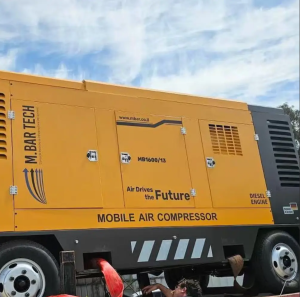
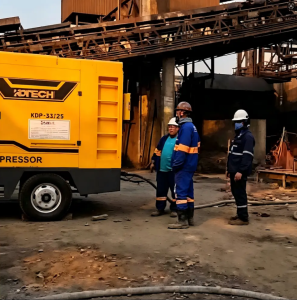
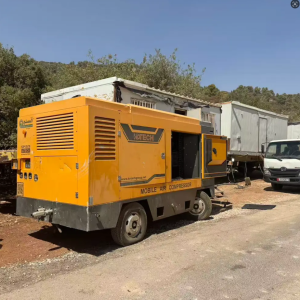
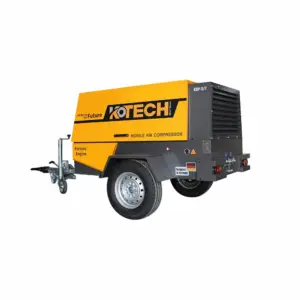
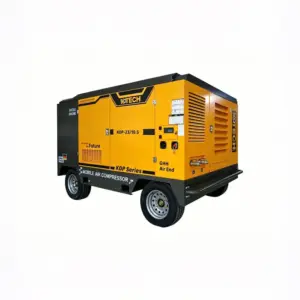
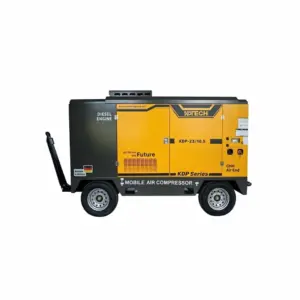
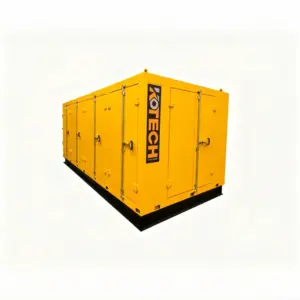
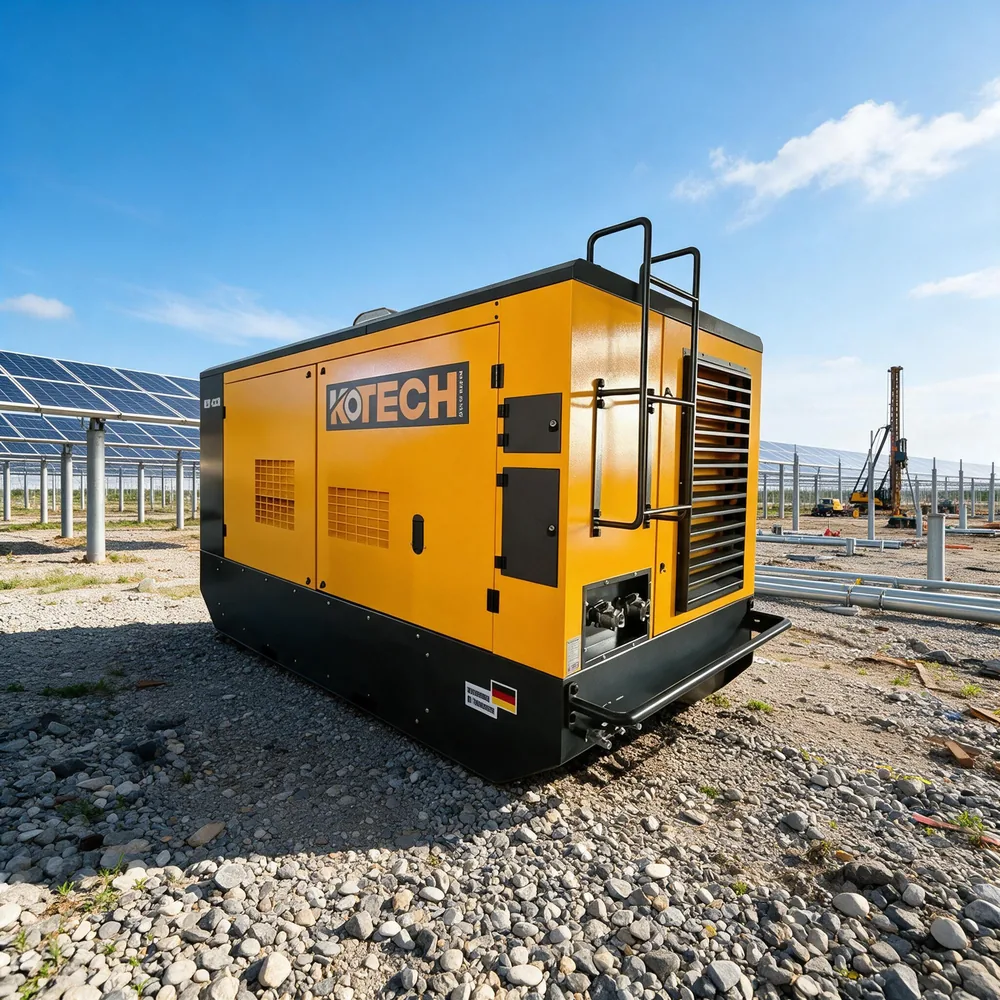
A utility-scale solar farm is first and foremost a piling project: tens of thousands of steel posts have to be driven or drilled into the ground before a single module is mounted, and every day of air downtime pushes panel installation and grid connection. Where ground is too hard or too rocky for vibratory drivers, contractors drill pile holes with air-powered down-the-hole hammers, which need a compressor that can hold pressure and flow continuously, hour after hour, across a site with no grid power. Skid-mounted diesel units are the usual choice because they can be craned between drill spreads, hold their own on uneven grade and run all day on their tank. This guide explains how much air pile drilling actually needs and how the KOTECH KDS skid diesel range maps to it.
Why solar pile drilling runs on compressed air
Ground-mount racking is fixed to steel piles that must land at a precise elevation and true vertical within tight tolerances, because the rails and modules have no room to compensate later. In soft uniform ground, vibratory or impact drivers press the piles in directly, but where the geotechnical report shows rock, caliche, boulders or hardpan within the embedment depth, the reliable method is to drill a hole with a down-the-hole (DTH) hammer and set or grout the pile. The hammer is powered entirely by compressed air: the same air that strikes the bit also flushes cuttings out of the hole and keeps the hammer lubricated and cool.
That makes the compressor a production machine rather than support equipment. A DTH hammer that is starved of air drills slowly, re-grinds its own cuttings, runs hot and wears the bit faster; a compressor that cannot hold rated pressure under continuous load turns every pile into a slow pile. Solar schedules are measured in piles per rig per day multiplied across a large fleet, so the difference between 90 and 150 seconds per hole decides whether the project meets its mechanical-completion milestone. The compressor therefore has to be sized for the hammer, not for an average day, and it has to survive thousands of cycles on a dusty open site.
- Rock, caliche and hardpan ground require air-powered DTH drilling rather than vibratory driving.
- Compressed air both powers the hammer and flushes cuttings, so air volume directly sets drill speed.
- Utility projects run thousands of piles; per-hole time saved compounds across the whole fleet.
- Sites are off-grid at the piling stage, so self-contained diesel power is mandatory.
Matching CFM and pressure to the DTH hammer
DTH hammers are published with a recommended air consumption and operating pressure, and the single most common sizing error is buying to the minimum figure instead of the realistic one. Consumption rises with hole depth as the annular volume grows, with back-pressure from cuttings in wet ground, and with wear on the hammer and seals; altitude derates the diesel engine driving the compressor; and leaks in the hose string cost flow that never reaches the bit. A practical spec therefore takes the hammer requirement and adds margin for depth, altitude and hose losses rather than matching it exactly.
Most solar pile holes are relatively shallow and modest in diameter, so single-hammer spreads sit comfortably in the 350 to 900 CFM band at roughly 10 to 20 bar depending on hammer design. The pressure matters as much as the volume: a high-CFM machine at too low a pressure will not fire the hammer crisply. Where the ground report shows very hard rock or holes trend deeper, stepping up a pressure class protects penetration rate more cheaply than adding a second rig, and some contractors run two hammers from one larger skid unit on wide, flat arrays to reduce equipment moves.
Real KOTECH KDS skid diesel compressor specifications
Current factory figures from the KOTECH product page; CFM and PSI are matched ratings and the fuel tank supports long field shifts.
Pick the model at the intersection of the hammer’s rated CFM and its operating pressure — a 700 CFM hammer that also needs 20 bar points at the KDS-20/20, not a higher-flow 12 bar frame. Confirm engine derating for the site altitude and ambient temperature before finalising.
Why skid mounting fits solar sites
Solar piling moves in a pattern unlike road or pipeline work. The spread advances row by row across a large graded pad, relocating perhaps dozens of times a day but only short distances, and it shares the site with grading equipment and survey crews. A skid package without road running gear is shorter, lower and easier to crane or forklift onto the next working position, and its integrated base frame sits securely on compacted pad material without stabiliser setup. Enclosed, sound-attenuated canopies also keep dust and noise down on projects that increasingly border operating farmland or residential edges.
Reliability on this duty is mostly about heat and dust. Intake pre-cleaners and regular air-filter service are essential because the compressor and the diesel engine are breathing the same rock-dust cloud the rig generates; coolant and aftercooler cores need blowing out at fuel stops; and fuel polishing matters when machines are refuelled from portable bowsers in the field. Specifying the fuel tank to the real shift length — and parking the compressor upwind of the drill so it ingests clean air — prevents most of the avoidable downtime on a piling spread.
- Skid packages relocate by crane or forklift in the short, frequent moves that row-by-row solar work demands.
- Size the fuel tank to the full shift to avoid mid-hole bowser delays.
- Fit intake pre-cleaners and service air filters aggressively in rock-dust conditions.
- Park upwind of the rig so the compressor breathes clean air and the radiator stays free of dust.
From geotech report to machine count
The air plan for a solar project should start from the geotechnical report rather than the rig salesman’s brochure. Identify the fraction of piles expected to encounter rock, the worst-case embedment into rock, the water-table condition and the site altitude and design temperature, then choose the hammer and its realistic CFM with depth and altitude margin. Machine count follows from the target piles per day: divide daily pile requirement by realistic per-hole cycle time at the chosen penetration rate, and add redundancy so one compressor down for service does not idle an entire drill crew. On multi-rig projects it is common to standardise on one or two KDS frames across the fleet, which lets crews share hoses, filters and operating experience and keeps spares simple across a remote site.
Buying tips
- Size the compressor to the DTH hammer’s realistic CFM at depth, with margin for altitude, hose losses and wet cuttings — not its bare minimum.
- Match both flow AND pressure: a high-CFM low-pressure frame will not run a high-pressure hammer efficiently.
- Use the geotech report to identify rock fraction and worst-case embedment before choosing the frame.
- Prefer skid packages on solar pads for short crane relocations and stable placement on compacted grade.
- Add one spare or N+1 capacity so a single compressor service does not idle the whole piling fleet.
Frequently asked questions
What size air compressor do I need for solar pile drilling?
Why use a skid compressor instead of a tow-behind on a solar farm?
Does high altitude change the compressor sizing?
Can one compressor run two pile hammers?
What causes most compressor downtime on solar piling sites?
How do I calculate how many compressors a solar project needs?
Share your pile count, hole diameter and depth, ground conditions and site altitude, and our engineers will size the right KOTECH KDS skid diesel compressor package — or fleet — for your solar piling schedule.
Related Applied Cases