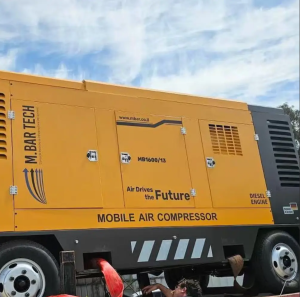
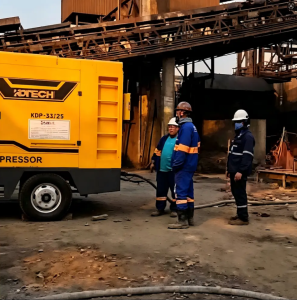
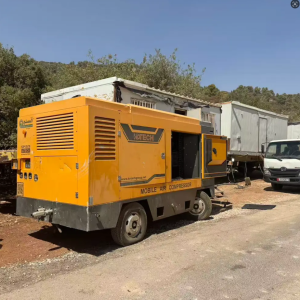
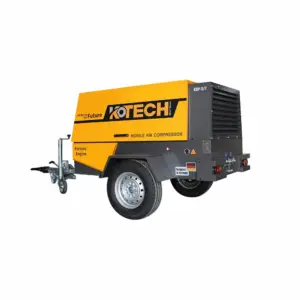
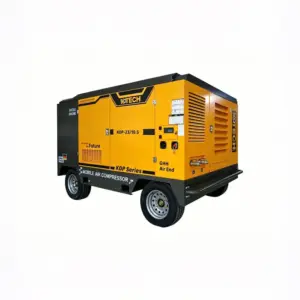
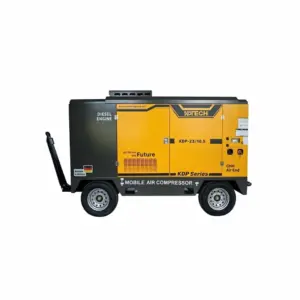
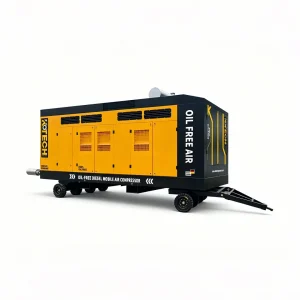
Geothermal drilling rarely happens in a convenient place: productive heat resources sit in volcanic and mountainous terrain where a rig may be working above 2,000 metres, far from the grid, on roads that barely exist. At altitude, every internal-combustion engine makes less power because the air itself is thinner, while the down-the-hole hammer down the hole still wants its full rated volume and pressure. A compressor that looked adequate on the supplier’s sea-level curve can quietly under-deliver on the pad, slowing penetration in exactly the hard, fractured, high-temperature rock where the project can least afford it. This guide explains how altitude, pressure and hammer demand interact and how to size a KOTECH KDP portable diesel compressor honestly for a geothermal program.
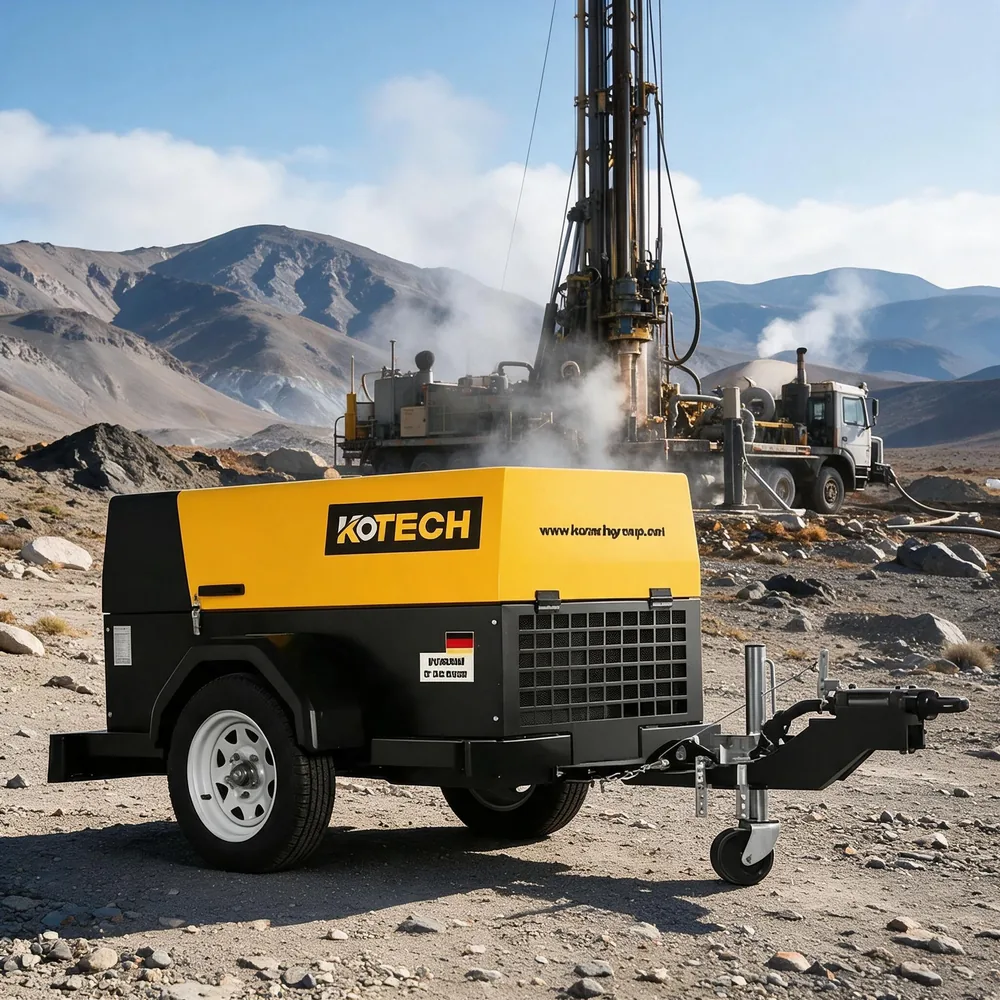
What geothermal drilling asks of the air system
Geothermal wells are drilled with air or aerated mud in many hard-rock prospects, because lost circulation in fractured formations and the need to keep cool, clean hole conditions make conventional mud drilling unattractive. With air drilling or a DTH hammer, the compressor does three jobs at once: it drives the hammer, it lifts cuttings out of a deep and often large-diameter hole at the annular velocity required to clean the bit, and in geothermal conditions it helps manage the heat and steam encountered downhole. Unlike a shallow construction hole, a geothermal well keeps getting deeper for weeks, so back-pressure, annular volume and cuttings load rise while the compressor must hold performance without respite.
The economic stakes are unusually high. Geothermal rigs and crews are expensive, hole problems in hot fractured rock escalate quickly, and the productive interval is often where penetration is slowest. Air starvation here does not just add minutes per stand; it promotes re-grinding of cuttings, accelerated bit and hammer wear, stuck-pipe risk from poor cleaning, and ultimately missed casing points. Sizing the compressor for the end-of-section depth and the worst expected altitude — not the collar elevation on a good day — is how operators protect the whole well timeline.
- Air powers the DTH hammer and lifts cuttings out of deep, often large-diameter geothermal holes.
- Demand rises with depth as annular volume and back-pressure grow.
- Hot, fractured hard rock leaves no margin for slow penetration or poor hole cleaning.
- Rigs work at altitude and off-grid, so diesel performance derating is a sizing input, not a footnote.
The altitude problem: thinner air cuts both engine and compressor
A naturally aspirated or turbocharged diesel engine loses roughly 3 percent of its sea-level power per 300 metres of elevation without compensation, and modern turbocharged packages recover much of this only up to their rated altitude; above that, derating is real and unavoidable. The airend it drives moves volume, but mass flow — what the hammer actually experiences — also changes with intake density. The combined effect is that a compressor producing its nameplate CFM at sea level can deliver less usable air at 3,000 metres, forcing either a larger frame, an engine package with altitude capability, or reduced penetration expectations.
Ambient temperature compounds the effect, because high geothermal pads are often both cold at night and hot in direct sun by day, and hot intake air is less dense again. The disciplined approach is to ask the manufacturer for the engine and compressor performance curves at the site elevation and maximum design temperature, then size to the derated output rather than the brochure figure. Reputable packages such as the KDP range publish ratings with defined operating envelopes, and selecting one frame larger than the sea-level calculation is almost always cheaper than the rig-time lost to an undersized compressor at 3,000 metres.
Real KOTECH KDP portable diesel compressor specifications
Current factory figures from the KOTECH product page; each model pairs CFM with a matched working pressure.
Apply the engine derate to these figures at the pad elevation before matching the hammer, and remember CFM and PSI are a matched pair on each model — choose the row that satisfies both the hammer pressure and the depth-adjusted flow, not just one of them.
Sizing method from hole to compressor
Start from the down-the-hole tool: take the hammer manufacturer’s recommended operating pressure and air consumption, then add the flow needed for annular cuttings velocity at the deepest section and largest hole diameter. Add pressure losses through the standpipe, rotary hose, injector and any boosters, because these are not negligible on a deep well. The resulting demand is the sea-level compressor requirement; only then apply the altitude and temperature derate to choose the actual frame. Boosters are common on geothermal spreads precisely because a standard compressor feeding a booster can deliver high downhole pressure without buying the entire flow at high pressure.
Field practice protects the calculation. Run intake restriction and discharge pressure logs so a fouling filter or a worn airend is spotted before it masquerades as a formation problem; service air filters aggressively in dust and steam; manage fuel quality and water separation in cold nights; and position the compressor to ingest cool, clean ambient air rather than radiator exhaust or rig dust. On remote mountain pads, fuel logistics planning — tanker access, storage, filtration — often decides whether the nominal 24-hour drilling program is real.
- Size from hammer CFM plus annular cleaning flow at total depth, then add hose and standpipe losses.
- Apply altitude and temperature derating to the result; pick the frame on derated output.
- Consider a standard compressor plus a booster for high downhole pressure rather than all flow at high pressure.
- Log intake restriction and discharge pressure to separate machine wear from drilling problems.
Reliability and logistics on a remote mountain pad
A geothermal pad can be hours from a workshop, so the compressor package has to be both road-towable on poor tracks and serviceable by the rig crew. Enclosed canopies, proven Cummins power, accessible service points and standard filtration all reduce the chance that a minor fault becomes a stranded-hole event. Cold-weather starts at altitude deserve attention: correct oil grade, battery condition and warm-up procedure prevent the classic early-shift failure, while sound attenuation keeps the machine acceptable when the pad is near highland communities. Planning spare filters, fluids and a contingency compressor within transport distance turns the inevitable service stop from a well-control-adjacent emergency into routine maintenance.
Buying tips
- Derate the diesel engine and compressor for pad altitude and maximum ambient temperature before matching the hammer — never size on sea-level brochure figures.
- Size CFM from the hammer plus annular cuttings-cleaning flow at total depth, and pressure including all surface and hose losses.
- Consider a booster-fed arrangement where high downhole pressure is needed only in the deepest sections.
- Choose a fully enclosed, proven-engine towable package serviceable on a remote pad with standard filters and fluids.
- Plan cold-start capability, fuel quality and a contingency machine within transport distance before spudding.
Frequently asked questions
How much power does a diesel compressor lose at high altitude?
What CFM does geothermal air drilling need?
Is high pressure or high flow more important for geothermal DTH drilling?
Why does geothermal drilling need bigger compressors than water-well drilling?
How do I keep a compressor running on a remote mountain pad?
Can I use the compressor’s rated CFM directly in my drilling calculation?
Send us your target hole diameter and total depth, hammer model, pad elevation and design temperature, and our engineers will derate and size the right KOTECH KDP portable diesel compressor — or compressor-plus-booster spread — for your geothermal program.
Related Applied Cases