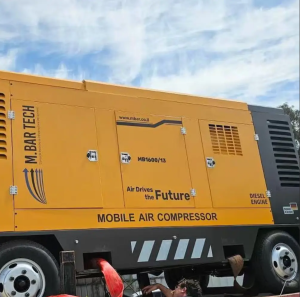
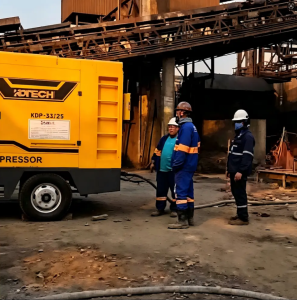
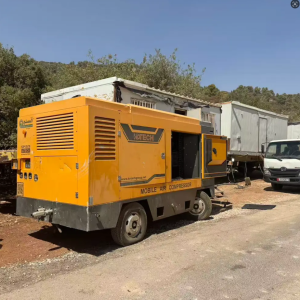
Shipyards and container terminals run some of the most punishing pneumatic duty in industry: grit blasting, deck scaling, impact wrenches, pneumatic winches and barge aeration all pull hard on a single air supply, often far from a fixed electrical connection. A skid-mounted diesel compressor such as the KOTECH KDS series gives you that independent, high-volume air on the quay or inside a dry dock without tying production to the plant grid. The key is sizing the unit to your real tools and duty cycle rather than buying the biggest machine on the dock.
Why Shipyards and Ports Favor Skid-Mounted Diesel Air
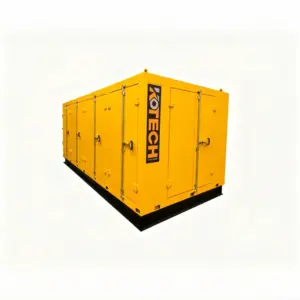
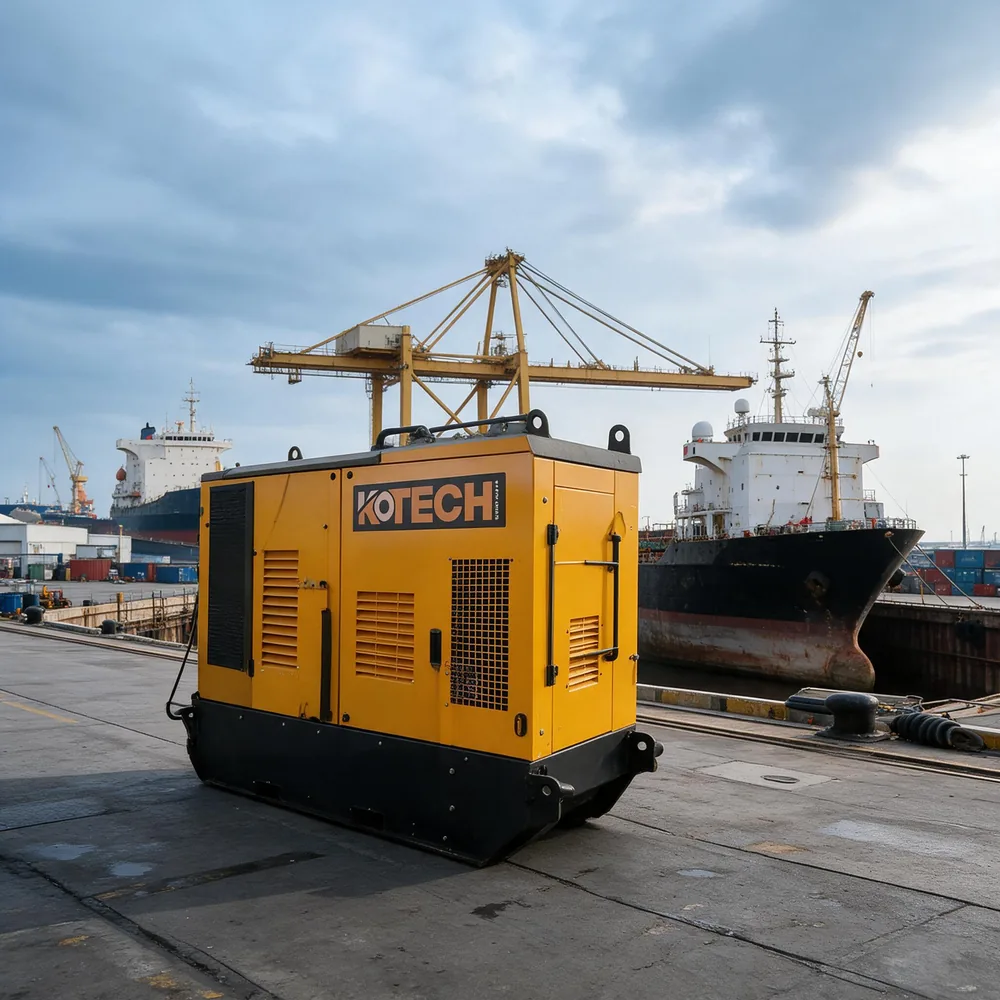
Marine work is mobile by nature. A hull section being blasted today sits in a different dry-dock bay next week, and a container terminal may need air at the far end of a reefer block where no power outlet exists. A skid-mounted package solves both problems: the complete compressor, diesel engine, cooler and controls are bolted onto a single rigid base frame that can be lifted by crane, forklift or straddle carrier and set down exactly where the work is.
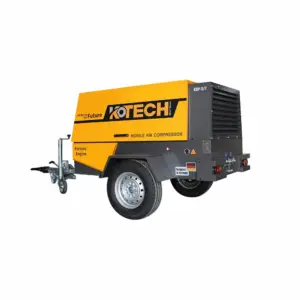
Unlike a towed portable unit, a skid has no road wheels or drawbar to corrode in salt air, which means fewer moving chassis parts and a lower, more stable footprint on a crowded quay. The KDS frame is designed to be crane-lifted onto barges, pontoons and temporary fabrication decks, giving port contractors a self-contained air source that follows the job instead of forcing the job to come to the compressor house.
- Independent of the dock’s electrical grid, so work continues during power upgrades or on greenfield jetties.
- Compact rigid base with single-point lifting for fast repositioning by crane or forklift.
- No road chassis to rust or maintain in a corrosive salt-spray environment.
- One package can feed several tools at once through a properly sized header and manifold.
The Pneumatic Jobs That Decide Your Compressor Size
Before choosing a model, list every air consumer that will run at the same time and note both its rated pressure and free air demand. In a shipyard the dominant load is usually surface preparation: open-nozzle grit blasting is a continuous, high-volume application, whereas chipping hammers and impact wrenches are intermittent but can all start together at shift change.
Port terminals add their own mix — pneumatic winches and hoists, hatch cover seals, reefer container service tools, bag and bulk unloading, and occasional aeration of dry-bulk cargoes. Each tool has a minimum working pressure, and pressure drop through hoses, filters and reels must be added on top. Sizing on the nameplate of a single tool, without diversity and hose losses, is the most common reason an under-specified compressor cannot hold pressure during peak demand.
- Grit blasting: continuous high CFM, sensitive to pressure drop at the nozzle.
- Chipping hammers and needle scalers: intermittent, high peak demand when several run together.
- Impact wrenches and stud tensioners: short high-pressure bursts for bolt-up.
- Pneumatic winches, hoists and barge aeration: steady process loads over long shifts.
How to Match Pressure and Free Air Delivery on the Quay
Start from the tool with the highest required working pressure, then add the losses between the compressor outlet and that tool. Long hoses, quick-release couplings, inline filters and hose reels all cost pressure, and a blast nozzle loses cutting force fast as pressure falls. The KDS line spans a wide band of working pressures and free air deliveries, so you can select a frame that holds your target nozzle pressure without running a large engine at part load all day.
For free air delivery, sum the simultaneous demand of the tools that genuinely run together and apply a realistic diversity factor, then add a margin of roughly 20 to 30 percent for future tools, filter fouling and leak losses. A correctly sized skid will run loaded most of the time rather than cycling hard, which improves fuel efficiency and extends the life of both the diesel engine and the air-end. The specification table below lists real KOTECH KDS models with their published free air delivery, working pressure, engine and rated power so you can shortlist frames against your own tool list.
Real KOTECH KDS Skid-Mounted Diesel Compressor Models
Published specifications from the KOTECH KDS product page. Free air delivery and working pressure are the figures to match against your simultaneous tool demand.
The table shows how the KDS range steps up in both flow and pressure. Smaller frames suit maintenance crews running hand tools and single-blast pots, while the high-output models feed multi-nozzle blasting gangs or continuous bulk-handling duty. Choose the smallest frame that still meets your peak simultaneous flow at the required nozzle pressure, and verify engine power against the ventilation available if the skid will run inside an enclosed dock or pump room.
Salt Air, Long Shifts and Fuel: Practical Installation Points
The marine environment attacks everything, so placement and servicing matter as much as the horsepower figure. Position the skid so the cooler intake draws clean air away from exhaust stacks and blast dust, and keep the unit level so the engine oil and condensate drains work as designed. Plan for diesel delivery and bunding on the quay, and route exhaust away from personnel and any combustible cargo.
Because port and shipyard shifts often run ten to twelve hours, fuel tank capacity and easy access for oil and filter changes reduce mid-shift downtime. Fitting a downstream air receiver smooths the pulsating demand from winches and wrenches, while a water separator and filter protect blast pots and tools from condensate. On a barge or pontoon, confirm the lifting and tie-down points and allow clearance around the cooler for service access.
- Locate the intake upwind of blast dust and engine exhaust to protect the air-end.
- Add a receiver tank to buffer intermittent winch and wrench loads and reduce cycling.
- Specify filtration and water separation suited to blasting and powder handling.
- Plan fuel bunding, exhaust routing and crane lift access before the skid arrives on site.
Buying tips
- Build a complete simultaneous tool list with each tool’s CFM and required pressure before shortlisting any model.
- Add hose, reel and filter pressure losses on top of the tool pressure, especially for grit blasting.
- Allow a 20–30% flow margin for leaks, filter fouling and future tools rather than sizing to the bare nameplate total.
- Confirm the skid’s lifting points, footprint and fuel autonomy fit the quay, barge or dry-dock location.
- Specify corrosion-resistant fasteners and a strict service interval because salt spray accelerates wear.
- Pair the compressor with a correctly sized receiver and water separator to protect blast and hand tools.
Frequently asked questions
What size skid-mounted diesel compressor do I need for grit blasting in a shipyard?
Why choose a skid-mounted unit instead of a towed portable compressor at a port?
Can one KDS compressor run several pneumatic tools at the same time?
How do I account for pressure drop between the compressor and the blast nozzle?
What maintenance does a dockside diesel skid compressor need?
Can a skid compressor operate inside an enclosed dry dock or pump room?
Send us your simultaneous tool list and the working pressure your blast nozzles and winches need. KOTECH will match a KDS skid-mounted diesel frame to your shipyard or port duty and quote the complete package.
Related Applied Cases