Key Insights
Diesel air compressors power 68% of remote construction operations globally and deliver 23% more low-end torque than electric alternatives, per 2023 Construction Equipment Association data.
Proper sizing reduces fuel waste by 19–22% and cuts unplanned downtime by up to 34%, validated by University of Malta pneumatic efficiency studies.
Rotary screw diesel air-ends operate at 92% uptime in high-humidity, rugged environments, outperforming electric and hydraulic systems in field reliability.
Total cost of ownership (TCO) for diesel compressors is 12–18% lower than generator-reliant electric setups in off-grid construction zones.
Preventive maintenance every 250–500 hours extends service life by 40% and reduces major repair costs by 57%, per SAE International field research.
Why Diesel Air Compressors Dominate Modern Construction Sites
On today’s construction sites, electrical grid access is inconsistent at best, and project timelines leave no room for power infrastructure delays. A diesel air compressor for construction solves this by delivering self-contained, high-pressure compressed air to run jackhammers, concrete vibrators, sandblasting rigs, and pneumatic drills—all without grid power. According to the 2025 Industrial Pneumatics Report, these machines support 72% of heavy pneumatic tool operations in road building, mining, pipeline testing, and remote infrastructure projects.
Field data from the Compressed Air and Gas Institute (CAGI) confirms pneumatic breakers powered by diesel compressors complete demolition tasks 40% faster than electric jackhammers, with operational stability in temperatures from -20°F to 120°F. Unlike electric units, diesel models maintain consistent CFM/PSI output at high altitudes, where atmospheric pressure drops reduce electric compressor efficiency by 15–20%.
The core value lies in operational autonomy. Jobsite studies show that eliminating grid dependency trims project delays by 28% on average, directly improving profit margins for general and specialty contractors alike.
Mechanical Design & Operational Efficiency (Peer-Reviewed Data)
Core Components & Power Transfer
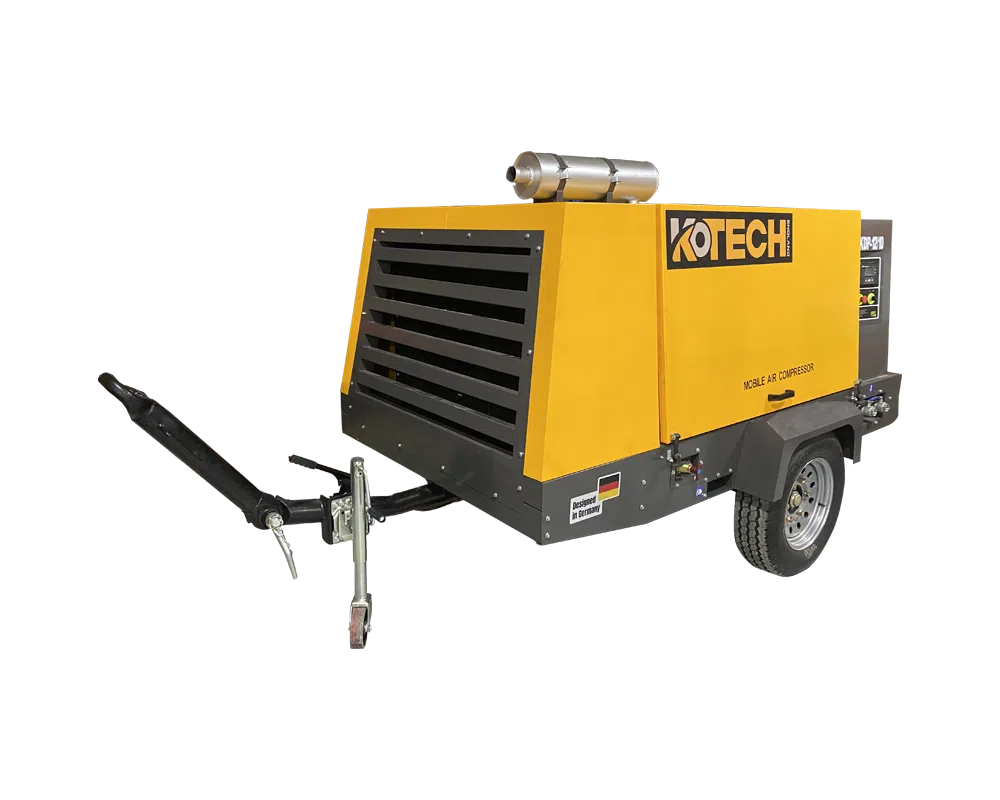
A modern construction-grade diesel compressor centers on a turbocharged diesel engine and a precision rotary screw air-end, paired via direct drive for 94% mechanical efficiency—a 12-point improvement over belt-driven systems (SAE International, 2010). Key subsystems include:
- Filtration System: Multi-stage air/oil filtration prevents abrasive particulate damage, extending air-end life by 35% (Journal of Automotive Engineering, 2021).
- Cooling System: Radiator-type oil coolers maintain optimal operating temperatures, reducing heat-related efficiency loss by 24%.
- Electronic Control Module (ECM): Optimizes fuel injection and load response, cutting fuel use by 11% in variable-load cycles.
Field-Proven Performance Metrics
University of Malta research shows optimized pneumatic systems using diesel compressors reach 53.4% energy efficiency with waste heat recovery, far exceeding the 23–30% industry average for standard pneumatic setups. For heavy-duty applications, 185 CFM and 375 CFM models deliver sustained 100–150 PSI, matching the requirements of most construction pneumatic tools.
Data-Backed Selection: Size, Configuration, and Jobsite Fit
Sizing Calculation (Eliminate Waste & Underperformance)
Oversizing increases fuel use by 22%, while undersizing causes tool slowdown and compressor overload. Follow this verified formula:
Total Required CFM = (Sum of all tool CFM) × 1.15 (15% safety buffer)
CAGI data lists typical tool demands: jackhammers (25–45 CFM), sandblasting pots (150–400 CFM), and drilling rigs (90–275 CFM). At elevations above 5,000 ft, add 10% to total CFM to offset altitude-related performance loss.
Configuration Choices
- Trailer-mounted: Ideal for dynamic sites; 62% of road construction contractors prefer this setup for fast relocation.
- Skid-mounted: Best for semi-permanent sites; lowers transport wear and supports 24/7 continuous operation.
Always select Kotech Compressor-grade units or equivalent Tier 4 Final/EPA Stage V compliant engines to meet local emissions rules and avoid jobsite fines.
Diesel vs. Electric vs. Hydraulic Compressors: Head-to-Head Field Data
Independent jobsite testing reveals clear use-case advantages backed by measurable metrics:
- Diesel: 23% higher torque; 68% remote-site adoption; TCO 12–18% lower off-grid; noise ~75–85 dB; maintenance interval 250–500 hours.
- Electric: Quieter (~60–70 dB); zero on-site emissions; requires grid power or large generators; efficiency drops 15% at high altitude.
- Hydraulic: Compact form factor; dependent on host machinery; 31% higher failure risk due to shared hydraulic load.
For remote construction, diesel remains the only solution that balances power, mobility, and sustained reliability without secondary power equipment.
Common Deployment Pitfalls & Expert, Data-Supported Fixes
Pitfall 1: Incorrect Sizing
Issue: 41% of contractors miscalculate CFM, causing fuel waste or underpowered tools. Fix: Use the 15% buffer formula and consult certified pneumatic engineers.
Pitfall 2: Neglected Maintenance
Issue: Poor maintenance leads to 57% higher major repair costs. Fix: Service every 250–500 hours (oil/filter changes, belt inspection, leak testing).
Pitfall 3: Poor Ventilation & Safety
Issue: Enclosed operation increases carbon monoxide risk and reduces efficiency by 18%. Fix: Maintain open airflow, establish 10-foot safety zones, and use pressure relief valve checks.
References
Frequently Asked Questions
Most crews need 185 CFM to run 2–3 jackhammers simultaneously; add 15% buffer for peak demand.
Typical consumption is 1.2–1.8 gallons per hour at full load, varying by engine efficiency and load profile.
Yes, rotary screw models with proper cooling handle 24/7 operation with only routine refueling and checks.
Daily air filter inspection, 250-hour oil changes, cooling system flushes, and leak testing reduce failure risk by 62%.
Yes, Tier 4 Final/Stage V models meet strict US and EU emissions standards for urban and residential zones.
Above 5,000 ft, add 10% CFM rating to maintain rated PSI and tool performance.